

Archive position — measured, not model output
1 like on Devpost
505 of the 7,850 archived projects have more likes, and 1,758 share exactly 1 — so this project's #1,720 place in the like-ranked listing is a tie-break inside that group, not a ranking.
Projects (log scale)
Likes on Devpost. ▲ marks this project's group.
Show the figures
| Likes | Projects | Share of archive |
|---|---|---|
| 0 | 5,587 | 71.2% |
| 1 | 1,758 | 22.4% |
| 2 | 284 | 3.6% |
| 3–4 | 132 | 1.7% |
| 5–9 | 75 | 1.0% |
| 10+ | 14 | 0.2% |
 User Stories BotA demo video on every pull request
Get a demo video on every new feature
GitHub App that watches your pull requests and records a narrated, captioned demo.
Save time on demo prep and make informed decisions faster with a video walkthrough of every new feature.
Executive Summary
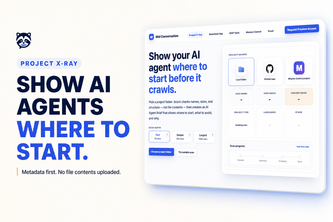
Project X-Ray, as described by its author, is a browser-based tool that scans code repositories for metadata-only information—file names, paths, types, sizes, and hierarchy—not file contents. It generates an AI agent brief and navigational map to help agents orient themselves in unfamiliar codebases without reading or uploading source code.
The project was submitted as part of the OpenAI 2026 hackathon. The author states that it existed before Build Week but received significant development during the event, including improvements to folder selection, report quality, Project Map rendering, and deployment tooling.
Key commercial due-diligence read: There is no evidence of revenue, customers, or traction beyond the author's own description. The project appears to be a proof-of-concept or prototype with no demonstrated product-market fit or business model.
Most important open question: Is there any indication that Project X-Ray has moved beyond a hackathon prototype into a viable product or service with real users?
What The Product Actually Is
The description states:
- Project X-Ray is a browser-based tool.
- It scans browser-visible file and folder metadata, including names, paths, types, sizes, and hierarchy.
- It does not read or upload project file contents.
- It creates:
- A bounded, ordered Start Here route
- An Avoid First context
- Direct proof paths separated from supporting validation metadata
- A navigable Project Map
- A five-part AI Agent Brief
- The output can be copied, downloaded as Markdown, or exported as JSON.
- It is designed to stay bounded for large repositories.
Inference: The tool appears to be a developer utility aimed at helping AI agents navigate codebases more efficiently by providing structured metadata-based orientation.
Positioning & Claim Evolution
The author claims:
- AI agents can lose time and context when blindly crawling unfamiliar repositories.
- Project X-Ray provides an orientation layer before agents start reading or editing code.
- It is a metadata-only map, which implies privacy and speed benefits.
- The tool supports browser-local scanning, with no file content upload.
Inference: The positioning centers on privacy, efficiency, and AI agent support. It positions itself as a lightweight, secure way to orient AI agents in codebases.
Target Customer & ICP
The description states:
- The tool is intended for AI agents.
- It helps them orient themselves in unfamiliar codebases.
- It supports browser-local scanning, which implies use by developers or tools running in browsers.
Inference: The primary customer appears to be AI agents or AI-powered development tools, with a secondary audience of developers using such tools. The ICP is likely developer tooling companies, AI agent builders, and open-source maintainers.
Business Model & Pricing Evidence
The description states:
- No pricing information is provided.
- The tool is described as a browser-based experience, with no mention of monetization or subscription models.
- It is presented as a metadata-only scanner, not a service or SaaS offering.
Inference: There is no evidence of a business model or pricing structure. The project appears to be a prototype or open-source tool, not a commercial product.
Technical & Delivery Signals
The description states:
- Built with: codex, css, gpt-5.6, html, javascript, node.js, playwright, python
- The public tool is a browser-based HTML/CSS/JavaScript experience.
- Browser-quality coverage uses Node and Playwright.
- Deployment-security coverage uses Python fixture tests.
- Codex with GPT-5.6 was used in development workflow but not at runtime.
- Scanner works from local metadata, does not read or upload file contents.
Inference: The tool is technically feasible, browser-based, and uses a mix of frontend and backend technologies. It is designed to be privacy-preserving and scalable for large repositories.
Traction & Maturity Signals
The description states:
- Project X-Ray existed before Build Week.
- Development occurred during the OpenAI 2026 hackathon.
- The author lists commit history from July 13–20, 2026, showing incremental improvements.
- It was submitted to a hackathon, not a commercial product.
Inference: There is no evidence of traction, revenue, or customer adoption. The project is described as a prototype or proof-of-concept with no indication of real-world usage.
Competitive Context
The description does not mention any competitors or market context.
Inference: No competitive landscape is evident from the provided information. It’s unclear whether similar tools exist or how Project X-Ray would position itself in the market.
Open Questions & Risks
- The tool is not a commercial product, but a hackathon submission.
- There is no evidence of revenue, customers, or traction.
- The project is described as browser-local, which may limit its scalability or adoption.
- No pricing, monetization, or business model is evident.
- The tool is metadata-only, so it may not fully address complex AI agent needs.
Questions the description leaves open
- What is the intended use case for Project X-Ray beyond the hackathon?
- Are there any plans to commercialize this tool or integrate it into existing platforms?
- How does it compare to other tools that help AI agents navigate codebases?
- Is there a target market or customer segment you are trying to reach?
- What is the long-term vision for Project X-Ray beyond its current prototype?
Overall Assessment
The description states:
- The project is a hackathon submission.
- It is not independently verified.
- No revenue, customers, or traction data are available.
Inference: There is no evidence of commercial viability, traction, or business model. It appears to be a prototype or proof-of-concept, not a product ready for investment or partnership.
Assessment: Not evidenced as a viable investment or partnership opportunity at this time.
User Stories BotA demo video on every pull request
Get a demo video on every new feature
GitHub App that watches your pull requests and records a narrated, captioned demo.
Save time on demo prep and make informed decisions faster with a video walkthrough of every new feature.
Source
Submitted to the OpenAI 2026 hackathon on Devpost. Project home on Devpost. Back to the full gallery on Devpost.
This competitive analysis was produced by top-founders.com (opens in a new tab)
Generated by a language model from this project's public Devpost page — its tagline, the author's own write-up and any built-with tags listed there — as captured in August 2026. Short quotations are the author's words. It is an opinion on the idea as a business, not on the people behind it, and it reflects the description as published then. If the project has moved on, request a correction below. The analysis is not independent research and contains no verified traction, revenue or customer data.
An independent guide by KFG International LLC — not affiliated with, endorsed by, or connected to Devpost or OpenAI.