

Archive position — measured, not model output
0 likes on Devpost
2,263 of the 7,850 archived projects have more likes, and 5,587 share exactly 0 — so this project's #3,682 place in the like-ranked listing is a tie-break inside that group, not a ranking.
Projects (log scale)
Likes on Devpost. ▲ marks this project's group.
Show the figures
| Likes | Projects | Share of archive |
|---|---|---|
| 0 | 5,587 | 71.2% |
| 1 | 1,758 | 22.4% |
| 2 | 284 | 3.6% |
| 3–4 | 132 | 1.7% |
| 5–9 | 75 | 1.0% |
| 10+ | 14 | 0.2% |
 User Stories BotA demo video on every pull request
Get a demo video on every new feature
GitHub App that watches your pull requests and records a narrated, captioned demo.
Save time on demo prep and make informed decisions faster with a video walkthrough of every new feature.
Executive Summary
What the company appears to be
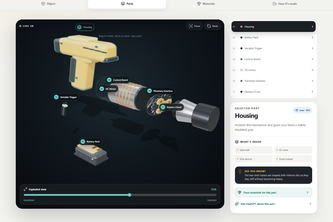
Deconstruct is a ChatGPT App that allows learners to explore everyday objects through interactive 3D science lessons. The app uses GPT-5.6 to interpret user prompts or images and generates an educational specification (ExplorationSpec), which is then validated and rendered as an interactive 3D experience using Three.js within the ChatGPT interface.
What changed
The project was built as a hackathon submission for the OpenAI 2026 hackathon. It represents a novel approach to combining generative AI with safe, bounded 3D rendering for educational purposes, leveraging a closed grammar and validation system to avoid arbitrary code execution.
Single most important open question
Is there any evidence of traction, revenue, or customer adoption beyond the self-reported project description? The author states that Deconstruct is a ChatGPT App, but no information exists about its actual usage, monetization, or market fit.
What The Product Actually Is
The description states that Deconstruct is a ChatGPT App. It allows users to describe an object or upload a photo and receive an interactive 3D exploration of its internal structure, materials, and manufacturing journey. This is achieved through:
- A GPT-5.6 model interpreting the input and generating an ExplorationSpec
- Validation via a Zod contract to ensure safe rendering
- Rendering using Three.js within ChatGPT
The system does not generate executable code; instead, it uses a declarative grammar for 3D structure, materials, and manufacturing steps.
Claim: Deconstruct is a ChatGPT App that turns an object into a 3D science lesson.
Evidence: The project write-up explicitly describes this as the core functionality.
Positioning & Claim Evolution
The author positions Deconstruct as a tool for interactive, safe, educational exploration of everyday objects, connecting structure, function, materials, and manufacturing in one experience. It aims to bridge the gap between real-world disassembly (which is often unsafe or impractical) and learning.
Key claims include:
- It helps learners understand how objects work by showing internal parts.
- It traces materials from raw resources back to finished products.
- It avoids unsafe disassembly while maintaining educational value.
- It integrates materials, manufacturing, and structure into a single narrative.
Claim: Deconstruct connects four questions: What is inside? What does each part do? What is it made from? How did those resources become this object?
Evidence: The write-up explicitly lists these four questions as the core of what Deconstruct addresses.
Target Customer & ICP
The description states that Deconstruct targets:
- Learners, particularly young students (e.g., 13-year-olds)
- Teachers who want to use familiar classroom objects for science lessons
- Educators looking for safe, reusable tools for exploration without the need for physical teardowns or expensive kits
Claim: The target audience includes learners and teachers seeking educational content that avoids unsafe disassembly.
Evidence: The write-up describes how Deconstruct addresses the limitations of real teardowns and supports classroom use.
Business Model & Pricing Evidence
There is no evidence in the description of a business model or pricing structure. The project is presented as a hackathon submission, with no mention of monetization, subscriptions, or sales channels.
Claim: No information on business model or pricing.
Evidence: Not evidenced.
Technical & Delivery Signals
The system uses:
- GPT-5.6 for language understanding and specification generation
- A closed grammar for 3D structures and materials
- Zod validation to ensure safe rendering
- Three.js for interactive visualization
- Built with React, Node.js, Express.js, Playwright, TypeScript, etc.
- Deployed via Google Cloud Run
The system is designed to be object-independent, using a declarative schema that supports multiple object types without hard-coded scenes.
Claim: The system uses a closed grammar and strict validation to avoid arbitrary code execution.
Evidence: The write-up explicitly describes how GPT-5.6 generates only a structured specification, which is validated before rendering.
Traction & Maturity Signals
There is no evidence of traction or maturity beyond the hackathon submission. No data on:
- User numbers
- Revenue
- Customer adoption
- Product usage metrics
Claim: No evidence of traction or customer adoption.
Evidence: Not evidenced.
Competitive Context
The description does not mention any direct competitors. However, it implies a space that includes:
- Educational tools for science and engineering
- 3D visualization platforms (e.g., CAD-based or AR/VR tools)
- AI-powered learning platforms
- Safe disassembly simulators or virtual teardowns
Claim: No competitive landscape described.
Evidence: Not evidenced.
Open Questions & Risks
Several risks and open questions are present:
- No traction or revenue — The project is a hackathon submission with no evidence of real-world adoption.
- Unproven market fit — No data on whether teachers or learners would use this tool.
- Limited scope — The system is built for ChatGPT and may not scale beyond that platform.
- Dependency on GPT-5.6 — If the model changes or becomes unavailable, the product could be broken.
- Self-reported validation only — No independent verification of claims about safety, usability, or educational effectiveness.
Inference: The lack of any traction or revenue data suggests that this is an unproven concept with no commercial viability yet.
Evidence: Not evidenced.
Questions the description leaves open
- What is the actual user base or pilot program for Deconstruct?
- Are there any plans to monetize or scale beyond the ChatGPT App?
- How does Deconstruct handle edge cases or ambiguous inputs (e.g., low-quality images)?
- Has the educational value of the output been tested with students or teachers?
- What are the long-term dependencies on OpenAI’s APIs and platform availability?
- Is there a roadmap for expanding beyond ChatGPT to other platforms or interfaces?
Overall Assessment
There is no evidence of commercial traction, revenue, or customer adoption. The project is described as a hackathon submission with no indication of market readiness or scalability.
Inference: This appears to be an experimental prototype rather than a viable product for investment or partnership.
Evidence: Not evidenced.
User Stories BotA demo video on every pull request
Get a demo video on every new feature
GitHub App that watches your pull requests and records a narrated, captioned demo.
Save time on demo prep and make informed decisions faster with a video walkthrough of every new feature.
Source
Submitted to the OpenAI 2026 hackathon on Devpost. Project home on Devpost. Back to the full gallery on Devpost.
This competitive analysis was produced by top-founders.com (opens in a new tab)
Generated by a language model from this project's public Devpost page — its tagline, the author's own write-up and any built-with tags listed there — as captured in August 2026. Short quotations are the author's words. It is an opinion on the idea as a business, not on the people behind it, and it reflects the description as published then. If the project has moved on, request a correction below. The analysis is not independent research and contains no verified traction, revenue or customer data.
An independent guide by KFG International LLC — not affiliated with, endorsed by, or connected to Devpost or OpenAI.