

Archive position — measured, not model output
0 likes on Devpost
2,263 of the 7,850 archived projects have more likes, and 5,587 share exactly 0 — so this project's #7,608 place in the like-ranked listing is a tie-break inside that group, not a ranking.
Projects (log scale)
Likes on Devpost. ▲ marks this project's group.
Show the figures
| Likes | Projects | Share of archive |
|---|---|---|
| 0 | 5,587 | 71.2% |
| 1 | 1,758 | 22.4% |
| 2 | 284 | 3.6% |
| 3–4 | 132 | 1.7% |
| 5–9 | 75 | 1.0% |
| 10+ | 14 | 0.2% |
 User Stories BotA demo video on every pull request
Get a demo video on every new feature
GitHub App that watches your pull requests and records a narrated, captioned demo.
Save time on demo prep and make informed decisions faster with a video walkthrough of every new feature.
Executive Summary
What the company appears to be
Voya is a self-reported local-first iPhone travel companion built during an OpenAI hackathon. The author describes it as an agentic travel companion that turns confirmations into verified live itineraries, monitors disruptions, and tells travelers what to do next.
What changed
During the OpenAI Build Week hackathon, the project evolved from a basic local-first itinerary app into an agentic system using GPT-5.6 and Codex. Key additions include trip-wide risk reasoning (Trip Guardian), bounded specialist agents, durable missions, and improved AI grounding with provider data.
The single most important open question
Is there any evidence of actual user adoption or revenue generation beyond the hackathon prototype? The description states no traction data exists.
What The Product Actually Is
- The description states Voya is a local-first iPhone travel companion.
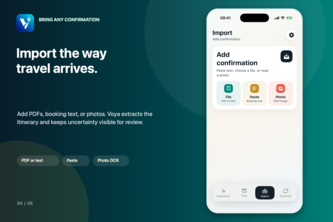
- It imports travel confirmations (flights, hotels, events) via screenshot, photo, PDF, file, or pasted text.
- It converts these into normalized itinerary data with confidence scores.
- It requires explicit review when extracted data is uncertain.
- It builds a time-zone-aware trip timeline.
- It enriches the itinerary with live flight status, weather, air quality, pollen, nearby events, and route options.
- It compares transit, driving, walking, and cycling with practical buffers and leave-by times.
- It detects trip-wide risks through Trip Guardian.
- It uses specialist agents for bounded tasks like disruption analysis, mobility, booking completeness, recovery, discovery, and concierge support.
- It keeps durable missions so the app can continue working toward an outcome instead of reducing every interaction to a one-shot chat.
- The signature experience is: import confirmation → let Voya verify it → receive specific, grounded action when trip changes.
Evidence Self-reported by author. No independent verification or traction data provided.
Positioning & Claim Evolution
- The description states Voya is designed as a calm, agentic layer around services travelers already use.
- It does not sell flights or hotels; it turns confirmations into a living itinerary and monitors real-world context.
- It aims to help travelers decide what to do next when plans change.
- During the hackathon, it evolved from a basic itinerary app to an agentic system powered by GPT-5.6 and Codex.
- The author claims it builds a coherent native product rather than a collection of AI demos.
- It is positioned as optimizing for confidence and calm, not message volume.
Evidence Self-reported claims about positioning and evolution. No external validation or market data provided.
Target Customer & ICP
- The description states Voya targets travelers who need help when plans change—specifically those dealing with disruptions like gate changes, flight slips, weather turns, or route issues.
- It is designed for users who already use travel services and want a calm assistant that doesn't take control away from them.
- The app is built specifically for iPhone (iOS) users.
Evidence Self-reported customer targeting. No specific ICP data or user segmentation provided.
Business Model & Pricing Evidence
- The description states Voya does not sell flights or hotels.
- It is described as a travel companion that works around existing services, not as a marketplace or sales platform.
- There is no mention of pricing, subscriptions, or monetization strategies.
- No revenue model or pricing evidence provided.
Evidence Self-reported positioning. No business model or pricing data.
Technical & Delivery Signals
- Built with Swift and SwiftUI for iOS client.
- Backend deployed as Vercel Functions using TypeScript.
- Uses GPT-5.6 (author-declared) for travel briefs, risk assessment, assistant reasoning, agent synthesis, and recommendation explanations.
- Integrates with FlightAware, Google Maps Platform, OpenWeather, Ticketmaster, Pexels, Wikipedia, Upstash Redis, and other APIs.
- Implements a coordinator-and-specialists architecture.
- Uses local-first design principles: confirmed itinerary data remains on device.
- Supports push notifications and deep-linked handling.
- Includes time-zone handling, cross-year sorting, transfer timing, itinerary merging, and disrupted travel flows.
- Uses Codex for engineering collaboration during the hackathon.
Evidence Self-reported technical stack and architecture. No independent verification or delivery metrics provided.
Traction & Maturity Signals
- The description states Voya existed before the hackathon as a local-first itinerary application.
- It was extended significantly during OpenAI Build Week.
- The author claims to have built a coherent native product rather than a demo.
- There is no evidence of user adoption, customer base, revenue, or usage metrics beyond the prototype.
Evidence Self-reported maturity and development history. No traction data provided.
Competitive Context
- The description does not mention competitors or market positioning relative to existing travel apps.
- It implies that current itinerary apps are good at storing bookings but fall short in helping travelers decide what to do next when disruptions occur.
- No competitive analysis, market size, or differentiation from other tools is provided.
Evidence Self-reported market framing. No competitive landscape data.
Open Questions & Risks
- The project is described as a hackathon prototype with no evidence of traction, revenue, or user adoption.
- It relies heavily on AI (GPT-5.6) for reasoning and guidance, but the author notes that deterministic facts must be preserved—this could create complexity in balancing AI and data integrity.
- No clear indication of scalability beyond the iOS platform or how it would handle large-scale travel disruptions or global usage.
- The team size is listed as one person (Ramil Aglyamov), which raises questions about execution capacity.
Evidence Self-reported claims. No external validation or risk assessment data provided.
Questions the description leaves open
- What specific user feedback did you gather during the hackathon, and how has it shaped the product?
- How do you plan to scale beyond a single developer and prototype stage?
- Are there any early adopters or pilot users who have tested the app in real-world conditions?
- What are your plans for monetization and long-term business sustainability?
- How do you ensure data privacy and security, especially with local-first design and AI integration?
- Can you explain how Trip Guardian works in practice and what kind of risks it detects?
- How does Voya handle edge cases like multi-city trips or complex itinerary merging?
Note
These questions are based on the self-reported description and are not grounded in verified data.
Overall Assessment
- The project is described as a hackathon prototype with no evidence of traction, revenue, or customer adoption.
- It shows technical ambition and an understanding of user needs but lacks commercial validation.
- The author states that Voya is built around existing travel services rather than selling directly, which may limit immediate monetization opportunities.
- Given the lack of any verified metrics, users, or business model, there is insufficient evidence to support a positive investment or partnership assessment.
Confidence Level Low — based entirely on self-reported information with no external corroboration.
User Stories BotA demo video on every pull request
Get a demo video on every new feature
GitHub App that watches your pull requests and records a narrated, captioned demo.
Save time on demo prep and make informed decisions faster with a video walkthrough of every new feature.
Source
Submitted to the OpenAI 2026 hackathon on Devpost. Project home on Devpost. Back to the full gallery on Devpost.
This competitive analysis was produced by top-founders.com (opens in a new tab)
Generated by a language model from this project's public Devpost page — its tagline, the author's own write-up and any built-with tags listed there — as captured in August 2026. Short quotations are the author's words. It is an opinion on the idea as a business, not on the people behind it, and it reflects the description as published then. If the project has moved on, request a correction below. The analysis is not independent research and contains no verified traction, revenue or customer data.
An independent guide by KFG International LLC — not affiliated with, endorsed by, or connected to Devpost or OpenAI.