

Archive position — measured, not model output
0 likes on Devpost
2,263 of the 7,850 archived projects have more likes, and 5,587 share exactly 0 — so this project's #7,610 place in the like-ranked listing is a tie-break inside that group, not a ranking.
Projects (log scale)
Likes on Devpost. ▲ marks this project's group.
Show the figures
| Likes | Projects | Share of archive |
|---|---|---|
| 0 | 5,587 | 71.2% |
| 1 | 1,758 | 22.4% |
| 2 | 284 | 3.6% |
| 3–4 | 132 | 1.7% |
| 5–9 | 75 | 1.0% |
| 10+ | 14 | 0.2% |
 User Stories BotA demo video on every pull request
Get a demo video on every new feature
GitHub App that watches your pull requests and records a narrated, captioned demo.
Save time on demo prep and make informed decisions faster with a video walkthrough of every new feature.
Executive Summary
What the company appears to be
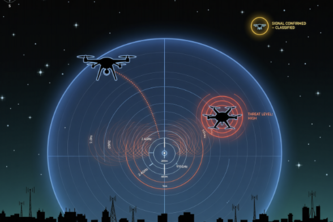
Vozhyk is an AI-powered iPhone app that the author describes as a drone detection tool using sound recognition and real-time alerts. It combines computer vision (via Apple's Vision framework and Core ML), Bluetooth scanning, and Wi-Fi network identification to detect possible drone activity.
What changed
The project was built as a hackathon submission for the OpenAI 2026 hackathon. The author states it is a working prototype that runs entirely on standard iPhones without specialized hardware.
Single most important open question
Is there any evidence of traction, revenue, or customer adoption beyond this self-reported prototype?
Note: This analysis is based solely on the self-reported project description provided by the caller. No independent verification or historical data exists for Vozhyk. All claims are stated by the author and not confirmed.
What The Product Actually Is
- The description states that Vozhyk is an AI-powered iPhone application.
- It uses Apple’s Vision framework, Core ML, and YOLO-based object detection models.
- It integrates camera feed analysis with Bluetooth Low Energy (BLE) scanning and Wi-Fi network identification.
- It includes a dual-model detection pipeline:
- A general YOLO model for detecting common objects including planes, birds, humans, etc.
- A custom fine-tuned plane_drone model trained from a reviewed drone video dataset.
- The app also features automatic camera zoom to improve long-distance detection.
- It displays threat indicators: CLEAR, POSSIBLE DRONE, DRONE DETECTED.
Inference: The product is described as a mobile application that runs entirely on iOS devices using native frameworks and AI models. It does not appear to be a commercial SaaS offering or a hardware product at this stage.
Positioning & Claim Evolution
- The author positions Vozhyk as an AI-powered tool for improving situational awareness around drones.
- It is described as a small, vigilant defender ("Hedgehog") helping users stay aware of their surroundings.
- The app aims to detect drone activity without requiring specialized equipment.
- It emphasizes on-device processing and privacy-conscious design.
Claim: Vozhyk is positioned as an accessible safety tool for civilians and emergency responders.
Inference: The positioning reflects a focus on personal safety, situational awareness, and mobile-based detection rather than enterprise or commercial use.
Target Customer & ICP
- Not evidenced.
- The description does not specify target customer segments (e.g., hobbyists, law enforcement, commercial operators).
- No mention of personas, user roles, or specific use cases beyond general drone safety.
Finding: There is no evidence of a defined ICP or target customer profile in the provided description.
Business Model & Pricing Evidence
- Not evidenced.
- No information about monetization strategy, pricing plans, or revenue streams.
- The project is described as a hackathon prototype with no indication of commercial intent or business model.
Finding: No evidence of a business model or pricing structure exists in the description.
Technical & Delivery Signals
- Built natively on iOS using SwiftUI, AVFoundation, Vision, Core ML, CoreBluetooth, and Network frameworks.
- Uses YOLOv8-based models for object detection and a custom fine-tuned drone model.
- Implements a modular architecture separating general and specific detection models.
- Includes dataset preparation tools built with Flask and OpenCV.
- Leverages OpenAI Codex for development acceleration.
- Features real-time camera zoom triggered by CoreMotion sensor data.
Inference: The technical stack suggests a strong focus on mobile AI, on-device processing, and integration of multiple iOS sensors. However, no evidence of production deployment or scalability beyond prototype status.
Traction & Maturity Signals
- Not evidenced.
- No mention of users, customers, downloads, usage metrics, or product adoption.
- The project is explicitly described as a hackathon submission.
- No data on performance, accuracy, or field testing results.
Finding: There is no evidence of traction, user base, or measurable product maturity beyond prototype development.
Competitive Context
- Not evidenced.
- No mention of competitors, market size, or competitive positioning.
- The description does not reference existing drone detection solutions or platforms.
Finding: No competitive context is provided in the self-reported description.
Open Questions & Risks
- Prototype-only status: The project is described as a hackathon prototype with no evidence of commercial viability or real-world deployment.
- Limited scope and accuracy: Detection relies on limited iOS APIs (no raw RF access), which may limit detection reliability.
- No monetization strategy: No indication of how the product would generate revenue or scale.
- High dependency on model quality: Model performance depends heavily on dataset preparation, which is not scalable without significant manual effort.
- Privacy and legal concerns: The use of BLE scanning and camera data raises potential privacy issues, though no mention of compliance or governance.
Inference: The project lacks commercial readiness, scalability, and clear path to monetization. It appears to be a proof-of-concept rather than a viable product.
Questions the description leaves open
- What is the current accuracy rate of the drone detection model in real-world conditions?
- How does Vozhyk handle false positives, especially in complex environments like urban areas or near birds?
- Is there any plan to monetize this app or integrate it into a larger platform?
- Has the team considered legal and regulatory implications of drone detection in various jurisdictions?
- What are the limitations of using only iOS APIs for RF-based detection?
- How is the dataset prepared, and what is the process for continuous model improvement?
Overall Assessment
- Not evidenced.
- No financial data, funding rounds, or valuation information is available.
- The project is described as a hackathon prototype with no evidence of traction or commercialization.
Finding: There is insufficient evidence to support an investment or partnership decision. The project appears to be in early-stage development and lacks any demonstrated commercial potential or market readiness.
User Stories BotA demo video on every pull request
Get a demo video on every new feature
GitHub App that watches your pull requests and records a narrated, captioned demo.
Save time on demo prep and make informed decisions faster with a video walkthrough of every new feature.
Source
Submitted to the OpenAI 2026 hackathon on Devpost. Project home on Devpost. Back to the full gallery on Devpost.
This competitive analysis was produced by top-founders.com (opens in a new tab)
Generated by a language model from this project's public Devpost page — its tagline, the author's own write-up and any built-with tags listed there — as captured in August 2026. Short quotations are the author's words. It is an opinion on the idea as a business, not on the people behind it, and it reflects the description as published then. If the project has moved on, request a correction below. The analysis is not independent research and contains no verified traction, revenue or customer data.
An independent guide by KFG International LLC — not affiliated with, endorsed by, or connected to Devpost or OpenAI.