

Archive position — measured, not model output
0 likes on Devpost
2,263 of the 7,850 archived projects have more likes, and 5,587 share exactly 0 — so this project's #3,684 place in the like-ranked listing is a tie-break inside that group, not a ranking.
Projects (log scale)
Likes on Devpost. ▲ marks this project's group.
Show the figures
| Likes | Projects | Share of archive |
|---|---|---|
| 0 | 5,587 | 71.2% |
| 1 | 1,758 | 22.4% |
| 2 | 284 | 3.6% |
| 3–4 | 132 | 1.7% |
| 5–9 | 75 | 1.0% |
| 10+ | 14 | 0.2% |
 User Stories BotA demo video on every pull request
Get a demo video on every new feature
GitHub App that watches your pull requests and records a narrated, captioned demo.
Save time on demo prep and make informed decisions faster with a video walkthrough of every new feature.
Executive Summary
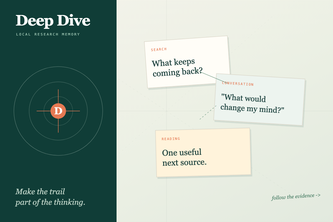
What the company appears to be: The description states that Deep Dive is a tool designed to organize search results, chats, notes, and saved pages into private, explainable threads, and to surface the next reading or question worth following.
What changed: This is a self-reported project submitted to the OpenAI 2026 hackathon. No evidence of prior versions or changes is provided.
The single most important open question: Is there any evidence of product-market fit, user adoption, revenue, or traction beyond the initial submission?
What The Product Actually Is
The description states that Deep Dive "turns your searches, chats, notes, and saved pages into private, explainable threads—then surfaces the next reading or question worth following."
- Claimed functionality: Organizing information from multiple sources (searches, chats, notes, saved pages) into structured, private threads.
- Claimed output: Threads that are "explainable" and capable of surfacing the next logical step in exploration or learning.
Not evidenced: No details on how this is implemented, what the UI looks like, or whether it's a web app, desktop tool, browser extension, or API. The author does not describe any specific features beyond the general concept.
Positioning & Claim Evolution
The description states: "Deep Dive turns your searches, chats, notes, and saved pages into private, explainable threads—then surfaces the next reading or question worth following."
- Positioning: A tool for personal knowledge management or exploration.
- Claim evolution: The author frames it as a way to organize and extend one's own learning journey through structured threads.
Not evidenced: No indication of how this differs from existing tools like Notion, Roam Research, or Obsidian. No evidence of prior versions or claimed improvements over current offerings.
Target Customer & ICP
The description does not state who the target customer is.
- Inference: Based on the tagline and functionality, it may be aimed at individuals who do a lot of research, note-taking, or exploration (e.g., researchers, students, professionals).
- Not evidenced: No evidence of specific personas, use cases, or customer segments.
Business Model & Pricing Evidence
The description does not state anything about pricing or business model.
- Not evidenced: No mention of monetization strategy, freemium tiers, subscriptions, or any commercial structure.
Technical & Delivery Signals
The author states that the project was built with: css, html, javascript.
- Claimed tech stack: Front-end web technologies.
- Inference: Likely a browser-based tool or web app, possibly a prototype or MVP.
Not evidenced: No evidence of backend infrastructure, scalability, or delivery method beyond the tech stack. No mention of hosting, deployment, or data persistence.
Traction & Maturity Signals
The description states that this project was submitted to the OpenAI 2026 hackathon on Devpost.
- Evidence: This is a hackathon submission.
- Not evidenced: No evidence of user adoption, revenue, customer base, or product maturity beyond the initial prototype.
Competitive Context
The description does not mention any competitors.
- Inference: The tool may compete with tools like Notion, Roam Research, Obsidian, or similar knowledge management platforms.
- Not evidenced: No evidence of competitive analysis, market positioning, or differentiation from existing tools.
Open Questions & Risks
- Risk: The project is a hackathon submission. There is no evidence of product-market fit, traction, or commercial viability.
- Open question: No evidence of team size beyond one person (James Stowe), which may indicate limited development capacity.
- Open question: No evidence of any monetization strategy, pricing, or business model.
Questions the description leaves open
- What problem are you solving, and how does this tool address it differently from existing solutions?
- How is the product currently being used or tested?
- What is your plan for scaling or monetizing the product?
- What are the key assumptions behind your approach, and how do you plan to validate them?
- Are there any early users or feedback loops in place?
Overall Assessment
Not evidenced: No evidence of revenue, traction, or commercial viability.
- Confidence level: Low.
- Assessment: This is a self-reported hackathon submission with no evidence of product-market fit, adoption, or business model. It is not ready for investment or partnership consideration without further development and validation.
User Stories BotA demo video on every pull request
Get a demo video on every new feature
GitHub App that watches your pull requests and records a narrated, captioned demo.
Save time on demo prep and make informed decisions faster with a video walkthrough of every new feature.
Source
Submitted to the OpenAI 2026 hackathon on Devpost. Project home on Devpost. Back to the full gallery on Devpost.
This competitive analysis was produced by top-founders.com (opens in a new tab)
Generated by a language model from this project's public Devpost page — its tagline and any built-with tags listed there, since the author published no write-up — as captured in August 2026. Short quotations are the author's words. It is an opinion on the idea as a business, not on the people behind it, and it reflects the description as published then. If the project has moved on, request a correction below. The analysis is not independent research and contains no verified traction, revenue or customer data.
An independent guide by KFG International LLC — not affiliated with, endorsed by, or connected to Devpost or OpenAI.