

Archive position — measured, not model output
0 likes on Devpost
2,263 of the 7,850 archived projects have more likes, and 5,587 share exactly 0 — so this project's #5,647 place in the like-ranked listing is a tie-break inside that group, not a ranking.
Projects (log scale)
Likes on Devpost. ▲ marks this project's group.
Show the figures
| Likes | Projects | Share of archive |
|---|---|---|
| 0 | 5,587 | 71.2% |
| 1 | 1,758 | 22.4% |
| 2 | 284 | 3.6% |
| 3–4 | 132 | 1.7% |
| 5–9 | 75 | 1.0% |
| 10+ | 14 | 0.2% |
 User Stories BotA demo video on every pull request
Get a demo video on every new feature
GitHub App that watches your pull requests and records a narrated, captioned demo.
Save time on demo prep and make informed decisions faster with a video walkthrough of every new feature.
Executive Summary
What the company appears to be
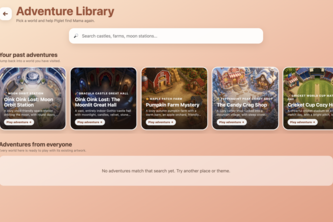
OinkOinkLost Game is a self-reported AI-powered interactive storybook adventure game for children, where a character named Piglet explores dynamically generated worlds with rooms and NPCs to find Mama. The project was built as part of an OpenAI 2026 hackathon submission.
What changed
The author states that the project evolved from a simple idea into a full playable experience using AI models and tools like Codex, FastAPI, React, Docker, and Google Cloud. It includes features such as dynamic world generation, NPC conversations, voice synthesis, and mobile-responsive gameplay.
Single most important open question — the commercial due-diligence read
Is there any evidence of traction, revenue, or customer adoption beyond the author's own description? The project is described as a hackathon submission with no indication of monetization, user base, or market validation.
What The Product Actually Is
The description states that OinkOinkLost Game is an AI-generated interactive storybook adventure. Players control Piglet in a world where they can walk through rooms, interact with NPCs, and solve mysteries to find Mama. It uses AI for generating worlds, characters, dialogue, images, and audio.
- The game allows players to choose pre-generated adventures or describe new settings.
- It generates structured story bibles, illustrated environments, character sprites, and NPC conversations.
- Conversations are dynamic rather than fixed dialogue trees.
- Voice input is supported via microphone.
- Adventures can be cached for reuse to reduce generation time.
- The frontend uses React, TypeScript, Vite, Zustand, and PixiJS; the backend uses Python, FastAPI, Uvicorn, Pydantic, Pillow, NumPy.
- It runs on Docker and is deployed via Google Cloud with Caddy and Nginx.
Confidence Low — all details are self-reported and unverified. No evidence of actual product usage or performance metrics.
Positioning & Claim Evolution
The author claims that OinkOinkLost Game explores what happens if an AI-generated story becomes a world a child can enter, explore, and influence — moving beyond static text or image generation.
- The project positions itself as more than just an AI chatbot wrapped in a game interface.
- It emphasizes multimodal interaction (visual, audio, speech) and spatial exploration.
- The author highlights the use of multiple OpenAI models to create a cohesive experience.
- There is no mention of branding, target audience beyond children, or positioning relative to competitors.
Confidence Low — claims are based on self-description only. No external validation or market positioning data provided.
Target Customer & ICP
The description states that the game targets children who want to explore a storybook world and interact with characters to solve a mystery.
- The core user is implied to be young children (e.g., “Piglet” suggests a child-friendly theme).
- There is no explicit mention of parental involvement or educational use.
- No segmentation beyond age group or interest in interactive stories.
Confidence Very low — no evidence of customer personas, surveys, or market research.
Business Model & Pricing Evidence
There is no evidence of any business model or pricing strategy. The description does not state whether the game will be sold, offered free-to-play, monetized through ads, or used in educational settings.
- The author mentions a “one-command Docker installation” and downloadable reunion images.
- No mention of subscriptions, in-app purchases, licensing, or revenue streams.
- No indication of how users would pay for or access the product beyond local installation.
Confidence Not evidenced — no commercial structure described.
Technical & Delivery Signals
The project is built using a combination of OpenAI APIs and open-source technologies:
- Backend: Python, FastAPI, Uvicorn, Pydantic, Pillow, NumPy.
- Frontend: React, TypeScript, Vite, Zustand, PixiJS.
- AI tools used include GPT models (gpt-5.4-mini, gpt-5.6-luna), image generation (gpt-image-2), TTS (gpt-4o-mini-tts), transcription (gpt-4o-mini-transcribe), moderation (omni-moderation-latest).
- Deployment: Dockerized, hosted on Google Cloud with Caddy and Nginx.
- Codex was used throughout the development lifecycle.
Confidence Medium — technical stack is detailed but not validated or tested in production.
Traction & Maturity Signals
There is no evidence of traction, adoption, or user engagement beyond the author’s own account.
- The project was submitted to a hackathon.
- No mention of downloads, active users, retention rates, or feedback from players.
- No data on performance, scalability, or long-term viability.
- The product is described as a prototype, not yet a commercial offering.
Confidence Not evidenced — no signs of real-world usage or growth metrics.
Competitive Context
The author does not reference any competitors or similar products. The description implies that the game aims to go beyond traditional AI storytelling apps by creating immersive, exploratory worlds.
- No comparison with existing children’s interactive games or AI story platforms.
- No mention of how this differs from other generative AI tools or educational software.
Confidence Not evidenced — no competitive analysis or market positioning provided.
Open Questions & Risks
Several risks and open questions are present based on the self-reported description:
- Unproven commercial viability: The project is presented as a hackathon submission with no evidence of monetization or user traction.
- High dependency on AI APIs: Reliance on OpenAI models may pose risks related to cost, availability, or API changes.
- Limited scalability assumptions: No mention of how the system handles large-scale generation or concurrent users.
- Unclear safety mechanisms: While moderation is mentioned, no details are given about content filtering or child safety features in practice.
- No clear path to market: No evidence of distribution strategy, marketing plan, or go-to-market approach.
Confidence Medium — risks inferred from lack of evidence and technical assumptions.
Questions the description leaves open
- Has the game been tested with children? What was the feedback?
- Are there any plans to monetize the product? If so, how?
- How does the system handle edge cases or failures during generation?
- What is the expected cost per adventure generated and stored?
- Is there a plan for community sharing or user-generated content?
- What are the long-term goals for scaling beyond the current prototype?
- How will the product ensure age-appropriate interactions and safety?
- Are there any partnerships or integrations planned with schools, publishers, or edtech platforms?
Overall Assessment
The project is described as a hackathon submission that demonstrates technical capability but lacks evidence of commercial traction, customer validation, or monetization strategy.
- It shows strong engineering execution using AI tools.
- However, there is no indication of market demand, user engagement, or business model.
- The author’s claims about innovation and interactivity are self-reported without external corroboration.
Assessment Not ready for investment or partnership at this stage. Requires further validation of product-market fit, revenue potential, and scalability before considering deeper due diligence.
User Stories BotA demo video on every pull request
Get a demo video on every new feature
GitHub App that watches your pull requests and records a narrated, captioned demo.
Save time on demo prep and make informed decisions faster with a video walkthrough of every new feature.
Source
Submitted to the OpenAI 2026 hackathon on Devpost. Project home on Devpost. Back to the full gallery on Devpost.
This competitive analysis was produced by top-founders.com (opens in a new tab)
Generated by a language model from this project's public Devpost page — its tagline, the author's own write-up and any built-with tags listed there — as captured in August 2026. Short quotations are the author's words. It is an opinion on the idea as a business, not on the people behind it, and it reflects the description as published then. If the project has moved on, request a correction below. The analysis is not independent research and contains no verified traction, revenue or customer data.
An independent guide by KFG International LLC — not affiliated with, endorsed by, or connected to Devpost or OpenAI.