

Archive position — measured, not model output
0 likes on Devpost
2,263 of the 7,850 archived projects have more likes, and 5,587 share exactly 0 — so this project's #3,680 place in the like-ranked listing is a tie-break inside that group, not a ranking.
Projects (log scale)
Likes on Devpost. ▲ marks this project's group.
Show the figures
| Likes | Projects | Share of archive |
|---|---|---|
| 0 | 5,587 | 71.2% |
| 1 | 1,758 | 22.4% |
| 2 | 284 | 3.6% |
| 3–4 | 132 | 1.7% |
| 5–9 | 75 | 1.0% |
| 10+ | 14 | 0.2% |
 User Stories BotA demo video on every pull request
Get a demo video on every new feature
GitHub App that watches your pull requests and records a narrated, captioned demo.
Save time on demo prep and make informed decisions faster with a video walkthrough of every new feature.
Executive Summary
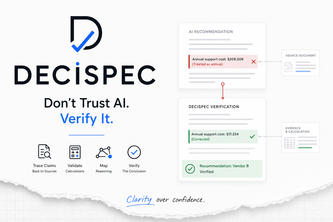
DECISPEC is a self-reported AI verification tool that claims to trace evidence, check calculations, and reveal where reasoning fails in AI-generated recommendations. The author states it verifies rather than generates AI responses, using a hybrid of deterministic code and GPT-5.6 for structured data conversion. It was built as a hackathon submission by one person (J-space Odeyemi) using React, Next.js, TypeScript, Codex, and the GPT-5.6 API.
The project description states that DECISPEC builds a dependency graph showing how conclusions are reached, recalculates affected values when errors are found, and produces transparent reports explaining changes. The system is designed to be repeatable and low-cost by minimizing reliance on AI for verification tasks.
Key commercial due-diligence questions include: What is the actual market need? How does this differ from existing tools? Is there a viable business model beyond a hackathon prototype?
Most important open question
Does DECISPEC have any evidence of traction, revenue, or customer adoption beyond its author's self-reported claims?
What The Product Actually Is
The description states that DECISPEC:
- Verifies AI-generated recommendations instead of creating new ones
- Traces claims back to their evidence
- Validates calculations
- Checks quoted information
- Builds a dependency graph showing how the final conclusion was reached
- Recalculates every affected value when errors are found
- Generates transparent reports explaining what changed and why
The system is described as using:
- React, Next.js, TypeScript for frontend
- Codex for development assistance
- GPT-5.6 API for converting unstructured documents into structured data
- Deterministic code for validation, evidence tracing, and correction propagation
Inference The product appears to be a proof-of-concept tool for verifying AI outputs, not a production-ready SaaS offering.
Positioning & Claim Evolution
The author states that DECISPEC was inspired by the realization that "AI has gotten really good at giving answers, but it's still surprisingly hard to know if those answers are actually correct." The positioning is that it doesn't generate new AI responses but instead verifies them.
Key claims:
- It checks if recommendations are supported by evidence
- It produces transparent, trustworthy decisions
- It traces reasoning back to its source
- It recalculates affected values and updates recommendations when errors are found
The author also states that the system is designed to be repeatable and low-cost, avoiding reliance on AI for verification tasks.
Inference The positioning reflects a niche in trust and transparency within AI decision-making, but it's not clear whether this addresses a market need beyond the author’s personal experience or use case.
Target Customer & ICP
The description does not state any specific customer segments or personas. It only mentions that DECISPEC works well for verifying reports and recommendations, and that it could be useful "anywhere important decisions are being made."
The author notes they want to support more document formats, handle larger document sets, and make reports easier for non-technical users to understand.
Inference The target customer is likely professionals or organizations who rely on AI-generated reports or recommendations and need assurance of their accuracy. However, no explicit ICP is defined.
Business Model & Pricing Evidence
The description does not provide any information about pricing, monetization, or business model. It only describes the tool's functionality and technical implementation.
Inference No evidence of a business model exists beyond the author’s own account.
Technical & Delivery Signals
The project was built with:
- React, Next.js, TypeScript
- Codex for development assistance
- GPT-5.6 API for converting unstructured documents into structured data
- Deterministic code for validation and correction propagation
Key technical claims:
- The system converts unstructured documents into structured data using GPT-5.6
- Verification is handled by deterministic code
- It builds a dependency graph showing how conclusions are reached
- Correction propagation is implemented to update affected values
- The approach aims to be repeatable and low-cost
Inference The technical stack suggests a web-based application with AI integration for data parsing, but no evidence of scalability or production deployment.
Traction & Maturity Signals
The description states that DECISPEC was built as part of an OpenAI 2026 hackathon submission. It is described as a prototype, not a commercial product.
No evidence of:
- Revenue
- Customers
- Users
- Product-market fit
- Market traction
- Adoption metrics
Inference The tool has no demonstrated traction or maturity beyond its author's personal development effort.
Competitive Context
The description does not mention any competitors or existing solutions in the space. It only states that DECISPEC verifies AI recommendations rather than generating them.
Inference No competitive landscape is described, making it impossible to assess positioning or differentiation.
Open Questions & Risks
- Single-person team: The entire project was built by one person (J-space Odeyemi), raising questions about scalability and long-term development.
- No revenue or customer data: There is no evidence of any commercial activity, users, or monetization.
- Hackathon prototype: The tool is described as a hackathon submission, suggesting it’s not yet mature for market use.
- Unproven market need: No evidence that the target problem (verifying AI recommendations) has a significant market demand.
- Lack of transparency in implementation details: While the author describes how the system works, there are no technical specifications or performance benchmarks.
Questions the description leaves open
- What specific use cases have you identified for DECISPEC beyond the author’s personal experience?
- How do you plan to validate the accuracy of your verification engine against real-world data?
- Have you tested DECISPEC with any external users or organizations?
- What is the expected cost structure and scalability of the system?
- Is there a clear path from prototype to commercial product?
- What are the key challenges in moving from a hackathon project to a viable business?
Overall Assessment
The description states that DECISPEC was built as a hackathon submission by one person and is not yet a commercial product. There is no evidence of revenue, customers, or traction.
Assessment Not evidenced as a viable investment or partnership opportunity at this stage. The project lacks commercial validation, scalability, and market proof beyond the author's own claims.
User Stories BotA demo video on every pull request
Get a demo video on every new feature
GitHub App that watches your pull requests and records a narrated, captioned demo.
Save time on demo prep and make informed decisions faster with a video walkthrough of every new feature.
Source
Submitted to the OpenAI 2026 hackathon on Devpost. Project home on Devpost. Back to the full gallery on Devpost.
This competitive analysis was produced by top-founders.com (opens in a new tab)
Generated by a language model from this project's public Devpost page — its tagline, the author's own write-up and any built-with tags listed there — as captured in August 2026. Short quotations are the author's words. It is an opinion on the idea as a business, not on the people behind it, and it reflects the description as published then. If the project has moved on, request a correction below. The analysis is not independent research and contains no verified traction, revenue or customer data.
An independent guide by KFG International LLC — not affiliated with, endorsed by, or connected to Devpost or OpenAI.