

Archive position — measured, not model output
0 likes on Devpost
2,263 of the 7,850 archived projects have more likes, and 5,587 share exactly 0 — so this project's #3,678 place in the like-ranked listing is a tie-break inside that group, not a ranking.
Projects (log scale)
Likes on Devpost. ▲ marks this project's group.
Show the figures
| Likes | Projects | Share of archive |
|---|---|---|
| 0 | 5,587 | 71.2% |
| 1 | 1,758 | 22.4% |
| 2 | 284 | 3.6% |
| 3–4 | 132 | 1.7% |
| 5–9 | 75 | 1.0% |
| 10+ | 14 | 0.2% |
 User Stories BotA demo video on every pull request
Get a demo video on every new feature
GitHub App that watches your pull requests and records a narrated, captioned demo.
Save time on demo prep and make informed decisions faster with a video walkthrough of every new feature.
Executive Summary
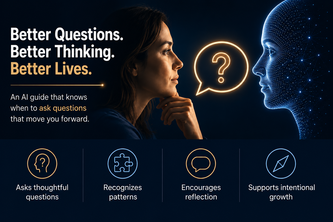
The description states that this is a project named Decisions Start with Better Questions, which aims to improve human decision-making through AI-guided conversation by prompting thoughtful questions rather than providing direct answers. The author, Alex MacRae, describes building an AI interaction model focused on asking better questions to help people think more clearly and make better decisions. This is a self-reported project submitted to the OpenAI 2026 hackathon.
The single most important open question is: What is the actual product or service being offered, and how does it differ from general-purpose AI tools like ChatGPT?
Confidence in this analysis is low due to lack of evidence for any commercial offering, revenue, customers, or technical implementation details beyond the author's own account.
What The Product Actually Is
The description states that the project was built using ChatGPT and OpenAI tools. It describes an AI interaction model focused on asking questions rather than answering them. However, it does not specify whether this is a standalone application, a plugin, a tool for developers, or something else entirely.
- The author states: "This project was developed through an ongoing collaboration with ChatGPT."
- The author states: "Instead of designing another assistant that immediately provides answers, we focused on creating an AI that knows when thoughtful questions are more valuable than immediate solutions."
- Not evidenced: whether this is a software product, API, web app, or other form of delivery.
Positioning & Claim Evolution
The description states the project's core positioning: "AI shouldn't only answer questions. It should know when to ask them." The author claims that better questions lead to better thinking and better decisions. The project evolved from a personal idea into a broader concept applicable across business, education, creativity, and decision-making.
- The author states: "What if AI became even more valuable by knowing when to stop answering and start asking?"
- The author states: "The same question-first approach can improve business planning, leadership, education, creative work, problem-solving, and everyday decision-making."
- Inference: The positioning has evolved from a personal tool to a broader framework for AI interaction.
- Not evidenced: specific claims about market differentiation or competitive advantages.
Target Customer & ICP
The description states that the project is aimed at people who make decisions in business, creative work, or personal contexts. It also mentions that it helps with problem-solving and strategic thinking. However, no specific customer segments or personas are identified.
- The author states: "I've learned that breakthrough moments usually begin with a better question, not a better answer."
- The author states: "The same question-first approach can improve business planning, leadership, education, creative work, problem-solving, and everyday decision-making."
- Not evidenced: specific customer types, use cases, or ICP.
Business Model & Pricing Evidence
There is no evidence in the description of any pricing structure, monetization strategy, or business model. The project appears to be a prototype or concept submitted for a hackathon.
- Not evidenced: revenue model, pricing, or commercial viability.
- Inference: If this were to become a product, it might be offered as an AI assistant tool or SaaS platform, but no such details are provided.
Technical & Delivery Signals
The description states that the project was built using ChatGPT and OpenAI tools. It does not provide information about technical architecture, scalability, or delivery mechanisms beyond its use of AI APIs.
- The author states: "This project was developed through an ongoing collaboration with ChatGPT."
- Not evidenced: technical stack, API integrations, platform deployment, or scalability considerations.
Traction & Maturity Signals
The description does not contain any evidence of traction, adoption, or maturity. It is a self-reported submission to a hackathon and lacks data on users, engagement, or product development stages.
- Not evidenced: customer base, user metrics, product usage, or market validation.
- The project was submitted to the OpenAI 2026 hackathon — this is not evidence of traction.
Competitive Context
The description does not provide any information about competitors or how this idea compares with existing AI tools or frameworks. It does not name or describe competing products or services.
- Not evidenced: competitive landscape, market positioning, or differentiation from similar offerings.
- Inference: The project may compete with general-purpose AI assistants like ChatGPT, but no such comparison is made.
Open Questions & Risks
The description raises several potential risks:
- Lack of clarity on the actual product or service being offered.
- No evidence of commercial viability or monetization strategy.
- The project appears to be a prototype submitted for a hackathon.
- Risk of being too abstract or generic in its value proposition.
- Not evidenced: specific risks, but these are inferred from lack of detail and absence of traction or business model.
Questions the description leaves open
- What is the actual product or service you're offering? Is it a tool, API, or platform?
- How does your solution differ from existing AI tools like ChatGPT or other question-answering platforms?
- Have you validated this concept with any users or customers yet?
- What is your plan for monetization and scaling the idea beyond a hackathon submission?
- Do you have a clear roadmap for product development or market entry?
Overall Assessment
The description does not provide sufficient evidence to assess whether this project is ready for investment or partnership. It lacks information on traction, revenue, customer validation, or business model.
- Not evidenced: investment readiness, commercial potential, or partnership opportunities.
- Inference: This appears to be an early-stage idea or prototype with no clear path to market or monetization.
User Stories BotA demo video on every pull request
Get a demo video on every new feature
GitHub App that watches your pull requests and records a narrated, captioned demo.
Save time on demo prep and make informed decisions faster with a video walkthrough of every new feature.
Source
Submitted to the OpenAI 2026 hackathon on Devpost. Project home on Devpost. Back to the full gallery on Devpost.
This competitive analysis was produced by top-founders.com (opens in a new tab)
Generated by a language model from this project's public Devpost page — its tagline, the author's own write-up and any built-with tags listed there — as captured in August 2026. Short quotations are the author's words. It is an opinion on the idea as a business, not on the people behind it, and it reflects the description as published then. If the project has moved on, request a correction below. The analysis is not independent research and contains no verified traction, revenue or customer data.
An independent guide by KFG International LLC — not affiliated with, endorsed by, or connected to Devpost or OpenAI.