

Archive position — measured, not model output
0 likes on Devpost
2,263 of the 7,850 archived projects have more likes, and 5,587 share exactly 0 — so this project's #7,604 place in the like-ranked listing is a tie-break inside that group, not a ranking.
Projects (log scale)
Likes on Devpost. ▲ marks this project's group.
Show the figures
| Likes | Projects | Share of archive |
|---|---|---|
| 0 | 5,587 | 71.2% |
| 1 | 1,758 | 22.4% |
| 2 | 284 | 3.6% |
| 3–4 | 132 | 1.7% |
| 5–9 | 75 | 1.0% |
| 10+ | 14 | 0.2% |
 User Stories BotA demo video on every pull request
Get a demo video on every new feature
GitHub App that watches your pull requests and records a narrated, captioned demo.
Save time on demo prep and make informed decisions faster with a video walkthrough of every new feature.
Executive Summary
What the company appears to be
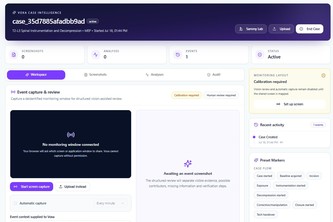
Voxa AI is a self-reported project that aims to improve intraoperative neuromonitoring (IONM) workflows through AI-assisted waveform analysis and report generation. It integrates GPT-5.6 vision capabilities into a system designed for real-time case tracking, annotation, and structured report creation.
What changed
The author reports shifting from standalone machine learning models and hardcoded chatbots to a human-supervised AI workflow using GPT-5.6 vision and screen capture APIs. The system now supports real-time waveform review, tagging, and automated PDF report generation, with an emphasis on transparency about uncertainty in data extraction.
Single most important open question
Is there evidence of any actual use or adoption by IONM technologists or clinical teams? The description states no revenue, customers, or traction beyond the author’s own experimentation and a hackathon submission.
What The Product Actually Is
The description states that Voxa AI is a system designed to improve intraoperative neuromonitoring workflows. It uses GPT-5.6 vision capabilities to analyze waveform screenshots during cases, extract visible labels and calibration data, and recommend verification steps. The system integrates with tools like the browser-screen-capture-api, React frontend, Express.js backend, and PostgreSQL database.
The author describes it as a human-supervised AI workflow that allows technologists to tag images with preset markers, log clinical events directly onto waveforms, and compile curated screenshots into automated PDF reports. It includes components for case tracking, waveform review, report generation, annotation lab support, and training modules.
Inference The system is built around screen capture and GPT vision models to extract visible data from waveform images, rather than relying on raw signal data or deep computer vision techniques.
Positioning & Claim Evolution
The author states that Voxa AI was inspired by a lack of standardized educational platforms for IONM technologists. It evolved from early experiments with dense theory-based training and hardcoded decision-tree chatbots to a more flexible, human-supervised approach using GPT-5.6 vision.
Claim
The system integrates report creation in parallel with intelligence case tracking, embedding structured learning guidance during case support.
Inference The positioning shifted from a purely technical or educational tool to an integrated workflow platform that supports both real-time case management and future AI model development through expert-labeled datasets.
Target Customer & ICP
The description states that the target users are Intraoperative Neuromonitoring (IONM) technologists, who work in neurosurgery, orthopaedics, anaesthesia, neurophysiology, and physics. These professionals are involved in monitoring neural function during surgery using various modalities such as SSEP and MEP.
Claim
The system is designed to support new IONM technologists by providing structured learning guidance and reducing cognitive load during cases.
Inference The primary customer segment appears to be internal teams within hospitals or medical service providers who perform IONM procedures, though no specific customers or organizations are named.
Business Model & Pricing Evidence
Not evidenced.
The description does not contain any information about pricing models, monetization strategies, or business models beyond the project’s development phase.
Technical & Delivery Signals
The system is built with the following technologies:
- Frontend: React, Tailwind CSS, Vite
- Backend: Express.js, Node.js, TypeScript
- Database: PostgreSQL, Drizzle ORM, Neon
- AI/ML: GPT-5.6 (via OpenAI API), browser-screen-capture-api
- Cloud: Google Cloud
The author notes that early experiments with automatic measurement markers and waveform reconstruction failed due to issues like incorrect anchoring and pixel ambiguity. As a result, the current approach emphasizes human supervision and stateful uncertainty reporting rather than full automation.
Inference The technical architecture supports real-time screen capture and AI-assisted annotation but does not appear to include raw signal processing or modality-specific computer vision models yet.
Traction & Maturity Signals
Not evidenced.
There is no mention of revenue, customers, user adoption, or product maturity beyond the hackathon submission. The project is described as a prototype built during Build Week and has not been independently verified for real-world use.
Competitive Context
Not evidenced.
No information is provided about competitors or existing solutions in the IONM workflow space. The description does not reference other tools, platforms, or vendors offering similar services.
Open Questions & Risks
- Unverified claims: All statements are self-reported and unverified.
- No traction or adoption: No evidence of real-world usage, customers, or revenue.
- Limited scope: The system is described as a prototype for a hackathon; no indication it has moved beyond experimental phase.
- Dependency on human supervision: The approach relies heavily on expert review, which may limit scalability.
- Unclear future roadmap: While the author mentions building modality-specific models, there’s no evidence of progress or validation.
Questions the description leaves open
- Has this system been tested with actual IONM technologists in clinical settings?
- What is the current level of human involvement required in the workflow?
- Are there any plans to validate performance with clinical experts beyond the hackathon?
- How does the system handle data privacy and compliance (e.g., HIPAA)?
- Is there a plan for monetization or commercial deployment?
Overall Assessment
Not evidenced.
There is no evidence of funding, valuation, or investment interest in Voxa AI beyond its submission to a hackathon. No commercial traction, partnerships, or investor engagement are mentioned.
Confidence level Low. The description provides only a self-reported account of a prototype project with no independent verification or evidence of real-world impact.
User Stories BotA demo video on every pull request
Get a demo video on every new feature
GitHub App that watches your pull requests and records a narrated, captioned demo.
Save time on demo prep and make informed decisions faster with a video walkthrough of every new feature.
Source
Submitted to the OpenAI 2026 hackathon on Devpost. Project home on Devpost. Back to the full gallery on Devpost.
This competitive analysis was produced by top-founders.com (opens in a new tab)
Generated by a language model from this project's public Devpost page — its tagline, the author's own write-up and any built-with tags listed there — as captured in August 2026. Short quotations are the author's words. It is an opinion on the idea as a business, not on the people behind it, and it reflects the description as published then. If the project has moved on, request a correction below. The analysis is not independent research and contains no verified traction, revenue or customer data.
An independent guide by KFG International LLC — not affiliated with, endorsed by, or connected to Devpost or OpenAI.