

Archive position — measured, not model output
0 likes on Devpost
2,263 of the 7,850 archived projects have more likes, and 5,587 share exactly 0 — so this project's #3,659 place in the like-ranked listing is a tie-break inside that group, not a ranking.
Projects (log scale)
Likes on Devpost. ▲ marks this project's group.
Show the figures
| Likes | Projects | Share of archive |
|---|---|---|
| 0 | 5,587 | 71.2% |
| 1 | 1,758 | 22.4% |
| 2 | 284 | 3.6% |
| 3–4 | 132 | 1.7% |
| 5–9 | 75 | 1.0% |
| 10+ | 14 | 0.2% |
 User Stories BotA demo video on every pull request
Get a demo video on every new feature
GitHub App that watches your pull requests and records a narrated, captioned demo.
Save time on demo prep and make informed decisions faster with a video walkthrough of every new feature.
Executive Summary
What the company appears to be
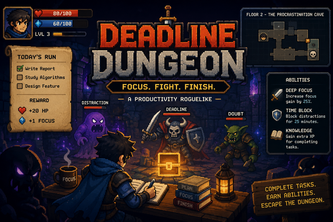
Deadline Dungeon is a self-reported productivity tool that frames focused work as a roguelike game. The author states it turns tasks into quests, uses dungeon rooms for focus sessions, and rewards progress with XP, achievements, and progression. It is built as a responsive web application using HTML, CSS, JavaScript, and a lightweight Python backend.
What changed
The project was submitted to the OpenAI 2026 hackathon. The description reflects an early-stage prototype built in a short timeframe (a hackathon), with no evidence of prior traction or commercial deployment.
Single most important open question
Is there any evidence that users actually engage with the tool beyond its initial development, or that it has been tested in real-world productivity settings?
What The Product Actually Is
The description states:
- Deadline Dungeon is a web-based application designed to make focused work feel like a roguelike game.
- It allows users to choose tasks, set focus durations, and enter dungeon rooms to complete them.
- Upon task completion, users earn XP, energy, achievements, and progress through the dungeon.
- The app includes a dungeon hub, quest log, focus timer, reward sequences, player levels, abilities, achievements, weekly statistics, and an interactive map showing cleared and locked rooms.
Evidence
- Built with HTML5, CSS3, JavaScript, and Python backend.
- Uses browser local storage as fallback for offline functionality.
- Focuses on a dark-fantasy visual system with minimal distractions.
- Implements a lightweight API using GET /api/state and POST /api/state endpoints.
Inference The product appears to be a prototype or MVP built during a hackathon, not a production-ready SaaS offering.
Positioning & Claim Evolution
The description states:
- The tool is inspired by roguelike games to make productivity feel rewarding.
- It aims to reduce the monotony of task lists and increase momentum through game-like progression.
- It positions itself as a way to "turn focused work into something that feels engaging rather than like another item on an endless to-do list."
Claims
- The app is designed to make productivity feel more engaging.
- It balances gamification with genuine utility.
- It rewards task completion, not just time spent in the app.
Inference The positioning is a response to perceived shortcomings in traditional productivity tools — namely, lack of reward or engagement. However, no evidence exists that this approach has been validated by users or market testing.
Target Customer & ICP
The description states:
- The tool targets individuals looking for ways to build consistent focus habits.
- It is aimed at people who find traditional task managers unengaging or demotivating.
Claims
- Users are those who want to "build consistent focus habits" and "make the journey feel rewarding."
- It is designed for people who struggle with motivation or distraction during focused work sessions.
Inference The ICP appears to be self-motivated individuals or professionals seeking productivity improvements, but no evidence of user personas, segmentation, or customer interviews exists.
Business Model & Pricing Evidence
The description states:
- No pricing information is provided.
- The tool is described as a web application with no mention of monetization strategies.
- It uses local storage and a simple Python backend, suggesting minimal infrastructure costs.
Evidence
- No revenue model, subscriptions, or pricing tiers are mentioned.
- The app is built using open-source tools and standard library components.
Inference There is no evidence of any business model or monetization strategy. The tool appears to be a prototype with no commercial intent at this stage.
Technical & Delivery Signals
The description states:
- Built as a responsive web application.
- Uses semantic HTML, modern CSS, and vanilla JavaScript.
- Includes a lightweight Python backend for state persistence.
- Implements browser local storage for offline functionality.
- Focuses on mobile-first design and minimal visual noise.
Evidence
- Technologies include HTML5, CSS3, JavaScript, Python (standard library), JSON, and local storage.
- The app is described as “responsive” and “mobile-first.”
- Uses GET/POST endpoints for API state management.
Inference The technical stack suggests a lightweight prototype built quickly, likely for a hackathon. No evidence of scalability, performance testing, or enterprise-grade infrastructure is provided.
Traction & Maturity Signals
The description states:
- The project was submitted to the OpenAI 2026 hackathon.
- It includes an end-to-end gameplay loop and user progression features.
- The team built a complete prototype in a short time.
Evidence
- No revenue, users, or adoption data are provided.
- No customer testimonials, usage metrics, or product analytics are mentioned.
- The project is described as a hackathon submission.
Inference No evidence of traction, user engagement, or market validation exists. The tool is in an early prototype phase with no commercial deployment.
Competitive Context
The description states:
- It is inspired by roguelike games and productivity tools.
- It aims to improve upon traditional task managers by adding gamification elements.
Claims
- It competes with traditional task managers and productivity apps.
- It differentiates itself through gamified progression and focus mechanics.
Inference No evidence of competitive analysis, market positioning, or comparison to existing tools is provided. The project does not appear to have a defined competitive landscape beyond its own self-description.
Open Questions & Risks
The description states:
- The app balances gamification with utility.
- It avoids over-engineering and keeps the experience focused on productivity.
Open Questions
- No evidence of user testing or feedback.
- No indication of scalability or long-term viability.
- No mention of monetization, partnerships, or go-to-market strategy.
- The tool is described as a hackathon prototype with no commercial intent.
Inference The project lacks any commercial or traction signals. It may be a proof-of-concept rather than a viable product or business.
Questions the description leaves open
- What specific user problems are you solving, and how do you know?
- Have you tested this with real users beyond the hackathon?
- How do you plan to monetize or scale this product?
- What is your roadmap for moving from prototype to a production-ready tool?
- Are there any existing competitors in this space, and how does your solution differ?
Overall Assessment
The description states:
- The project is a hackathon submission.
- It has no evidence of traction, revenue, or commercial deployment.
Assessment Not evidenced. There is no evidence to support any investment or partnership interest in Deadline Dungeon. The tool is described as a prototype with no commercial viability, user engagement, or business model. Any potential value lies in its conceptual innovation, but no data supports that innovation translating into a product or market opportunity.
User Stories BotA demo video on every pull request
Get a demo video on every new feature
GitHub App that watches your pull requests and records a narrated, captioned demo.
Save time on demo prep and make informed decisions faster with a video walkthrough of every new feature.
Source
Submitted to the OpenAI 2026 hackathon on Devpost. Project home on Devpost. Back to the full gallery on Devpost.
This competitive analysis was produced by top-founders.com (opens in a new tab)
Generated by a language model from this project's public Devpost page — its tagline, the author's own write-up and any built-with tags listed there — as captured in August 2026. Short quotations are the author's words. It is an opinion on the idea as a business, not on the people behind it, and it reflects the description as published then. If the project has moved on, request a correction below. The analysis is not independent research and contains no verified traction, revenue or customer data.
An independent guide by KFG International LLC — not affiliated with, endorsed by, or connected to Devpost or OpenAI.