

Archive position — measured, not model output
0 likes on Devpost
2,263 of the 7,850 archived projects have more likes, and 5,587 share exactly 0 — so this project's #3,660 place in the like-ranked listing is a tie-break inside that group, not a ranking.
Projects (log scale)
Likes on Devpost. ▲ marks this project's group.
Show the figures
| Likes | Projects | Share of archive |
|---|---|---|
| 0 | 5,587 | 71.2% |
| 1 | 1,758 | 22.4% |
| 2 | 284 | 3.6% |
| 3–4 | 132 | 1.7% |
| 5–9 | 75 | 1.0% |
| 10+ | 14 | 0.2% |
 User Stories BotA demo video on every pull request
Get a demo video on every new feature
GitHub App that watches your pull requests and records a narrated, captioned demo.
Save time on demo prep and make informed decisions faster with a video walkthrough of every new feature.
Executive Summary
What the company appears to be
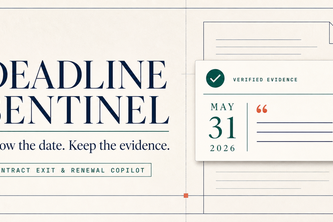
Deadline Sentinel is a self-reported contract deadline analysis tool built as a hackathon submission. It processes English, selectable-text PDFs to identify and calculate renewal or exit deadlines using deterministic logic and verified citations. The system uses AI for fact extraction but separates language understanding from decision-making authority.
What changed
The project was submitted to the OpenAI 2026 hackathon. It is described as a proof-of-concept with synthetic data, no live customer documents, and no persistence of uploaded files.
Single most important open question
Is there evidence of traction, revenue, or real-world usage beyond the demo?
Note: This analysis is based entirely on the self-reported description provided by the author. No external verification, funding rounds, headcount, customers, or performance data are available. The author states that this is a hackathon submission with no private document handling or production deployment.
What The Product Actually Is
The description states that Deadline Sentinel:
- Accepts English, selectable-text PDFs.
- Identifies contract expiration or renewal anchors.
- Finds non-renewal notice periods.
- Attaches every material fact to an exact quotation and page number.
- Verifies citations against text extracted from the PDF.
- Only supports conflict-free calendar-day terms.
- Displays calculated deadlines, supporting evidence, editable notice drafts, and downloadable calendar events.
- Returns "Needs review" when documents contain conflicting terms, business-day language, missing dates, or unverifiable evidence.
It is described as a stateless TypeScript application built with React, vinext, Vite, Tailwind CSS, Zod, unpdf, and the Temporal polyfill. The model used is GPT-5.6 Sol via OpenAI Responses API.
Inference: The system appears to be a narrow, focused tool for contract deadline calculation using AI-assisted fact extraction and deterministic logic. It does not appear to support OCR, scanned documents, or complex business calendars.
Positioning & Claim Evolution
The author states:
- The product was built because generic contract summaries are insufficient.
- The goal is to make evidence as important as output.
- Refusing to answer is considered a successful result when the document is ambiguous.
Claim: The tool aims to increase trust and accuracy in contract deadlines by grounding outputs in verifiable citations.
Inference: This suggests an emphasis on transparency, auditability, and reducing reliance on unverified or conflicting clauses.
Target Customer & ICP
The description does not state a specific customer segment or ideal customer profile (ICP). It implies the tool is for users who need to manage contract renewals or exits, particularly in situations where deadlines are critical.
Not evidenced: No explicit mention of target industries, roles, or use cases beyond general contract management.
Business Model & Pricing Evidence
The description does not provide any information about pricing, monetization, or business model. It is a hackathon submission with no indication of commercial intent or revenue streams.
Not evidenced: No pricing, licensing, or sales strategy described.
Technical & Delivery Signals
The system:
- Is built with React, TypeScript, and various open-source tools.
- Uses GPT-5.6 Sol via OpenAI Responses API for structured fact extraction.
- Treats model output as untrusted; local code validates citations.
- Processes uploaded documents synchronously and does not persist them.
- Includes 58 automated checks covering behavior, API contracts, evidence attacks, date calculation, and acceptance scenarios.
Inference: The architecture is designed to be safe and testable, with clear separation between AI interpretation and decision-making. It avoids persistence and uses strict validation logic.
Traction & Maturity Signals
The project is described as a hackathon submission:
- Uses synthetic contracts in demo mode.
- No private documents or credentials required.
- No live deployment or user base mentioned.
- No evidence of revenue, customers, or adoption beyond the author’s own testing.
Not evidenced: No traction data, user feedback, or production usage.
Competitive Context
The description does not mention any competitors. It is unclear whether similar tools exist in the market for contract deadline analysis or AI-assisted contract parsing.
Not evidenced: No competitive landscape or market positioning described.
Open Questions & Risks
- The tool is a hackathon submission with no production deployment.
- No evidence of real-world use, customers, or revenue.
- Relies heavily on synthetic data and does not support OCR, scanned documents, or business-day calculations.
- The author’s own write-up emphasizes the importance of uncertainty and abstention — suggesting that many inputs may not result in actionable outputs.
Inference: The tool is likely not production-ready and may not scale to real-world contract complexity without significant development.
Questions the description leaves open
- What is the intended use case beyond the demo?
- Are there any plans for handling scanned PDFs or business-day calculations?
- Has the system been tested with real-world contracts, or only synthetic data?
- How does the tool handle edge cases like multi-jurisdictional clauses or complex amendment structures?
- Is there a plan to move beyond the hackathon prototype into a production-ready product?
Overall Assessment
The project is described as a hackathon submission with no evidence of traction, revenue, or real-world adoption. It is a proof-of-concept that demonstrates technical capability in structured AI processing and validation but lacks commercial maturity.
Assessment: Not ready for investment or partnership at this stage. The tool shows potential for further development but requires significant work to become production-ready and scalable.
User Stories BotA demo video on every pull request
Get a demo video on every new feature
GitHub App that watches your pull requests and records a narrated, captioned demo.
Save time on demo prep and make informed decisions faster with a video walkthrough of every new feature.
Source
Submitted to the OpenAI 2026 hackathon on Devpost. Project home on Devpost. Back to the full gallery on Devpost.
This competitive analysis was produced by top-founders.com (opens in a new tab)
Generated by a language model from this project's public Devpost page — its tagline, the author's own write-up and any built-with tags listed there — as captured in August 2026. Short quotations are the author's words. It is an opinion on the idea as a business, not on the people behind it, and it reflects the description as published then. If the project has moved on, request a correction below. The analysis is not independent research and contains no verified traction, revenue or customer data.
An independent guide by KFG International LLC — not affiliated with, endorsed by, or connected to Devpost or OpenAI.