

Archive position — measured, not model output
0 likes on Devpost
2,263 of the 7,850 archived projects have more likes, and 5,587 share exactly 0 — so this project's #3,579 place in the like-ranked listing is a tie-break inside that group, not a ranking.
Projects (log scale)
Likes on Devpost. ▲ marks this project's group.
Show the figures
| Likes | Projects | Share of archive |
|---|---|---|
| 0 | 5,587 | 71.2% |
| 1 | 1,758 | 22.4% |
| 2 | 284 | 3.6% |
| 3–4 | 132 | 1.7% |
| 5–9 | 75 | 1.0% |
| 10+ | 14 | 0.2% |
 User Stories BotA demo video on every pull request
Get a demo video on every new feature
GitHub App that watches your pull requests and records a narrated, captioned demo.
Save time on demo prep and make informed decisions faster with a video walkthrough of every new feature.
Executive Summary
Company: CrossCheck
Self-reported basis: The description is entirely self-reported by the author, unverified, and lacks any independent corroboration.
Commercial due-diligence read: CrossCheck appears to be a prototype platform for consumer pre-screening with lenders, designed to help users understand their fit before formal applications. It is not evidenced to have traction, revenue, customers or adoption. The single most important open question is whether the author can demonstrate a viable path to real lender integration and compliance with financial regulations.
What The Product Actually Is
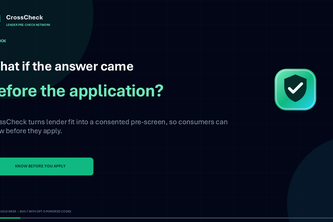
The description states that CrossCheck is a consent-first lender pre-screening platform. It allows consumers to select a lender, authorize specific credit information, and receive a result based on that lender’s own rules — Pre-Qualified, Conditional Review, or Not Pre-Qualified.
It includes:
- A mobile-first user interface
- A dashboard showing sample credit data (FICO score, utilization, inquiries, etc.)
- A section for preparing documents (identity, address, income, employment)
- A lenders marketplace covering credit cards, personal loans, auto loans, and home loans
- A status center that saves each lender check and displays match score, decision, explanation, and next step
The prototype is built using:
- HTML5, CSS, JavaScript, Tailwind
- Node.js, Netlify
- Serverless function (
screenLender.js) for processing lender checks - Simulated lender profiles with thresholds and weighted models
Not evidenced: No real credit bureau or bank integrations; no actual document uploads or encrypted transfers; no production data or live user behavior.
Positioning & Claim Evolution
The author states that CrossCheck was inspired by the idea of reducing uncertainty in credit applications. It is positioned as a platform that allows consumers to pre-check with a chosen lender, rather than relying on generic approval estimates.
Key claims:
- Consumers can ask a selected lender to pre-screen their profile against that lender’s own policies.
- Unlike generic recommendation scores, CrossCheck is designed around lender-specific evaluation and consumer-controlled data sharing.
- It aims to reduce blind applications, uncertainty, and rejection anxiety.
- For lenders, it represents a consent-based acquisition channel.
The author also states that the platform is not just another credit score application but a two-sided infrastructure product that creates value for both consumers and lenders.
Inference: The positioning suggests a potential shift from generic credit tools to a more personalized, lender-specific pre-screening model. However, this is not evidenced in any real-world usage or feedback.
Target Customer & ICP
The description states that CrossCheck targets:
- Consumers who are applying for credit and want to understand their fit with specific lenders before submitting formal applications.
- Lenders who want to acquire qualified, high-intent borrowers through a consent-based channel.
It is implied that the platform is aimed at people seeking credit cards, personal loans, auto loans, or home loans.
The author notes that the prototype includes:
- A sample 740 FICO profile
- A dashboard with credit data (utilization, inquiries, payment history, account age)
- A documents section for identity, address, income, and employment evidence
Not evidenced: No actual customer base, user personas, or segmentation data. The target ICP is inferred from the prototype's structure and the author’s claims.
Business Model & Pricing Evidence
The description states that CrossCheck is not yet monetized, but it outlines a potential business model:
- Lender platform subscriptions
- Qualified customer handoffs
- Privacy-safe market analytics
It also notes that the current version uses simulated lender profiles and does not connect to real banks or credit bureaus.
The author mentions that a future version would require:
- Encrypted document transfer
- Explicit consent records
- Identity verification
- Fair-lending review
- Compliance controls
- Secure lender APIs
Not evidenced: No pricing structure, revenue model, or monetization strategy is described beyond speculative future plans.
Technical & Delivery Signals
The prototype is built as a lightweight Netlify application with:
public/index.htmlfor the responsive interfacenetlify/functions/screenLender.jsfor serverless lender-screening logicnetlify.tomlfor configuration and routing
Key technical elements:
- The serverless function validates FICO score, credit utilization, product category, and selected lender.
- It contains 12 illustrative lender profiles across four credit categories.
- Each lender profile has different score thresholds, utilization ranges, and adjustments.
- A weighted model is used to calculate match scores:
M = 0.68F + 0.32U + A - P
- Responses are marked as non-cacheable and saved only in the consumer’s browser.
The author notes:
- Demo files are stored locally, not uploaded
- The frontend-to-function request flow was debugged
- The prototype uses ChatGPT and Codex for interface design and function development
Not evidenced: No production-grade infrastructure, no real-time data handling, no integration with credit bureaus or financial institutions.
Traction & Maturity Signals
The description states that CrossCheck is a prototype, not a live product. It includes:
- A complete mobile-first journey
- Demo sign-in and guest access
- Sample credit data and document preparation
- Simulated lender checks
It also notes:
- The prototype does not connect to real banks or credit bureaus
- No actual document uploads or encrypted transfers
- No production user data or live metrics
Not evidenced: No evidence of traction, revenue, customer adoption, or product-market fit.
Competitive Context
The author states that existing platforms generally provide approval estimates based on broad historical data, but CrossCheck is different in that it allows consumers to ask a selected lender to pre-screen their profile against that lender’s own policies.
It is positioned as a consent-first, lender-specific pre-screening tool, not a generic credit score application.
The author also notes:
- The platform aims to reduce blind applications and rejection anxiety
- It offers a two-sided infrastructure product for both consumers and lenders
Not evidenced: No competitive analysis or market positioning data. No evidence of existing competitors or market share.
Open Questions & Risks
Key risks and open questions based on the description:
- No real lender integration: The prototype uses simulated profiles, not actual banks.
- Privacy and compliance concerns: The platform would need to handle sensitive financial data with strict regulatory compliance (e.g., fair lending laws, data protection).
- Technical limitations: No encrypted document transfer or secure API integrations in the prototype.
- Unclear monetization path: No evidence of a working business model or revenue streams.
- User trust and clarity: The author notes that one challenge was communicating the difference between an estimated match and guaranteed approval — this could lead to user confusion or legal issues.
Inference: Without real lender partnerships, compliance, or production data, CrossCheck is at high risk of failing to scale or meet regulatory requirements.
Questions the description leaves open
- What are the specific steps you’ve taken toward integrating with actual lenders?
- How do you plan to ensure compliance with financial regulations (e.g., fair lending laws, data privacy)?
- Have you validated your value proposition with real consumers or lenders?
- What is your path to production, and what technical hurdles remain?
- How do you plan to monetize the platform beyond subscriptions?
- What are the key assumptions in your business model that could fail?
Overall Assessment
Not evidenced: No financials, no customer data, no traction, no revenue or valuation.
The description is entirely self-reported and unverified. CrossCheck is a prototype with no evidence of real-world adoption, revenue, or integration with actual lenders or credit bureaus.
It is positioned as a conceptual platform for consumer pre-screening that could evolve into a two-sided product for consumers and lenders.
Confidence level: Low — based on the lack of any verifiable data, traction, or customer evidence. The author’s claims are speculative and not substantiated by real-world performance or outcomes.
User Stories BotA demo video on every pull request
Get a demo video on every new feature
GitHub App that watches your pull requests and records a narrated, captioned demo.
Save time on demo prep and make informed decisions faster with a video walkthrough of every new feature.
Source
Submitted to the OpenAI 2026 hackathon on Devpost. Project home on Devpost. Back to the full gallery on Devpost.
This competitive analysis was produced by top-founders.com (opens in a new tab)
Generated by a language model from this project's public Devpost page — its tagline, the author's own write-up and any built-with tags listed there — as captured in August 2026. Short quotations are the author's words. It is an opinion on the idea as a business, not on the people behind it, and it reflects the description as published then. If the project has moved on, request a correction below. The analysis is not independent research and contains no verified traction, revenue or customer data.
An independent guide by KFG International LLC — not affiliated with, endorsed by, or connected to Devpost or OpenAI.