

Archive position — measured, not model output
0 likes on Devpost
2,263 of the 7,850 archived projects have more likes, and 5,587 share exactly 0 — so this project's #3,578 place in the like-ranked listing is a tie-break inside that group, not a ranking.
Projects (log scale)
Likes on Devpost. ▲ marks this project's group.
Show the figures
| Likes | Projects | Share of archive |
|---|---|---|
| 0 | 5,587 | 71.2% |
| 1 | 1,758 | 22.4% |
| 2 | 284 | 3.6% |
| 3–4 | 132 | 1.7% |
| 5–9 | 75 | 1.0% |
| 10+ | 14 | 0.2% |
 User Stories BotA demo video on every pull request
Get a demo video on every new feature
GitHub App that watches your pull requests and records a narrated, captioned demo.
Save time on demo prep and make informed decisions faster with a video walkthrough of every new feature.
Executive Summary
What the company appears to be
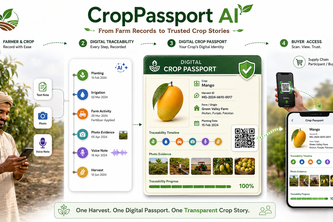
CropPassport AI is a self-reported digital platform for agricultural traceability, built as an MVP for the OpenAI 2026 hackathon. It allows farmers to document crop lifecycle activities using text, photos, and voice notes, which are then transformed into a shareable "Digital Crop Passport" accessible via QR code. The system integrates AI (via LLMs) to structure unstructured data and generate summaries.
What changed
The project was submitted as a hackathon entry, indicating it is in early development with no commercial traction or revenue evidence. It does not appear to have moved beyond the MVP stage.
Single most important open question
Is there any evidence of real-world adoption or pilot use by farmers or buyers? The description states that CropPassport AI is an MVP and lacks any indication of customer engagement, sales, or market validation.
What The Product Actually Is
The description states that CropPassport AI is a farmer-friendly digital crop traceability platform. It enables farmers to:
- Record basic crop information (crop type, planting date, harvest date)
- Add ongoing farming activities using text, photos, and voice notes
- Generate a Digital Crop Passport containing:
- Crop identity
- Farm origin
- Cultivation details
- Timeline of activities
- Photo and voice evidence
- Traceability completeness score
- AI-generated summary
The platform is designed for two user roles:
- Farmer: to document crop lifecycle
- Buyer: to access a read-only version of the passport via QR code
Technical implementation includes:
- Frontend built with HTML, CSS, JavaScript
- Browser storage for local data
- Supabase for publishing data across devices
- OpenRouter for LLM-powered analysis and summaries
- QR code generation
- Vercel deployment
Not evidenced: No mention of pricing, monetization, or customer base.
Positioning & Claim Evolution
The description states that CropPassport AI was inspired by the lack of digital documentation in small-scale farming in Pakistan. The core claim is:
“What if every crop could have its own digital passport?”
This positions the product as a simple, accessible tool for traceability, aimed at farmers with limited technical knowledge.
It also claims to:
- Turn simple farm records into structured data
- Use AI to help organize and summarize farming notes
- Enable buyers to see the documented journey of crops
Inference: The positioning suggests an intent to democratize agricultural traceability, but no evidence exists that this has been tested or validated in real-world settings.
Target Customer & ICP
The description states:
- Primary user: Farmer
- Works in Dera Ghazi Khan, Pakistan
- Likely small-scale, with limited technical knowledge
- Secondary user: Buyer
- Interested in crop origin and cultivation details
Not evidenced:
- No stated customer segments beyond these two roles
- No evidence of buyer engagement or demand
- No indication of geographic scope beyond Pakistan
Business Model & Pricing Evidence
The description does not provide any information on:
- Revenue model
- Pricing structure
- Monetization strategy
- Customer acquisition costs
- Unit economics
Not evidenced: The product is described as an MVP, with no mention of paid features or commercial use.
Technical & Delivery Signals
The project was built using:
- HTML, CSS, JavaScript (frontend)
- Supabase (cloud database)
- OpenRouter (LLM integration)
- Vercel (deployment)
- GitHub (version control)
Not evidenced:
- No mention of scalability or infrastructure robustness
- No indication of data security or privacy features
- No evidence of mobile-first design or offline capabilities
Traction & Maturity Signals
The description states that CropPassport AI is an MVP, built for a hackathon. It was submitted to the OpenAI 2026 hackathon on Devpost.
Not evidenced:
- No customer data, usage metrics, or adoption
- No revenue, ARR, or funding rounds
- No indication of pilot programs or real-world testing
Competitive Context
The description does not mention any competitors. It also does not state whether similar traceability tools exist in the market.
Not evidenced:
- No competitive analysis
- No evidence of existing solutions or market gaps being addressed
Open Questions & Risks
- No commercial traction: The product is described as an MVP, with no evidence of adoption or revenue.
- Unverified claims: All features and benefits are self-reported without independent validation.
- Limited scope: No mention of integration with existing agricultural systems or supply chains.
- Technical limitations: Use of browser storage implies limited cross-device functionality; lack of offline support is a concern for rural users.
- No monetization strategy: No indication of how the product will generate revenue.
Questions the description leaves open
- What is the current status of the MVP? Is it being tested with farmers or buyers?
- Have you conducted any user research or field testing with actual farmers?
- How do you plan to scale beyond a hackathon prototype?
- Are there any partnerships or pilot programs in place with agricultural organizations or buyers?
- What is your long-term vision for monetization and customer acquisition?
- How do you intend to address data privacy, security, and offline access concerns?
- What are the technical limitations of the current architecture, and how will they be addressed?
Overall Assessment
Not evidenced: There is no evidence of commercial traction, revenue, or customer engagement.
The description indicates that CropPassport AI is a hackathon MVP, with no signs of market validation or product-market fit. It is not evident whether the founders have plans to move beyond the prototype stage or how they intend to build a sustainable business.
Confidence level: Low — based entirely on self-reported, unverified information.
User Stories BotA demo video on every pull request
Get a demo video on every new feature
GitHub App that watches your pull requests and records a narrated, captioned demo.
Save time on demo prep and make informed decisions faster with a video walkthrough of every new feature.
Source
Submitted to the OpenAI 2026 hackathon on Devpost. Project home on Devpost. Back to the full gallery on Devpost.
This competitive analysis was produced by top-founders.com (opens in a new tab)
Generated by a language model from this project's public Devpost page — its tagline, the author's own write-up and any built-with tags listed there — as captured in August 2026. Short quotations are the author's words. It is an opinion on the idea as a business, not on the people behind it, and it reflects the description as published then. If the project has moved on, request a correction below. The analysis is not independent research and contains no verified traction, revenue or customer data.
An independent guide by KFG International LLC — not affiliated with, endorsed by, or connected to Devpost or OpenAI.