

Archive position — measured, not model output
0 likes on Devpost
2,263 of the 7,850 archived projects have more likes, and 5,587 share exactly 0 — so this project's #3,571 place in the like-ranked listing is a tie-break inside that group, not a ranking.
Projects (log scale)
Likes on Devpost. ▲ marks this project's group.
Show the figures
| Likes | Projects | Share of archive |
|---|---|---|
| 0 | 5,587 | 71.2% |
| 1 | 1,758 | 22.4% |
| 2 | 284 | 3.6% |
| 3–4 | 132 | 1.7% |
| 5–9 | 75 | 1.0% |
| 10+ | 14 | 0.2% |
 User Stories BotA demo video on every pull request
Get a demo video on every new feature
GitHub App that watches your pull requests and records a narrated, captioned demo.
Save time on demo prep and make informed decisions faster with a video walkthrough of every new feature.
Executive Summary
What the company appears to be
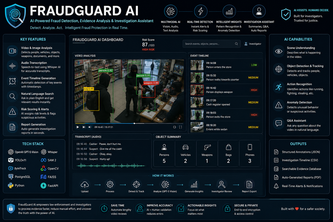
CrimeLensAi is an AI-powered video annotation platform built for large-scale object segmentation, tracking, and dataset generation using Segment Anything Model 2 (SAM2). The project is self-reported as a tool for investigators reviewing CCTV, bodycam, and drone footage, with features including automatic captioning, temporal tracking, and COCO JSON export. It supports parallel GPU processing and batch video workflows.
What changed
The author states this is a hackathon submission to the OpenAI 2026 hackathon. No prior version or evolution of the product is described. The project is presented as a prototype or proof-of-concept, not a commercial offering.
Single most important open question
Is there any evidence that CrimeLensAi has been used in real-world investigations or by law enforcement agencies? The description contains no customer data, usage metrics, or adoption signals beyond the author’s own claims.
What The Product Actually Is
The description states that CrimeLensAi is an AI-powered video annotation platform. It leverages SAM2 for object segmentation and tracking, performs GPU-accelerated parallel processing, and generates COCO JSON annotations for computer vision datasets. It supports batch video processing and includes features such as automatic caption generation using BLIP-2/LLaVA, CLIP-based classification, and visualization dashboards.
The system is described as designed for researchers and developers to build datasets for object detection, segmentation, tracking, and multimodal AI applications.
Inference The product appears to be a developer tool or internal platform for building AI datasets rather than an end-user application for law enforcement or investigators. It is not clear whether it has been deployed in production environments.
Positioning & Claim Evolution
The description states that CrimeLensAi is intended to help investigators spend less time reviewing footage by automating event identification, timestamp generation, and summarization of video content. The tagline reinforces this positioning: “Investigators spend hours reviewing CCTV, bodycam, and drone footage. An AI assistant can automatically identify key events, generate timestamps, and summarize footage to speed up evidence review.”
However, the project is described as a hackathon submission with no mention of prior versions or commercial development. It is not clear whether the product has evolved from an idea into a market-ready solution.
Inference The positioning is based on self-reported use cases (e.g., law enforcement) but lacks evidence of actual deployment or adoption in those contexts.
Target Customer & ICP
The description states that CrimeLensAi is intended for investigators reviewing CCTV, bodycam, and drone footage. It also mentions applications in autonomous driving, smart surveillance, retail analytics, and wildlife monitoring.
However, there is no evidence of a defined customer persona or ideal customer profile (ICP). No specific buyer personas, use cases, or target industries beyond general AI development are detailed.
Inference The product may be aimed at both law enforcement and developers working in computer vision. However, the lack of customer data or segmentation makes it difficult to assess whether a clear ICP exists.
Business Model & Pricing Evidence
There is no evidence of any pricing model, monetization strategy, or business model described in the project write-up. The description does not mention subscriptions, licensing fees, usage-based billing, or any commercial arrangements.
Inference No business model is evident from the self-reported content. It appears to be a prototype or open-source tool without a defined revenue path.
Technical & Delivery Signals
The project is built with PyTorch, SAM2, BLIP-2/LLaVA, OpenCV, FFmpeg, FastAPI, React, CUDA, and distributed computing frameworks like Ray and Torch Distributed. It supports multi-GPU inference, parallel processing, and batch workflows.
It includes a backend architecture with frame extraction, segmentation, tracking, captioning, classification, and COCO JSON export. The system is described as supporting real-time streaming support and WebSocket-based live annotation in future enhancements.
Inference The technical stack suggests a strong foundation for AI-driven video processing. However, the lack of deployment details or production readiness signals limits confidence in its delivery capability.
Traction & Maturity Signals
There is no evidence of traction, revenue, customer adoption, or usage metrics. The project is described as a hackathon submission and lacks any data on user engagement, performance benchmarks, or product maturity beyond the author's own account.
Inference No signs of traction or market validation are evident. The project appears to be in early development or prototype stage.
Competitive Context
The description does not mention competitors or a competitive landscape. It is unclear whether CrimeLensAi competes with other video annotation tools, AI-powered surveillance platforms, or dataset generation systems.
Inference No competitive positioning or market differentiation is described. The project’s place in the broader ecosystem is unknown.
Open Questions & Risks
- No commercial traction or adoption: The project is a hackathon submission with no evidence of real-world usage.
- Unclear business model: No pricing, monetization, or revenue strategy is evident.
- Unverified claims: All descriptions are self-reported and unverified; no third-party validation exists.
- Limited customer insight: No target customer data or use case details beyond general AI applications.
- Prototype nature: The system appears to be a proof-of-concept rather than a production-ready tool.
Questions the description leaves open
- What is the intended commercial path for CrimeLensAi? Is it meant for law enforcement, developers, or both?
- Has the platform been tested in real-world scenarios or with actual users from target industries?
- Are there any partnerships or pilot programs with law enforcement agencies or surveillance vendors?
- How does CrimeLensAi plan to scale beyond a prototype or hackathon submission?
- What are the technical limitations of the current system, and how do they intend to address them?
Overall Assessment
Not evidenced.
The project is described as a hackathon submission with no evidence of traction, revenue, customers, or commercial viability. The description lacks any data on product-market fit, user feedback, or business development.
Confidence Low. This is a self-reported prototype with no external validation or market signals. Any potential investment or partnership value would depend on further development and demonstration of real-world utility.
User Stories BotA demo video on every pull request
Get a demo video on every new feature
GitHub App that watches your pull requests and records a narrated, captioned demo.
Save time on demo prep and make informed decisions faster with a video walkthrough of every new feature.
Source
Submitted to the OpenAI 2026 hackathon on Devpost. Project home on Devpost. Back to the full gallery on Devpost.
This competitive analysis was produced by top-founders.com (opens in a new tab)
Generated by a language model from this project's public Devpost page — its tagline, the author's own write-up and any built-with tags listed there — as captured in August 2026. Short quotations are the author's words. It is an opinion on the idea as a business, not on the people behind it, and it reflects the description as published then. If the project has moved on, request a correction below. The analysis is not independent research and contains no verified traction, revenue or customer data.
An independent guide by KFG International LLC — not affiliated with, endorsed by, or connected to Devpost or OpenAI.