

Archive position — measured, not model output
0 likes on Devpost
2,263 of the 7,850 archived projects have more likes, and 5,587 share exactly 0 — so this project's #3,572 place in the like-ranked listing is a tie-break inside that group, not a ranking.
Projects (log scale)
Likes on Devpost. ▲ marks this project's group.
Show the figures
| Likes | Projects | Share of archive |
|---|---|---|
| 0 | 5,587 | 71.2% |
| 1 | 1,758 | 22.4% |
| 2 | 284 | 3.6% |
| 3–4 | 132 | 1.7% |
| 5–9 | 75 | 1.0% |
| 10+ | 14 | 0.2% |
 User Stories BotA demo video on every pull request
Get a demo video on every new feature
GitHub App that watches your pull requests and records a narrated, captioned demo.
Save time on demo prep and make informed decisions faster with a video walkthrough of every new feature.
Executive Summary
Company: CrisisLoop Clinical
Self-reported basis: The entire analysis is based on a single project description submitted by the author to the OpenAI 2026 hackathon on Devpost. No external verification, revenue, customer data or traction evidence is available.
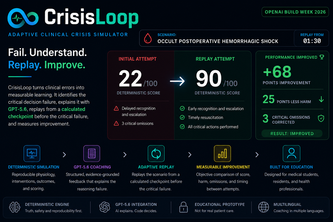
What it appears to be: A browser-based clinical crisis simulator that enables learners to fail, understand, replay, and improve on critical decisions in a deterministic educational environment. It uses a combination of deterministic simulation logic and GPT-5.6 for coaching feedback.
What changed: The project description indicates this is a prototype built for a hackathon with an MVP deployed publicly. It includes a functional demonstration of how a learner can improve from 22/100 to 90/100 in a simulated clinical scenario, using structured output from GPT-5.6 and replay mechanics.
Single most important open question: Is there evidence that this educational tool has been validated or adopted beyond the hackathon context, and does it have any commercial traction or path to monetization?
What The Product Actually Is
The description states that CrisisLoop Clinical is an adaptive clinical crisis simulator. It presents learners with a scenario (e.g., occult postoperative hemorrhage) and allows them to interact with it through time progression, interventions, and observation.
Key technical components include:
- A deterministic engine controlling physiological progression, scoring, harm, and critical failure detection.
- Integration of GPT-5.6 for generating educational coaching based on verified performance data.
- A replay mechanism that reconstructs a scenario from a pre-failure checkpoint to allow learners to retry decisions.
- Structured comparison between initial and improved attempts across score, harm, omissions, and timing.
The system separates simulation truth from AI explanation:
- The deterministic engine controls all clinical outcomes.
- GPT-5.6 only receives verified data and generates explanations; it cannot alter simulation results.
Inference: This is a browser-based educational tool designed for clinical training, not a real-time or live patient care system.
Positioning & Claim Evolution
The author states that CrisisLoop Clinical was inspired by the question:
“What if a clinical error could become an immediate, measurable learning loop?”
It positions itself as:
- An educational platform that turns clinical errors into structured learning opportunities.
- A tool that supports the cycle of Fail → Understand → Replay → Improve.
- A system where AI feedback is grounded in deterministic simulation data.
The project claims to have demonstrated measurable improvement (from 22/100 to 90/100) using its own framework, and it emphasizes:
- Deterministic control over clinical outcomes
- Structured AI coaching
- Replay and comparison mechanics
Inference: The positioning is focused on clinical education, not commercial healthcare delivery or decision support.
Target Customer & ICP
The description does not explicitly define a target customer or ideal customer profile (ICP). However, it implies:
- Use cases are for clinical learners in educational settings.
- It may be relevant to medical schools, residency programs, or simulation centers.
- The tool is built for educational simulation, not real-world clinical use.
Inference: The ICP likely includes medical educators, trainees, and institutions seeking structured, repeatable clinical learning tools.
Business Model & Pricing Evidence
There is no evidence in the description of a business model or pricing structure. The project is presented as a hackathon prototype, not a commercial product.
Not evidenced: No mention of monetization, licensing, subscriptions, or customer acquisition strategies.
Technical & Delivery Signals
The system is built with:
- Frontend: React, TypeScript, Vite
- Backend: Python, FastAPI, Pydantic, OpenAI API
- Deployment: Frontend on Vercel, backend on Render
- Testing: 44 backend and API tests passing after Codex audit
- AI Integration: GPT-5.6 used for structured coaching only; not allowed to modify simulation data
The architecture is described as:
- Separating deterministic logic from AI explanation
- Using Codex for production-readiness audit, including test improvements and documentation fixes
Inference: The technical stack suggests a functional MVP with clear separation of concerns. It was deployed publicly and tested in a production-like environment.
Traction & Maturity Signals
The description states:
- A publicly available MVP
- Demonstrated improvement from 22/100 to 90/100
- 44 passing automated tests after Codex audit
- Successful deployment on Vercel and Render
- No actionable regressions identified post-audit
Not evidenced: No data on:
- Number of users or learners
- Adoption rate
- Customer feedback or retention
- Real-world usage beyond the hackathon
- Institutional partnerships or pilot programs
Competitive Context
The description does not mention competitors. However, it implies a niche in clinical simulation and educational AI.
Inference: The space includes:
- Traditional clinical simulators (e.g., mannequin-based systems)
- Virtual reality or digital simulation platforms
- AI-powered coaching tools for medical education
CrisisLoop Clinical distinguishes itself by:
- Combining deterministic simulation with grounded AI feedback
- Enabling replay and quantified improvement
- Using a structured, non-modifiable AI interface
Open Questions & Risks
Risk 1: The system is described as a hackathon prototype, not a commercial product.
Risk 2: No evidence of real-world adoption or validation beyond the demo.
Risk 3: GPT-5.6 is used for coaching only; no indication of how it scales or integrates into broader systems.
Risk 4: The tool is explicitly stated to be not a medical device, which may limit its commercial viability in regulated environments.
Open Question: No evidence of any revenue model, customer base, or institutional use beyond the prototype.
Questions the description leaves open
- What is the intended path from this prototype to a commercial product?
- Has the improvement demonstration (22/100 → 90/100) been validated in a controlled educational setting?
- Are there any partnerships with medical institutions or educators currently in place?
- How does the system plan to scale beyond a single scenario and learner?
- What are the legal and regulatory considerations for using AI in clinical education?
- Is there a plan to monetize this tool, and if so, how?
Overall Assessment
Not evidenced: No information on funding, valuation, or commercial traction.
Inference: This is an early-stage prototype with a clear educational use case. It shows technical capability and a functional demo but lacks evidence of market adoption, scalability, or monetization strategy.
Confidence level: Low — based entirely on self-reported project description, no external validation or data.
User Stories BotA demo video on every pull request
Get a demo video on every new feature
GitHub App that watches your pull requests and records a narrated, captioned demo.
Save time on demo prep and make informed decisions faster with a video walkthrough of every new feature.
Source
Submitted to the OpenAI 2026 hackathon on Devpost. Project home on Devpost. Back to the full gallery on Devpost.
This competitive analysis was produced by top-founders.com (opens in a new tab)
Generated by a language model from this project's public Devpost page — its tagline, the author's own write-up and any built-with tags listed there — as captured in August 2026. Short quotations are the author's words. It is an opinion on the idea as a business, not on the people behind it, and it reflects the description as published then. If the project has moved on, request a correction below. The analysis is not independent research and contains no verified traction, revenue or customer data.
An independent guide by KFG International LLC — not affiliated with, endorsed by, or connected to Devpost or OpenAI.