

Archive position — measured, not model output
0 likes on Devpost
2,263 of the 7,850 archived projects have more likes, and 5,587 share exactly 0 — so this project's #5,535 place in the like-ranked listing is a tie-break inside that group, not a ranking.
Projects (log scale)
Likes on Devpost. ▲ marks this project's group.
Show the figures
| Likes | Projects | Share of archive |
|---|---|---|
| 0 | 5,587 | 71.2% |
| 1 | 1,758 | 22.4% |
| 2 | 284 | 3.6% |
| 3–4 | 132 | 1.7% |
| 5–9 | 75 | 1.0% |
| 10+ | 14 | 0.2% |
 User Stories BotA demo video on every pull request
Get a demo video on every new feature
GitHub App that watches your pull requests and records a narrated, captioned demo.
Save time on demo prep and make informed decisions faster with a video walkthrough of every new feature.
Executive Summary
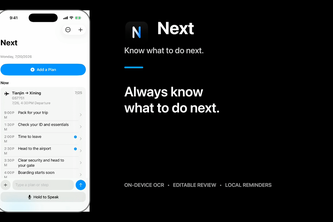
What the company appears to be: Next is a self-reported iOS app that processes travel-related inputs (screenshots, voice, manual entry) into an editable timeline of actions with local reminders. It claims to automate the translation of travel information into actionable steps without requiring an account or backend services.
What changed: The project description represents a self-reported development effort submitted for the OpenAI 2026 hackathon. No evidence suggests prior commercial activity, funding, or customer traction beyond its submission context.
Single most important open question: Is there any evidence of actual user adoption, revenue, or product-market fit beyond the author’s own account?
Analysis basis: This report is based solely on the self-reported project description provided by the caller. No external verification, archived data, or third-party sources are available. All statements reflect claims made in the description and should be treated as such.
What The Product Actually Is
- The description states that Next is a native iOS app for iOS 18 and later.
- It accepts three forms of input: travel screenshots, spoken sentences (via Apple’s Speech framework), and manually entered plan details.
- The app uses Vision OCR to extract text from screenshots; users can correct this extracted text before it is parsed into structured data.
- A parser identifies flight, train, hotel, or general plan details, which are then converted into preparation steps such as packing, leaving home, arriving at the airport, boarding, checking in, and checking out.
- These steps remain editable and are stored locally using SwiftData.
- Local notifications are scheduled via UserNotifications to remind users of upcoming actions.
- The app has no account system, backend, or runtime API calls to OpenAI or other third parties.
Inference: Based on the description, Next appears to be a privacy-focused, on-device-only tool designed for personal travel planning automation. It is not a commercial product but rather a prototype submitted for a hackathon.
Positioning & Claim Evolution
- The author states that traditional task apps require users to manually reconstruct timelines from fragmented information like screenshots and chat messages.
- Next aims to answer the question: “What should I do next?” by automating this process.
- It positions itself as an AI executive assistant for travel, though it does not use external APIs or cloud services at runtime.
- The app emphasizes local processing, user control, and editable outputs throughout its workflow.
Inference: The positioning is framed around convenience and privacy, leveraging on-device capabilities to avoid data leakage or reliance on third-party systems. However, the claim of being an “AI executive assistant” lacks evidence of advanced AI behavior beyond OCR and parsing logic.
Target Customer & ICP
- Not evidenced.
Finding: No explicit identification of target customer segments, personas, or ideal customer profiles (ICPs) is provided in the description.
Business Model & Pricing Evidence
- The description does not mention any pricing model, monetization strategy, or business model.
- There is no indication of whether Next will be sold, offered as freemium, or supported through advertising.
- No evidence of revenue streams, subscriptions, or paid features.
Finding: No evidence of a defined business model or pricing structure.
Technical & Delivery Signals
- Built with Swift, SwiftUI, Vision, Speech, SwiftData, UserNotifications, and XCTest.
- Uses a modular pipeline: Input → OCR/transcript → editable source text → TravelParser → editable draft → ReminderStepGenerator → local notifications.
- All processing happens locally; no backend or cloud dependencies.
- The app supports multiple input types (screenshot, speech, manual) across various travel contexts (flights, trains, hotels).
- Has 112 passing automated tests.
- Future plans include Siri support, App Intents, and Apple Watch integration.
Inference: Technical architecture shows a focus on native iOS development with strong emphasis on local processing and test coverage. The modular design suggests maintainability and extensibility.
Traction & Maturity Signals
- Not evidenced.
Finding: No evidence of user adoption, customer base, usage metrics, or product maturity beyond the hackathon submission.
Competitive Context
- Not evidenced.
Finding: No mention of competitors or competitive landscape within the travel planning or task management space.
Open Questions & Risks
- The app is described as a hackathon project with no prior commercial activity.
- It lacks any form of monetization, customer data, or revenue model.
- There is no evidence of product-market fit or user feedback beyond internal testing.
- The use of GPT-5.6 and Codex during development indicates tooling support but not real-world traction.
- The app does not appear to have a path to scale beyond its current prototype state.
Inference: The lack of commercial activity, revenue, or customer engagement raises concerns about viability as a product or business opportunity.
Questions the description leaves open
- What is the actual user feedback from beta testers or early adopters?
- How does Next differentiate itself from existing travel planning tools (e.g., TripIt, Google Trips)?
- Are there any plans to expand beyond iOS or add cloud syncing capabilities?
- Has the team considered how to monetize this tool if it were to become a commercial product?
- What are the technical limitations of the current OCR and parsing pipeline that might affect accuracy at scale?
Overall Assessment
- Not evidenced.
Finding: No evidence of any investment interest, partnership discussions, or strategic value beyond its hackathon submission. The project is presented as a prototype with no commercial traction or clear path to monetization.
User Stories BotA demo video on every pull request
Get a demo video on every new feature
GitHub App that watches your pull requests and records a narrated, captioned demo.
Save time on demo prep and make informed decisions faster with a video walkthrough of every new feature.
Source
Submitted to the OpenAI 2026 hackathon on Devpost. Project home on Devpost. Back to the full gallery on Devpost.
This competitive analysis was produced by top-founders.com (opens in a new tab)
Generated by a language model from this project's public Devpost page — its tagline, the author's own write-up and any built-with tags listed there — as captured in August 2026. Short quotations are the author's words. It is an opinion on the idea as a business, not on the people behind it, and it reflects the description as published then. If the project has moved on, request a correction below. The analysis is not independent research and contains no verified traction, revenue or customer data.
An independent guide by KFG International LLC — not affiliated with, endorsed by, or connected to Devpost or OpenAI.