

Archive position — measured, not model output
0 likes on Devpost
2,263 of the 7,850 archived projects have more likes, and 5,587 share exactly 0 — so this project's #3,573 place in the like-ranked listing is a tie-break inside that group, not a ranking.
Projects (log scale)
Likes on Devpost. ▲ marks this project's group.
Show the figures
| Likes | Projects | Share of archive |
|---|---|---|
| 0 | 5,587 | 71.2% |
| 1 | 1,758 | 22.4% |
| 2 | 284 | 3.6% |
| 3–4 | 132 | 1.7% |
| 5–9 | 75 | 1.0% |
| 10+ | 14 | 0.2% |
 User Stories BotA demo video on every pull request
Get a demo video on every new feature
GitHub App that watches your pull requests and records a narrated, captioned demo.
Save time on demo prep and make informed decisions faster with a video walkthrough of every new feature.
Executive Summary
Company: CrisisResponse
Self-reported basis: The analysis is based entirely on the project description provided by the caller — its name, tagline, the author's own write-up, and technology stack. No external verification or historical data are available.
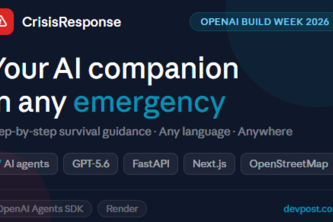
What it appears to be: A self-reported AI-powered emergency response system designed to guide people through life-threatening situations in real time, using multi-agent architecture and GPT-5.6. It claims to support multiple languages, image input, and global emergency service integration.
What changed: The project was submitted as part of the OpenAI 2026 hackathon. No prior version or evolution is described; this is a new build.
Single most important open question: Is there any evidence that CrisisResponse has been tested in real-world emergencies or has any users beyond its creators?
What The Product Actually Is
The description states that CrisisResponse is an intelligent multi-agent AI system that provides real-time, step-by-step guidance during life-threatening emergencies, including:
- Emergency type and severity assessment
- Nearest emergency services (via OpenStreetMap)
- Country-specific contact numbers
- Medically accurate survival instructions
- Voice and SMS alert capabilities (future)
It uses five specialized AI agents powered by GPT-5.6 and GPT-4o Vision, orchestrated via the OpenAI Agents SDK, deployed using FastAPI, Next.js, and Render.
The system is described as:
- Capable of handling any language
- Supporting image uploads for better situational understanding
- Providing real-time updates based on evolving conditions
- Deployed live and accessible
Inference: The product is a proof-of-concept or prototype built in a hackathon environment. It is not evidenced to have any production users, revenue, or actual deployment beyond the developers' own testing.
Positioning & Claim Evolution
The description states that CrisisResponse was built because:
“People die not because help was unavailable but because they did not know what to do in the critical first minutes.”
This positions the product as a life-saving tool for vulnerable moments, emphasizing AI accessibility, real-time response, and global reach.
It claims to be:
- An AI-powered emergency assistant
- Capable of step-by-step guidance
- Supporting multiple languages
- Using GPT-5.6
- Integrating computer vision
There is no indication that the product has evolved from an earlier version or that it was previously marketed or used in any capacity.
Inference: The positioning is aspirational and focused on humanitarian impact, but lacks evidence of prior traction or market validation.
Target Customer & ICP
The description does not define a specific customer segment or ideal customer profile (ICP). It implies the system is for:
- Anyone facing a life-threatening emergency
- Users who are not necessarily tech-savvy, given its real-time, step-by-step nature
- People in any country, with support for local emergency numbers
It does not describe:
- Specific demographics
- Geographic focus
- Use cases beyond general emergencies
- Target user personas or buyer profiles
Inference: The target is broad and undefined. It is unclear whether the team has identified a specific user group or market segment.
Business Model & Pricing Evidence
The description does not mention any business model, pricing strategy, monetization plan, or revenue streams.
It does not state:
- Whether the system will be offered for free
- If there are paid tiers or subscriptions
- If it is intended for public use, enterprise, or humanitarian organizations
- Any commercial partnerships or licensing plans
Inference: No evidence of a business model exists in the description. The project appears to be a prototype with no commercialization strategy described.
Technical & Delivery Signals
The system is built using:
- AI agents powered by GPT-5.6 and GPT-4o Vision
- OpenAI Agents SDK
- FastAPI, Next.js, Tailwind, Python, TypeScript
- OpenStreetMap for location services
- Deployed on Render
The team claims to have:
- Integrated computer vision with text input
- Built a multi-agent pipeline that passes state correctly
- Implemented predictive guidance and escalation warnings
- Achieved real-time response in seconds
It is described as:
- Live and deployed
- Accessible right now
Inference: The technical architecture is described in detail, but there is no evidence of performance metrics, scalability, or production-level reliability.
Traction & Maturity Signals
The description states that the system is:
- Live and accessible
- Deployed during a hackathon
- Built and deployed under time pressure
It does not mention:
- Any users or usage data
- Customer feedback or testing
- Product iterations or improvements
- Any form of validation beyond internal development
Inference: The system is at the prototype stage. There is no evidence of traction, adoption, or user engagement.
Competitive Context
The description does not reference any competitors or existing solutions in the emergency response space.
It does not state:
- Whether similar tools exist
- How CrisisResponse differs from them
- If it targets a specific niche within emergency tech
Inference: No competitive context is provided. The team may be unaware of existing solutions, or the description omits this information.
Open Questions & Risks
- No evidence of real-world testing or deployment beyond the hackathon
- No revenue, customers, or traction data
- Unverified claims about AI accuracy and reliability
- No business model or monetization strategy
- No indication of regulatory compliance or safety validation
- No mention of partnerships or institutional support
- Self-reported technical capabilities without independent verification
Inference: The project is a prototype with no commercial or operational maturity. Risks include unproven AI reliability, lack of user feedback, and unclear path to market.
Questions the description leaves open
- Has the system been tested in any real emergency scenarios?
- What are the actual accuracy rates of the AI agents in identifying emergencies and providing guidance?
- How does the system handle edge cases or ambiguous inputs (e.g., unclear images, multiple emergencies)?
- Are there any plans to validate medical accuracy with healthcare professionals?
- What is the intended business model for CrisisResponse?
- Has the team considered regulatory or legal implications of deploying AI in emergency response?
- How does the system ensure data privacy and security for users?
- What are the scalability limitations of the current architecture?
Overall Assessment
Not evidenced.
The description provides no evidence of:
- Revenue
- Customers
- Traction
- Market validation
- Product-market fit
- Business model
- Commercial viability
It is a self-reported hackathon prototype, not a commercial product or company. The team has built a working system, but there is no indication that it has been validated in real-world use or is ready for investment or partnership.
Inference: This is a pre-product concept with potential humanitarian value, but no evidence of commercial readiness or market traction. It should be considered a proof-of-concept, not an investment opportunity or strategic partner at this stage.
User Stories BotA demo video on every pull request
Get a demo video on every new feature
GitHub App that watches your pull requests and records a narrated, captioned demo.
Save time on demo prep and make informed decisions faster with a video walkthrough of every new feature.
Source
Submitted to the OpenAI 2026 hackathon on Devpost. Project home on Devpost. Back to the full gallery on Devpost.
This competitive analysis was produced by top-founders.com (opens in a new tab)
Generated by a language model from this project's public Devpost page — its tagline, the author's own write-up and any built-with tags listed there — as captured in August 2026. Short quotations are the author's words. It is an opinion on the idea as a business, not on the people behind it, and it reflects the description as published then. If the project has moved on, request a correction below. The analysis is not independent research and contains no verified traction, revenue or customer data.
An independent guide by KFG International LLC — not affiliated with, endorsed by, or connected to Devpost or OpenAI.