

Archive position — measured, not model output
0 likes on Devpost
2,263 of the 7,850 archived projects have more likes, and 5,587 share exactly 0 — so this project's #7,499 place in the like-ranked listing is a tie-break inside that group, not a ranking.
Projects (log scale)
Likes on Devpost. ▲ marks this project's group.
Show the figures
| Likes | Projects | Share of archive |
|---|---|---|
| 0 | 5,587 | 71.2% |
| 1 | 1,758 | 22.4% |
| 2 | 284 | 3.6% |
| 3–4 | 132 | 1.7% |
| 5–9 | 75 | 1.0% |
| 10+ | 14 | 0.2% |
 User Stories BotA demo video on every pull request
Get a demo video on every new feature
GitHub App that watches your pull requests and records a narrated, captioned demo.
Save time on demo prep and make informed decisions faster with a video walkthrough of every new feature.
Executive Summary
VaultXT is a mobile text editor for large TXT files, built as a Flutter application for Android and iOS. The project was submitted to the OpenAI 2026 hackathon by ONNEL LAB, a single-person team. It claims to enable editing of very long documents (multi-line and single-line) without loading entire files into memory, using techniques like virtualization, piece tables, and UTF-8-aware coordinate systems.
The author states that VaultXT is designed to avoid switching users to read-only views when handling large files, and instead maintains a consistent editing experience across file sizes. It uses local-first storage, automatic saving, and atomic file replacement.
Key commercial due-diligence questions include:
- What is the actual product-market fit for this niche?
- Is there any evidence of user demand or adoption beyond the hackathon submission?
- How does the technical approach scale to real-world usage?
The single most important open question
Does VaultXT have a viable business model or path to monetization, or is it purely a proof-of-concept?
What The Product Actually Is
The description states that VaultXT is a Flutter text editor for Android and iOS, designed specifically for editing large TXT files. It imports text into a private folder on the device and saves changes automatically.
Key technical features include:
- Rendering only text near the current screen
- Cancelling old loading work when scrollbar moves elsewhere
- Storing edits in a piece table instead of rebuilding one large string
- Handling native keyboard composition without splitting Korean text or emoji
- Autosaving locally with atomic file replacement
The product is built using Flutter and Dart, with backend components shared via the onnel_text_engine package. Large documents remain file-backed; editing operations are handled through a bounded window while preserving document-global selection and byte origins.
Inference The author describes VaultXT as a solution to a specific problem — slow or uneditable long text files on mobile devices — but does not provide evidence of actual users, usage patterns, or adoption beyond the hackathon submission.
Positioning & Claim Evolution
The author positions VaultXT as a mobile text editor optimized for large TXT files, aiming to make editing such documents feel like normal editing. The tagline “VaultXT is a mobile text editor for large TXT files” reflects this focus.
Claims evolve from:
- Initial inspiration: "opening long plain-text files on a phone is still harder than it should be"
- Technical solution: virtualization, piece tables, UTF-8-aware coordinate systems
- Product goal: consistent editing experience regardless of file size
There is no evidence of prior market positioning or branding beyond the hackathon submission.
Inference The positioning appears to be niche and targeted at developers or power users who work with large text files on mobile devices. However, there's no indication of broader commercial intent or target audience beyond self-reported use cases.
Target Customer & ICP
The description does not explicitly define a target customer segment or Ideal Customer Profile (ICP).
It implies the product is for users who:
- Work with large TXT files on mobile
- Need to edit such files without performance degradation
- Prefer local-only storage and automatic saving
There is no mention of specific industries, personas, or use cases beyond general text editing needs.
Inference The ICP likely includes developers, researchers, or technical professionals who encounter very long text documents on mobile devices. However, this remains speculative based on the lack of explicit customer data or segmentation in the description.
Business Model & Pricing Evidence
The description provides no evidence of a business model or pricing strategy.
It does not mention:
- Revenue streams
- Monetization plans
- Subscription tiers or freemium models
- Licensing or enterprise features
- Paid upgrades or premium functionality
The project is presented as a hackathon submission with no indication of commercial viability or monetization path.
Inference There is no evidence that VaultXT has moved beyond prototype stage into any form of monetization or revenue generation.
Technical & Delivery Signals
VaultXT uses:
- Flutter framework
- Dart language
- Piece table implementation
- Virtualization techniques
- UTF-8-aware coordinate systems
- Local-first storage
- Atomic file replacement
The author mentions using Codex as an engineering collaborator during development, helping trace failures and implement focused engine contracts.
Key technical claims:
- Large documents stay file-backed
- Editing operates on a bounded window while preserving global selection
- Coordinate conversions between pixels, string offsets, and UTF-8 bytes are handled correctly
- Input mutations preserve Unicode correctness (e.g., Korean text, emoji)
- Performance testing includes device-video inspection and frame timing
Inference The technical approach shows strong engineering effort and attention to detail around performance and correctness. However, the lack of real-world usage data or scalability validation limits its commercial relevance.
Traction & Maturity Signals
The description contains no evidence of traction, including:
- No customer base
- No revenue figures
- No user feedback or reviews
- No market adoption metrics
- No product roadmap beyond hackathon submission
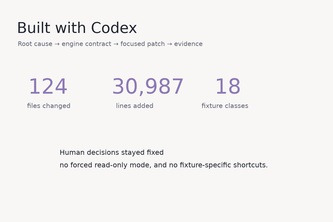
It does state that during Build Week, the author changed 124 files and added over 30,000 lines across implementation, tests, tools, and documentation. The repository includes generators for 18 real-size fixture classes.
Inference While there is evidence of significant development effort, there is no indication of product-market fit or user engagement beyond the hackathon context.
Competitive Context
The description provides no information about competitors in the mobile text editing space.
It does not reference:
- Existing mobile editors for large files
- Similar tools or platforms
- Market share or competitive positioning
There is no mention of how VaultXT differentiates from other solutions or what its competitive advantages might be.
Inference Without knowledge of existing alternatives, it's impossible to assess whether VaultXT addresses a gap in the market or duplicates functionality already available.
Open Questions & Risks
Several risks and open questions emerge from the description:
- Niche focus: The product targets a very specific use case (large TXT files), which may limit its addressable market.
- No commercial traction: No evidence of users, adoption, or monetization suggests it's not yet ready for market.
- Single-person team: With only one member, scalability and long-term maintenance are concerns.
- Hackathon origin: The product is a hackathon submission, implying it may be experimental or incomplete.
- No pricing or business model: Absence of any commercial strategy raises questions about viability.
Inference VaultXT appears to be an early-stage technical prototype with no clear path to market traction or monetization. Its niche focus and lack of commercial evidence raise significant risk for investment or partnership consideration.
Questions the description leaves open
- What is the actual demand for this type of functionality in your target user base?
- Have you conducted any user research or interviews with potential customers?
- Is there a plan to monetize VaultXT, and if so, what form will that take?
- How do you intend to scale beyond the current hackathon prototype?
- What are the key assumptions underlying your product design decisions?
- Are there any existing competitors in this space, and how does VaultXT differentiate from them?
- What is the long-term roadmap for the project beyond the current implementation?
Overall Assessment
Not evidenced
The description provides no evidence of:
- Revenue or financial performance
- Customer traction or adoption
- Market demand or competitive positioning
- Commercial strategy or monetization plans
VaultXT is described as a hackathon submission by a single-person team, with strong technical execution but no indication of commercial readiness or viability.
Inference Based on the self-reported information alone, VaultXT does not demonstrate sufficient traction, market validation, or business model to warrant investment or partnership consideration. It remains an experimental prototype without clear evidence of product-market fit or scalability.
User Stories BotA demo video on every pull request
Get a demo video on every new feature
GitHub App that watches your pull requests and records a narrated, captioned demo.
Save time on demo prep and make informed decisions faster with a video walkthrough of every new feature.
Source
Submitted to the OpenAI 2026 hackathon on Devpost. Project home on Devpost. Back to the full gallery on Devpost.
This competitive analysis was produced by top-founders.com (opens in a new tab)
Generated by a language model from this project's public Devpost page — its tagline, the author's own write-up and any built-with tags listed there — as captured in August 2026. Short quotations are the author's words. It is an opinion on the idea as a business, not on the people behind it, and it reflects the description as published then. If the project has moved on, request a correction below. The analysis is not independent research and contains no verified traction, revenue or customer data.
An independent guide by KFG International LLC — not affiliated with, endorsed by, or connected to Devpost or OpenAI.