

Archive position — measured, not model output
0 likes on Devpost
2,263 of the 7,850 archived projects have more likes, and 5,587 share exactly 0 — so this project's #7,500 place in the like-ranked listing is a tie-break inside that group, not a ranking.
Projects (log scale)
Likes on Devpost. ▲ marks this project's group.
Show the figures
| Likes | Projects | Share of archive |
|---|---|---|
| 0 | 5,587 | 71.2% |
| 1 | 1,758 | 22.4% |
| 2 | 284 | 3.6% |
| 3–4 | 132 | 1.7% |
| 5–9 | 75 | 1.0% |
| 10+ | 14 | 0.2% |
 User Stories BotA demo video on every pull request
Get a demo video on every new feature
GitHub App that watches your pull requests and records a narrated, captioned demo.
Save time on demo prep and make informed decisions faster with a video walkthrough of every new feature.
Executive Summary
The description states that VBE Resilient Print Archive is a system for encoding digital files into printable, color-coded pages using Visual Base Encoding (VBE), which can be reconstructed later with integrity verification. The author, Kareem Helmy, built this as a hackathon project using Python and AI-assisted development tools. The system claims to support recovery after image degradation and includes basic error detection and SHA-256 verification.
Key commercial due-diligence question: Is there evidence of any market need or demand for this capability beyond the author's personal interest?
The description is self-reported and unverified, with no evidence of revenue, customers, traction, or commercial adoption. The project appears to be a proof-of-concept prototype developed by one person in a hackathon context.
What The Product Actually Is
The description states that VBE Resilient Print Archive:
- Converts any digital file into structured color-coded image pages
- Can be stored digitally or printed on paper
- Uses Visual Base Encoding (VBE) to encode raw data
- Decodes pages back into the original file using SHA-256 integrity verification
- Audits page sets for missing, duplicated, or unexpected pages
- Supports multi-page file encoding
- Has been tested against JPEG compression and moderate blur
- Includes a planned encrypted mode
The system is described as being built with Python, Pillow, NumPy, OpenCV, and ChatGPT.
Positioning & Claim Evolution
The description states that the project was inspired by the question of whether digital files can be represented as physical pages and later reconstructed with verification. It positions itself as a method for durable storage of digital data through printable pages.
Claims include:
- VBE turns any digital file into printable, self-verifying color pages
- The system reconstructs the original after printing, scanning, compression, or moderate image distortion
- Pages appear as structured color patterns rather than readable content
- It supports integrity verification via SHA-256
- A planned encrypted mode would allow durable physical carriers for encrypted information
The claim evolution shows a progression from conceptual exploration to prototype implementation with testing.
Target Customer & ICP
Not evidenced. The description does not identify specific customer segments, use cases, or target industries. It only describes the technical capabilities of the system.
Business Model & Pricing Evidence
Not evidenced. There is no mention of pricing models, monetization strategies, or business model assumptions in the description.
Technical & Delivery Signals
The description states that:
- The system was built iteratively with controlled testing
- It uses Python, Pillow, NumPy, OpenCV, and ChatGPT
- It includes feature design, testing under controlled conditions, failure case identification, and iterative improvement
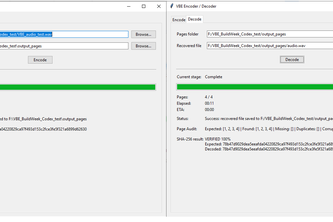
- Current prototype supports encoding/decoding, SHA-256 verification, page auditing, multi-page support, and recovery from selected missing-page scenarios
- Tests include JPEG compression, moderate blur, and print-and-camera testing in progress
- Planned improvements include GUI, automatic page detection, perspective correction, stronger error correction, improved storage density, processing speed, encryption, and documented format specification
Traction & Maturity Signals
Not evidenced. There is no evidence of revenue, customers, adoption, or market traction beyond the author's own account of a hackathon project.
Competitive Context
Not evidenced. The description does not mention existing competitive solutions or market positioning relative to other file storage or recovery systems.
Open Questions & Risks
- The system is described as a hackathon prototype built by one person
- No evidence of commercial viability, market demand, or customer traction
- The author is described as a 3D animation professional rather than a traditional software developer
- No evidence of scalability, performance, or robustness beyond controlled testing scenarios
- The project has no funding, team size, or business development history
Questions the description leaves open
- What specific market problems are you trying to solve with this technology?
- Have you identified any potential customers or use cases for this system?
- What is your plan for scaling beyond the current prototype?
- How do you intend to monetize this capability?
- What are the technical limitations of the current implementation that would prevent commercial deployment?
Overall Assessment
Not evidenced. The description provides no information about financials, valuation, funding rounds, or partnership opportunities. The project appears to be a personal exploration with no evidence of commercial potential or traction.
User Stories BotA demo video on every pull request
Get a demo video on every new feature
GitHub App that watches your pull requests and records a narrated, captioned demo.
Save time on demo prep and make informed decisions faster with a video walkthrough of every new feature.
Source
Submitted to the OpenAI 2026 hackathon on Devpost. Project home on Devpost. Back to the full gallery on Devpost.
This competitive analysis was produced by top-founders.com (opens in a new tab)
Generated by a language model from this project's public Devpost page — its tagline, the author's own write-up and any built-with tags listed there — as captured in August 2026. Short quotations are the author's words. It is an opinion on the idea as a business, not on the people behind it, and it reflects the description as published then. If the project has moved on, request a correction below. The analysis is not independent research and contains no verified traction, revenue or customer data.
An independent guide by KFG International LLC — not affiliated with, endorsed by, or connected to Devpost or OpenAI.