

Archive position — measured, not model output
1 like on Devpost
505 of the 7,850 archived projects have more likes, and 1,758 share exactly 1 — so this project's #1,613 place in the like-ranked listing is a tie-break inside that group, not a ranking.
Projects (log scale)
Likes on Devpost. ▲ marks this project's group.
Show the figures
| Likes | Projects | Share of archive |
|---|---|---|
| 0 | 5,587 | 71.2% |
| 1 | 1,758 | 22.4% |
| 2 | 284 | 3.6% |
| 3–4 | 132 | 1.7% |
| 5–9 | 75 | 1.0% |
| 10+ | 14 | 0.2% |
 User Stories BotA demo video on every pull request
Get a demo video on every new feature
GitHub App that watches your pull requests and records a narrated, captioned demo.
Save time on demo prep and make informed decisions faster with a video walkthrough of every new feature.
Executive Summary
What the company appears to be: Outrider is a self-hosted AI code reviewer for GitHub pull requests, built as a personal project by one developer (Dilans Damme). It uses AI models to analyze code changes and suggest findings, with human approval required for high-risk issues. The system is designed to be auditable and replayable, with severity rules and evidence labels enforced via internal checks.
What changed: The author states that Outrider was built as a response to existing tools like Greptile, aiming to improve trust in AI code review by making findings traceable and allowing human control over high-risk outcomes. It includes features such as structured severity rules, evidence labeling, and replayability of reviews.
Single most important open question: Is there any evidence that Outrider has been adopted or tested beyond the author’s sandbox environment? The description contains no information about users, customers, revenue, or real-world usage — only self-reported claims about functionality and testing.
Note: This analysis is based entirely on the self-reported project description provided by the author. No external verification or historical data is available.
What The Product Actually Is
The description states that Outrider is a self-hosted AI code reviewer for GitHub pull requests. It performs the following actions:
- Reads changes in a pull request.
- Identifies bugs and other issues.
- Leaves inline comments with suggested fixes when possible.
- Uses tree-sitter to parse source code structure before sending it to an AI model.
- Sends only relevant code sections (e.g., function or class around changed lines) for review.
- Enforces severity rules from a fixed, versioned table.
- Labels each finding by evidence type:
- Observed: found directly in code.
- Inferred: derived through related code.
- Judged: based on model reasoning.
- Pauses before posting high-severity findings for human approval.
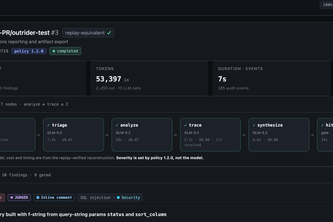
- Stores all review steps in Postgres for auditability and replayability.
- Operates entirely within the user’s own infrastructure using their own model provider keys.
Inference: The product is built as a Python application with LangGraph, uses React/Vite for its dashboard, and integrates with GitHub, Slack, and PostgreSQL. It supports multiple languages including Python, JavaScript, TypeScript, and TSX.
Positioning & Claim Evolution
The author states that Outrider was inspired by AI reviewers like Greptile but focuses on trust in AI code review. Key positioning elements include:
- Trust: The model’s findings are traceable and human-approved for high-risk items.
- Auditable and replayable reviews: Every step is saved, and finished reviews can be replayed to confirm results.
- Controlled AI use: Severity comes from project rules, not the model alone; evidence labels must match proof.
Claim: The author positions Outrider as a safer, more transparent alternative to generic AI reviewers. This claim is based on internal design decisions rather than external validation or user feedback.
Target Customer & ICP
The description does not state who the target customer is beyond the implied audience of developers working with GitHub pull requests. It also does not define an Ideal Customer Profile (ICP).
Not evidenced: No mention of specific roles, teams, company sizes, or use cases beyond general developer workflows.
Business Model & Pricing Evidence
There is no evidence in the description of a business model or pricing structure.
Not evidenced: No information about monetization, subscriptions, licensing, or fees.
Technical & Delivery Signals
The system is built using:
- Languages: Python, TypeScript
- Frameworks: FastAPI, LangGraph, React/Vite
- Infrastructure: GitHub, Slack, PostgreSQL, OpenAI, Anthropic
- Tools: Tree-sitter for parsing, CI checks to enforce boundaries
- Features:
- Parallel file review
- Prompt caching (Sonnet achieved 95.2% cache hit rate in benchmarks)
- Line-number consistency across formats (handled via one central conversion module)
- Human approval workflow with timeout handling
- Replayable audit logs
Inference: The architecture shows attention to safety, modularity, and traceability — key signals for a tool intended for production use.
Traction & Maturity Signals
The description includes some limited demonstration of functionality:
- Outrider can complete full reviews on real pull requests in sandbox repositories.
- In controlled benchmarks:
- A strong model found all 22 planted vulnerable cases.
- All 408 recorded responses passed schema validation.
However, there is no evidence of:
- Real-world adoption or customer base
- Revenue or monetization
- Production usage beyond sandbox testing
- Performance metrics on actual pull requests
Not evidenced: No data on user numbers, retention, or real-world performance.
Competitive Context
The author mentions that Outrider was inspired by tools like Greptile, suggesting a competitive landscape in AI code review for GitHub. However, no comparison to other tools is made beyond this reference.
Inference: The product enters a market where similar tools exist, but the description does not elaborate on how Outrider differentiates itself from competitors or whether it has any competitive advantages.
Open Questions & Risks
Several potential risks and open questions are present in the self-reported account:
- No real-world usage: The only evidence of testing is within sandbox environments.
- Single-person development team: The project is built by one individual, which raises questions about scalability or long-term maintenance.
- Unproven accuracy: Benchmarks use planted examples; no data on generalization to real-world code.
- Limited language support: Currently supports only Python, JS, TS, and TSX.
- No production reliability metrics: The author notes that full performance measurement is pending.
Inference: While the system has strong internal design principles, its lack of external validation or adoption suggests it remains in early-stage development.
Questions the description leaves open
- Has Outrider been tested on real pull requests from actual users or teams?
- What is the current level of performance and latency for full reviews?
- Are there any known issues with handling large diffs or complex codebases?
- How does the system handle edge cases like deletion-only changes or import-only modifications?
- What are the plans for expanding language support beyond Python, JS, TS, and TSX?
- Is there a plan to integrate with GitHub Checks or other merge-blocking mechanisms?
- Has the author considered how to scale this tool for enterprise use?
Overall Assessment
There is no evidence of revenue, customers, traction, or product-market fit beyond the author’s own testing.
Assessment: At this stage, Outrider appears to be a proof-of-concept or early-stage prototype, not a commercial product ready for investment or partnership. The architecture and safety features are well thought out, but without real-world usage or measurable impact, it cannot be evaluated as a viable business opportunity.
Confidence level: Low — based on minimal evidence provided in the self-reported description.
User Stories BotA demo video on every pull request
Get a demo video on every new feature
GitHub App that watches your pull requests and records a narrated, captioned demo.
Save time on demo prep and make informed decisions faster with a video walkthrough of every new feature.
Source
Submitted to the OpenAI 2026 hackathon on Devpost. Project home on Devpost. Back to the full gallery on Devpost.
This competitive analysis was produced by top-founders.com (opens in a new tab)
Generated by a language model from this project's public Devpost page — its tagline, the author's own write-up and any built-with tags listed there — as captured in August 2026. Short quotations are the author's words. It is an opinion on the idea as a business, not on the people behind it, and it reflects the description as published then. If the project has moved on, request a correction below. The analysis is not independent research and contains no verified traction, revenue or customer data.
An independent guide by KFG International LLC — not affiliated with, endorsed by, or connected to Devpost or OpenAI.