

Archive position — measured, not model output
1 like on Devpost
505 of the 7,850 archived projects have more likes, and 1,758 share exactly 1 — so this project's #1,615 place in the like-ranked listing is a tie-break inside that group, not a ranking.
Projects (log scale)
Likes on Devpost. ▲ marks this project's group.
Show the figures
| Likes | Projects | Share of archive |
|---|---|---|
| 0 | 5,587 | 71.2% |
| 1 | 1,758 | 22.4% |
| 2 | 284 | 3.6% |
| 3–4 | 132 | 1.7% |
| 5–9 | 75 | 1.0% |
| 10+ | 14 | 0.2% |
 User Stories BotA demo video on every pull request
Get a demo video on every new feature
GitHub App that watches your pull requests and records a narrated, captioned demo.
Save time on demo prep and make informed decisions faster with a video walkthrough of every new feature.
Executive Summary
What the company appears to be
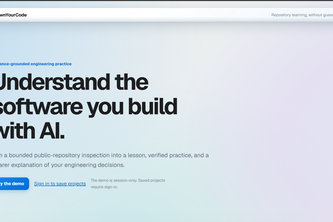
OwnYourCode is a self-reported educational tool for students and junior developers that uses AI to help users understand software projects they encounter. The author states it turns a public GitHub repository into a guided learning experience, using deterministic validation for code structure and AI for explanations.
What changed
This is a single-person project submitted as a hackathon entry (OpenAI 2026). It has no evidence of revenue, customers or traction beyond the author's own description. The product is described as a full-stack application built with React, FastAPI, PostgreSQL, and AI models like GPT-5.6.
The single most important open question
Is there any evidence that users actually engage with this tool, or that it provides value beyond the author's own experience? The description contains no data on adoption, usage patterns, or learning outcomes.
What The Product Actually Is
The description states OwnYourCode is a full-stack application built with:
- React, TypeScript, Vite for frontend
- FastAPI and Python for API
- PostgreSQL and SQLAlchemy for database
- Alembic for migrations
- Clerk for authentication
- Docker Compose for local environment
- GitHub APIs for bounded public repository inspection
- OpenAI models (including GPT-5.6) for lesson generation and explanation evaluation
The application follows a modular-monolith architecture where:
- Frontend sends validated requests to FastAPI backend
- Backend validates with Pydantic, verifies authenticated user, scopes projects by owner
- Repository evidence is collected deterministically before being sent to models
- Model output is structured and validated again before persistence
- For coding labs, learner code is parsed using Python's AST (never executed)
- Security challenges use server-owned fixtures, not actual repository scanning
The product allows users to:
- Provide public GitHub repositories for inspection
- Create guided learning flows through architecture understanding, assessments, coding labs, security challenges, and architecture defense
- Save projects with persistent workspaces that survive refreshes or logout
- Access a public demo session-only version without account creation
Inference The product is described as a self-contained educational platform that combines AI-powered explanations with deterministic code validation for learning purposes.
Positioning & Claim Evolution
The author states OwnYourCode helps students and junior developers understand projects they encounter, especially when working with AI-generated code. It aims to bridge the gap between building with AI and truly understanding what was built.
Key claims:
- "AI may help you build the code, but OwnYourCode helps you understand, verify, and defend it"
- "OwnYourCode turns a software project into a personalized learning experience"
- "The main idea is simple: AI may help you build the code, but OwnYourCode helps you understand, verify, and defend it"
The positioning evolved from:
- Initial problem identification: students/juniors can build complex projects with AI but don't understand them
- Solution definition: create a tool that makes understanding AI-generated code possible
- Product evolution: from public demo to persistent workspaces and planned Build From Scratch experiences
Inference The positioning is centered on helping developers maintain ownership of their understanding, not just their code.
Target Customer & ICP
The description states the target audience is:
- Students
- Junior developers
The author identifies these users as those who can build complex projects with AI but struggle to understand the underlying code and architecture.
Inference The primary customer segment appears to be early-career developers or learners who are using AI tools for development but need help understanding what they've built.
Business Model & Pricing Evidence
The description does not provide evidence of any business model or pricing structure. It mentions:
- Public demo is session-only and can be tried without account creation
- Signed-in users can save projects, return after refresh/logout, archive projects, resume workspaces
- New Idea projects will have Build From Scratch workflows planned
Inference No commercial model is described beyond the author's own implementation. The product appears to be a personal project with no evidence of monetization.
Technical & Delivery Signals
The application uses:
- React, TypeScript, Vite (frontend)
- FastAPI, Python (backend)
- PostgreSQL, SQLAlchemy
- Alembic for migrations
- Clerk for authentication
- GitHub APIs for bounded repository inspection
- OpenAI models including GPT-5.6 for explanation generation
Key technical elements mentioned:
- Modular-monolith architecture
- Deterministic validation before sending to models
- Model output structured and validated again
- AST parsing for coding labs (no execution)
- Server-owned fixtures for security challenges
- Immutable inspection snapshots
- Versioned learning definitions
- Idempotency protection
- Context fingerprints
Inference The technical approach shows deliberate separation of deterministic validation from AI explanation, with safety measures around code execution and data integrity.
Traction & Maturity Signals
The description contains no evidence of traction or maturity:
- No revenue data
- No customer base
- No usage metrics
- No product adoption indicators
- No evidence of user engagement beyond the author's own testing
The project is described as a single-person hackathon submission (OpenAI 2026) with no indication of any external validation, user feedback, or market traction.
Inference There are no signals of product-market fit or commercial viability. The tool exists only in the author's description.
Competitive Context
The description does not mention any competitors or competitive landscape. It does not reference existing tools for:
- Code understanding
- Developer education
- AI-assisted learning platforms
- Repository analysis tools
Inference No competitive context is provided, making it impossible to assess positioning relative to other solutions.
Open Questions & Risks
Key risks and open questions based on the description:
- No evidence of traction or adoption: The product exists only in author's own account with no external validation
- Single-person development: One person built a full-stack application including AI integration, which may indicate limited scalability or testing
- Unproven learning effectiveness: No data on whether the tool actually improves understanding or learning outcomes
- No commercial model: No indication of how this would be monetized or scaled beyond personal use
- Limited scope: The public demo is session-only, suggesting no persistent user engagement mechanism yet
- Unverified claims: All statements are self-reported without independent verification
Inference The project appears to be a proof-of-concept rather than a commercial product with demonstrated value.
Questions the description leaves open
- What specific learning outcomes have you observed from users of this tool?
- How do you plan to validate that the AI explanations are actually helpful for understanding code?
- What evidence do you have that students/junior developers struggle with understanding AI-generated code in practice?
- How will you scale beyond a single developer's implementation?
- What is your roadmap for monetization and user acquisition?
- Have you tested this with actual students or junior developers, and what feedback did they provide?
- How do you plan to handle the technical complexity of repository analysis at scale?
- What are the key metrics you would use to measure success?
Overall Assessment
Not evidenced
The description provides no evidence that this represents a viable business opportunity or investment target. It is described as a single-person hackathon project with no revenue, customers, traction or commercial model.
The author's own account states:
- This is a hackathon submission
- No revenue, customer or traction data exists beyond the author's own description
- The product is not independently verified
Inference Without any evidence of market demand, user engagement, or commercial viability, this does not meet criteria for investment or partnership consideration. It appears to be a personal project with no demonstrated business case.
User Stories BotA demo video on every pull request
Get a demo video on every new feature
GitHub App that watches your pull requests and records a narrated, captioned demo.
Save time on demo prep and make informed decisions faster with a video walkthrough of every new feature.
Source
Submitted to the OpenAI 2026 hackathon on Devpost. Project home on Devpost. Back to the full gallery on Devpost.
This competitive analysis was produced by top-founders.com (opens in a new tab)
Generated by a language model from this project's public Devpost page — its tagline, the author's own write-up and any built-with tags listed there — as captured in August 2026. Short quotations are the author's words. It is an opinion on the idea as a business, not on the people behind it, and it reflects the description as published then. If the project has moved on, request a correction below. The analysis is not independent research and contains no verified traction, revenue or customer data.
An independent guide by KFG International LLC — not affiliated with, endorsed by, or connected to Devpost or OpenAI.