

Archive position — measured, not model output
1 like on Devpost
505 of the 7,850 archived projects have more likes, and 1,758 share exactly 1 — so this project's #1,612 place in the like-ranked listing is a tie-break inside that group, not a ranking.
Projects (log scale)
Likes on Devpost. ▲ marks this project's group.
Show the figures
| Likes | Projects | Share of archive |
|---|---|---|
| 0 | 5,587 | 71.2% |
| 1 | 1,758 | 22.4% |
| 2 | 284 | 3.6% |
| 3–4 | 132 | 1.7% |
| 5–9 | 75 | 1.0% |
| 10+ | 14 | 0.2% |
 User Stories BotA demo video on every pull request
Get a demo video on every new feature
GitHub App that watches your pull requests and records a narrated, captioned demo.
Save time on demo prep and make informed decisions faster with a video walkthrough of every new feature.
Executive Summary
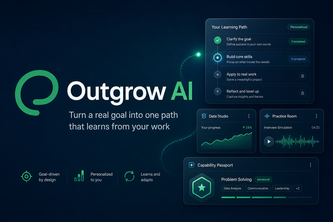
The company appears to be a solo project named Outgrow AI, self-described as a personal learning operating system built around the principle that assistance should decrease as capability increases. The author states it uses GPT-5.6 as its intelligence layer and Codex as an engineering partner, with a full-stack TypeScript platform using technologies like Next.js, React, PostgreSQL, and Docker.
What changed: The project evolved from a deterministic learning demonstration into a production system capable of generating personalized learning paths from arbitrary goals and sources, supporting multiple learning environments (Learning Room, Data Studio, Coding Studio, Practice Room), and incorporating adaptive follow-ups, evidence-led path changes, and learner memory.
The single most important open question: Is there any evidence of real user adoption or feedback beyond the author's own account? The description contains no data on users, revenue, customers, or traction — only self-reported claims about functionality and design decisions.
This analysis is based entirely on the self-reported, unverified project description provided by the caller. No external corroboration exists for any of the stated features, capabilities, or outcomes.
What The Product Actually Is
The description states that Outgrow AI is a personal learning operating system. It allows learners to begin with a real outcome (e.g., preparing for an interview, debugging code) and add existing materials (documents, URLs, repositories, etc.).
Ava — the AI assistant — creates a personalized path containing explanations, source material, practice, projects, reviews, and a Solo Challenge. The system changes from evidence produced while the learner works.
It supports four main learning environments:
- Learning Room for source-grounded lessons
- Data Studio for datasets and analytics
- Coding Studio for real files and terminal commands
- Practice Room for oral exams, presentations, code reviews
The system records more than just correctness; it preserves artifacts, explanations, help history, path changes, and independent transfer to new work.
It also includes:
- An Evidence Ledger
- A private-by-default Capability Passport
- Forge, which converts expert material into versioned education that can improve from learner feedback
The description states this is a full-stack TypeScript platform built with Next.js, React, PostgreSQL, and GPT-5.6.
Positioning & Claim Evolution
The author positions Outgrow AI as:
- A personal learning operating system
- An AI tutor you’re meant to outgrow
- A system that decreases assistance as capability increases
It claims to address fragmentation in learning by organizing around the learner’s real goal, existing material, and demonstrated progress.
The evolution described shows a shift from:
- A scripted demonstration (e.g., data analysis journey)
- To a general platform supporting diverse goals (anatomy, coding, climate, finance, data)
The author states that Outgrow is built around the principle: “Assistance should decrease as capability increases.” This is a core positioning claim.
Target Customer & ICP
The description does not clearly define a specific customer segment or ideal customer profile (ICP). It mentions:
- Learners working toward outcomes like:
- Preparing for a data analyst interview
- Understanding anatomy notes before an exam
- Debugging and deploying a React application
- Explaining a climate report clearly
- Practicing oral exams, presentations, or code reviews
It also mentions educators and subject-matter experts who use Forge to convert their material into versioned education.
The description does not state whether the target is students, professionals, educators, or general learners. It implies a broad audience but lacks specificity.
Business Model & Pricing Evidence
There is no evidence of pricing, monetization strategy, or business model in the self-reported description.
The author states that:
- Learners can create artifacts and defend reasoning
- They can inspect evidence behind capabilities
- They choose what becomes part of a shareable Passport
But there’s no mention of:
- Subscription tiers
- Freemium offerings
- Enterprise licensing
- Revenue streams
- Pricing models
The business model remains unreported.
Technical & Delivery Signals
The platform is described as a full-stack TypeScript system built with:
- Next.js, React, Tailwind CSS
- PostgreSQL for state storage
- pgvector for retrieval
- Redis and BullMQ for async work
- Drizzle ORM and Zod for validation
- Docker Compose for deployment
- Monaco Editor, xterm.js, DuckDB-WASM
- Codex as engineering partner
- GPT-5.6 as the intelligence layer
It uses structured-output contracts to ensure model outputs are validated before persistence.
Key technical features include:
- Persistent multi-workspace learning
- Arbitrary goal-and-source-driven paths
- Adaptive questions and follow-ups
- Restored drafts and editable transcripts
- Rubric-based evaluation
- Evidence-linked path changes
- Curated cross-workspace memory
- Fresh Solo Challenges with Ava hidden
The description indicates a production-ready system with automated testing, CI/CD, accessibility coverage, and migration support.
Traction & Maturity Signals
There is no evidence of traction or maturity beyond the author’s own account. The description does not mention:
- Users
- Customers
- Revenue
- Adoption metrics
- Product usage data
- Feedback from real learners
The author notes:
- Hundreds of automated unit and integration tests
- Eight successful live GPT-5.6 Sol operations
- Cross-browser Playwright coverage
- Deterministic learning evaluations
But none of these constitute traction or user validation.
Traction is not evidenced.
Competitive Context
There is no mention of competitors in the description. The author does not reference:
- Existing platforms like Coursera, Udemy, Khan Academy, Duolingo, etc.
- AI tutoring tools such as Grammarly, Notion AI, or Perplexity
- Learning management systems (LMS) or adaptive learning technologies
No competitive context is provided.
Open Questions & Risks
Several risks and open questions are implied by the self-reported nature of the description:
- Solo development: Only one team member is listed (Yashas Gunderia), raising questions about scalability, maintenance, and long-term viability.
- Unverified claims: All features and functionality are self-reported without external validation or user feedback.
- No revenue or customer data: The absence of any traction signals suggests the product may not yet have reached users or generated value.
- High technical complexity: The system involves AI orchestration, multiple learning environments, and complex state management — all of which could introduce risks if not well-tested or maintained.
- Dependency on GPT-5.6: The reliance on a proprietary model raises concerns about availability, cost, and control.
These are inferred from the lack of evidence and the nature of the solo project.
Questions the description leaves open
- What is your definition of “learning” in this system? How do you distinguish between completion and actual understanding?
- Can you provide examples of how learner evidence influences path adaptation?
- How do you plan to scale beyond a single developer?
- Have you conducted any user studies or gathered feedback from learners?
- What are the key assumptions about AI behavior that underpin your system design?
- How do you handle edge cases where a learner’s work doesn’t align with expected outcomes?
- Is there a mechanism for learners to opt out of data collection or sharing?
- How do you ensure consistency and reliability across different learning environments?
These questions aim to probe the depth of understanding, user validation, and scalability assumptions.
Overall Assessment
There is no evidence that this project has achieved any level of traction, revenue, or customer adoption. The description is entirely self-reported and lacks verifiable data on users, product-market fit, or business viability.
The system appears technically sophisticated, but without real-world usage or feedback, it remains a conceptual prototype.
This is not a viable investment or partnership opportunity based on the available evidence. It requires further validation through user testing, market feedback, and measurable outcomes before any due-diligence assessment can proceed.
User Stories BotA demo video on every pull request
Get a demo video on every new feature
GitHub App that watches your pull requests and records a narrated, captioned demo.
Save time on demo prep and make informed decisions faster with a video walkthrough of every new feature.
Source
Submitted to the OpenAI 2026 hackathon on Devpost. Project home on Devpost. Back to the full gallery on Devpost.
This competitive analysis was produced by top-founders.com (opens in a new tab)
Generated by a language model from this project's public Devpost page — its tagline, the author's own write-up and any built-with tags listed there — as captured in August 2026. Short quotations are the author's words. It is an opinion on the idea as a business, not on the people behind it, and it reflects the description as published then. If the project has moved on, request a correction below. The analysis is not independent research and contains no verified traction, revenue or customer data.
An independent guide by KFG International LLC — not affiliated with, endorsed by, or connected to Devpost or OpenAI.