

Archive position — measured, not model output
0 likes on Devpost
2,263 of the 7,850 archived projects have more likes, and 5,587 share exactly 0 — so this project's #7,497 place in the like-ranked listing is a tie-break inside that group, not a ranking.
Projects (log scale)
Likes on Devpost. ▲ marks this project's group.
Show the figures
| Likes | Projects | Share of archive |
|---|---|---|
| 0 | 5,587 | 71.2% |
| 1 | 1,758 | 22.4% |
| 2 | 284 | 3.6% |
| 3–4 | 132 | 1.7% |
| 5–9 | 75 | 1.0% |
| 10+ | 14 | 0.2% |
 User Stories BotA demo video on every pull request
Get a demo video on every new feature
GitHub App that watches your pull requests and records a narrated, captioned demo.
Save time on demo prep and make informed decisions faster with a video walkthrough of every new feature.
Executive Summary
What the company appears to be
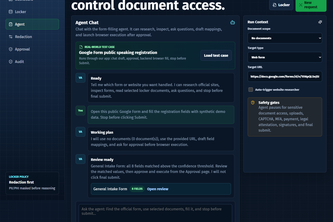
Vault Form Agent is a self-reported enterprise-grade web application designed to automate form filling in sensitive workflows. It allows users to upload documents, apply redaction rules, and use an AI-powered agent to fill forms while maintaining control over data handling and submission.
What changed
The project was built as part of a hackathon submission for the OpenAI 2026 hackathon. The author describes it as a proof-of-concept tool that integrates document management, redaction, browser automation, and human approval mechanisms to support secure form-filling in regulated environments like government, healthcare, or enterprise settings.
Single most important open question
Is there any evidence of real-world usage, customer feedback, or traction beyond the hackathon demo?
What The Product Actually Is
The description states that Vault Form Agent is an enterprise-grade web app with:
- A secure document locker
- Redaction policy engine
- Chat-style form agent
- Visible browser runner
- Audit trail
- CLI and skill scaffold
It supports uploading documents (PDFs, scanned images, text files, JSON) and uses a Docling-ready extraction layer with OCR fallbacks. The backend is built using FastAPI; the frontend uses React/Vite.
The system includes:
- Built-in and custom redaction rules
- Browser automation via Playwright
- Human-controlled guards for submission
- A chat interface for task description
Inference: The product appears to be a prototype or proof-of-concept, not yet a production-ready SaaS offering. It is described as being built during a hackathon.
Positioning & Claim Evolution
The author claims that Vault Form Agent explores what a safer form-filling agent should look like when documents are sensitive and users still need control.
It positions itself as:
- A secure alternative to manual copy-paste workflows
- An enterprise-grade solution for handling PII/PHI in regulated domains (government, healthcare, insurance)
- A tool that reduces risk by masking sensitive data before it reaches the agent
Inference: The positioning is aligned with current trends in AI-assisted automation and data privacy compliance. However, the claims are self-reported and lack independent validation.
Target Customer & ICP
The description states that Vault Form Agent targets:
- Government agencies
- Healthcare providers
- Insurance companies
- Enterprise users who handle sensitive data
These customers are said to be dealing with workflows where:
- Users must find official sites
- They need to extract details from scattered documents
- PII/PHI must be protected
- Accidental submission needs to be avoided
- Audit trails are required
Inference: The ICP seems to be organizations requiring high levels of data security and compliance, but no evidence exists about actual customers or use cases beyond the demo.
Business Model & Pricing Evidence
There is no evidence in the description of any business model or pricing structure. The project was submitted as a hackathon entry and does not mention monetization strategies, subscriptions, licensing, or sales channels.
Inference: No commercial viability or revenue model has been described.
Technical & Delivery Signals
The technical stack includes:
- Backend: FastAPI, Python, Pydantic, uvicorn
- Frontend: React, Vite, TypeScript, JavaScript, CSS
- Tools: Playwright, OCR, OpenAI Codex/GPT-5.6, Docling-ready extraction
- Other: GitHub, HTML, JSON, CLI
The system supports:
- Document upload and metadata tagging
- Text extraction from various formats (PDF, image, etc.)
- Redaction using built-in and custom rules
- Browser automation with visible execution
- Human review of submissions
- CLI for developer workflows
Inference: The architecture shows a strong focus on security, compliance, and usability. However, no production deployment or scalability data is provided.
Traction & Maturity Signals
The project was built during the OpenAI 2026 hackathon, and includes:
- Demo recordings
- Visual walkthroughs
- Setup instructions
- Sample data
- Architecture documentation
- Security notes
There is no evidence of:
- Customers
- Revenue
- Usage metrics
- Product-market fit
- Post-hackathon development or iteration
Inference: This is a hackathon prototype with no demonstrated traction or maturity beyond the initial build.
Competitive Context
The description does not mention competitors. However, based on the stated functionality (secure form filling, redaction, browser automation), potential categories include:
- Document processing platforms
- AI-powered workflow automation tools
- Compliance and data governance solutions
- Form-filling agents with security features
Inference: No competitive analysis or differentiation strategy is evident in the description.
Open Questions & Risks
Key risks and open questions based on the self-reported information:
- No real-world usage or customer feedback
- Unverified claims about enterprise-grade capabilities
- Prototype-only status (hackathon project)
- Lack of commercialization strategy
- No mention of scalability, performance, or security testing
- No evidence of team experience or prior traction
Inference: The product is unproven in a real-world setting and lacks any indication of market readiness.
Questions the description leaves open
- What specific use cases have you identified for this tool beyond the hackathon demo?
- Have you tested the redaction policies with actual sensitive data?
- Is there a plan to move beyond the prototype stage, and if so, what are the next steps?
- How do you intend to monetize or deploy this product in enterprise environments?
- What is your understanding of regulatory compliance requirements for such tools?
Overall Assessment
Not evidenced: There is no evidence of revenue, customers, traction, or any commercial activity beyond the hackathon submission.
The project appears to be a self-reported prototype, built during a hackathon, with no indication of market validation, product-market fit, or business model. It is described as an experimental tool exploring secure form-filling workflows but lacks any demonstration of real-world adoption or scalability.
Confidence level: Low — based entirely on self-reporting and limited evidence.
User Stories BotA demo video on every pull request
Get a demo video on every new feature
GitHub App that watches your pull requests and records a narrated, captioned demo.
Save time on demo prep and make informed decisions faster with a video walkthrough of every new feature.
Source
Submitted to the OpenAI 2026 hackathon on Devpost. Project home on Devpost. Back to the full gallery on Devpost.
This competitive analysis was produced by top-founders.com (opens in a new tab)
Generated by a language model from this project's public Devpost page — its tagline, the author's own write-up and any built-with tags listed there — as captured in August 2026. Short quotations are the author's words. It is an opinion on the idea as a business, not on the people behind it, and it reflects the description as published then. If the project has moved on, request a correction below. The analysis is not independent research and contains no verified traction, revenue or customer data.
An independent guide by KFG International LLC — not affiliated with, endorsed by, or connected to Devpost or OpenAI.