

Archive position — measured, not model output
1 like on Devpost
505 of the 7,850 archived projects have more likes, and 1,758 share exactly 1 — so this project's #888 place in the like-ranked listing is a tie-break inside that group, not a ranking.
Projects (log scale)
Likes on Devpost. ▲ marks this project's group.
Show the figures
| Likes | Projects | Share of archive |
|---|---|---|
| 0 | 5,587 | 71.2% |
| 1 | 1,758 | 22.4% |
| 2 | 284 | 3.6% |
| 3–4 | 132 | 1.7% |
| 5–9 | 75 | 1.0% |
| 10+ | 14 | 0.2% |
 User Stories BotA demo video on every pull request
Get a demo video on every new feature
GitHub App that watches your pull requests and records a narrated, captioned demo.
Save time on demo prep and make informed decisions faster with a video walkthrough of every new feature.
Executive Summary
What the company appears to be
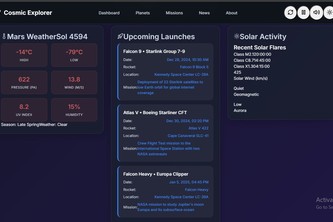
Cosmic Explorer is a self-reported space data dashboard built by one developer (Avinash Chavda) for the OpenAI 2026 hackathon. It aggregates real-time data from NASA and related APIs, offering features like live system status tracking, mission monitoring, solar weather updates, and user personalization.
What changed
The project was submitted as a hackathon entry, indicating it is in an early-stage prototype or proof-of-concept phase. No commercial traction, revenue, or customer data are evidenced.
Single most important open question
Is there any evidence of real-world usage, user feedback, or monetization strategy beyond the author’s self-reported claims?
What The Product Actually Is
The description states that Cosmic Explorer is a dashboard for real-time space data, integrating APIs from NASA and related sources. It displays:
- Live system statuses
- Current missions (e.g., Artemis, Mars Sample Return)
- Planetary data with scientific accuracy
- Solar weather monitoring
- Advanced filtering and search
- User features like theme switching, favorites, and live updates
It is built using modern frontend technologies including React, Tailwind CSS, Vite, and JavaScript.
Evidence
- The author states: “Shows live space system statuses,” “Tracks current missions,” “Displays planetary data with scientific accuracy,” “Shows solar weather monitoring.”
- Built with: apod, donki, html5, javascript, mars-rover, nasaapi, react, tailwind, vite.
Inference The product is a frontend dashboard that aggregates and displays space-related data from public APIs. It is not described as a platform or marketplace but rather a data visualization tool.
Positioning & Claim Evolution
The author positions Cosmic Explorer as a centralized, fast, and beautifully designed dashboard for real-time space data, aimed at both students and scientists.
Evidence
- The tagline: “Boosted performance with 3–5s load, smart caching, error handling, live system status, theme switch, favorites, space agency data, missions, solar weather, news, mobile-friendly & more!”
- The write-up states: “We wanted to build a system that makes cosmic information fun, interactive, and useful to everyone—from students to scientists.”
Inference The positioning is focused on accessibility and interactivity for a broad audience. It is not yet positioned as a commercial product or enterprise solution.
Target Customer & ICP
The author states the target audience includes students and scientists, with an intent to make space data “fun, interactive, and useful” to everyone.
Evidence
- The write-up says: “We wanted to build a system that makes cosmic information fun, interactive, and useful to everyone—from students to scientists.”
Inference The ICP is likely early-stage users or hobbyists interested in space data. No evidence of enterprise or institutional customers is provided.
Business Model & Pricing Evidence
No business model or pricing strategy is evidenced.
Evidence
- The description does not mention revenue, monetization, subscriptions, or pricing tiers.
- The project is described as a hackathon submission with no indication of commercial intent.
Inference It is unclear if the product will be monetized, and there is no evidence of any pricing model or revenue stream.
Technical & Delivery Signals
The author reports technical implementation details:
- Built using React, Tailwind CSS, Vite, JavaScript
- Integrated multiple APIs (NASA APIs, APOD, DONKI, Mars Rover)
- Implemented caching to reduce API load and improve performance
- Optimized load time from 15s to ~3s
Evidence
- “I used modern frontend and backend technologies to create a responsive, fast-loading, and visually appealing dashboard.”
- “Reduced load time from 15s to just ~3s using caching and optimization”
- “Integrated multiple APIs with error handling and fallback support”
Inference The technical stack is modern and focused on performance. The author demonstrates some understanding of API management and UI design.
Traction & Maturity Signals
No traction or maturity signals are evidenced.
Evidence
- The project is described as a hackathon submission.
- No user base, customer data, or adoption metrics are provided.
- No mention of usage beyond the author’s own development.
Inference This is an early-stage prototype. There is no evidence of product-market fit, user engagement, or commercial viability.
Competitive Context
No competitive analysis or market positioning is evidenced.
Evidence
- The description does not name competitors or describe how Cosmic Explorer differentiates from existing space data dashboards.
- No mention of similar tools or platforms in the space data domain.
Inference It is unclear whether there are comparable products, and if so, how this one might stand out.
Open Questions & Risks
Key Risk
The project is a single-developer hackathon submission with no evidence of traction, revenue, or user adoption. It may not have evolved beyond prototype stage.
Open Question
No business model or monetization strategy is evident. The author does not describe any path to commercial viability.
Inference There is a high risk that this project will not scale or be commercially viable without further development and investment.
Questions the description leaves open
- What is the current status of the product beyond the hackathon submission?
- Are there any users or feedback from real-world usage?
- What is the plan for monetization or commercialization?
- How does the project intend to scale beyond a single developer?
- Is there an intention to integrate with additional APIs or data sources?
- What are the long-term goals for product development and user engagement?
Overall Assessment
Not evidenced.
The project is described as a hackathon submission by one developer, with no evidence of traction, revenue, or commercial strategy. It is not clear whether this represents a viable investment or partnership opportunity.
Inference At this stage, the project appears to be an early prototype with no demonstrated path to market or monetization. A deeper due diligence would require evidence of user engagement, product-market fit, and business development beyond the author’s own claims.
User Stories BotA demo video on every pull request
Get a demo video on every new feature
GitHub App that watches your pull requests and records a narrated, captioned demo.
Save time on demo prep and make informed decisions faster with a video walkthrough of every new feature.
Source
Submitted to the OpenAI 2026 hackathon on Devpost. Project home on Devpost. Back to the full gallery on Devpost.
This competitive analysis was produced by top-founders.com (opens in a new tab)
Generated by a language model from this project's public Devpost page — its tagline, the author's own write-up and any built-with tags listed there — as captured in August 2026. Short quotations are the author's words. It is an opinion on the idea as a business, not on the people behind it, and it reflects the description as published then. If the project has moved on, request a correction below. The analysis is not independent research and contains no verified traction, revenue or customer data.
An independent guide by KFG International LLC — not affiliated with, endorsed by, or connected to Devpost or OpenAI.