

Archive position — measured, not model output
0 likes on Devpost
2,263 of the 7,850 archived projects have more likes, and 5,587 share exactly 0 — so this project's #3,514 place in the like-ranked listing is a tie-break inside that group, not a ranking.
Projects (log scale)
Likes on Devpost. ▲ marks this project's group.
Show the figures
| Likes | Projects | Share of archive |
|---|---|---|
| 0 | 5,587 | 71.2% |
| 1 | 1,758 | 22.4% |
| 2 | 284 | 3.6% |
| 3–4 | 132 | 1.7% |
| 5–9 | 75 | 1.0% |
| 10+ | 14 | 0.2% |
 User Stories BotA demo video on every pull request
Get a demo video on every new feature
GitHub App that watches your pull requests and records a narrated, captioned demo.
Save time on demo prep and make informed decisions faster with a video walkthrough of every new feature.
Executive Summary
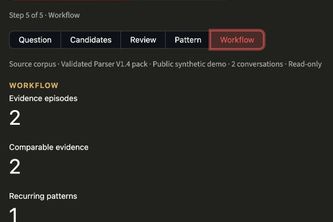
What the company appears to be: Conversation Pattern Forge is a self-reported tool that helps users discover recurring workflows from their AI conversation history. The author describes it as an application built during a hackathon, using OpenAI exports and structured parsing techniques to identify patterns in conversations and propose reusable workflows.
What changed: The project evolved from a forensic parser for OpenAI conversation exports into a system designed to detect and present evidence-backed recurring workflows. It was developed over a short timeframe (Build Week) with limited resources, including one developer and AI-assisted development tools.
Single most important open question: Is there any evidence of traction or adoption beyond the author's personal use case? The description does not indicate whether the tool has been used by others, how many users exist, or what kind of commercial interest it might attract.
What The Product Actually Is
The description states that Conversation Pattern Forge is a system that:
- Processes OpenAI conversation exports into structured notes.
- Allows users to ask focused questions about their conversation history.
- Ranks potentially relevant conversations deterministically.
- Requires explicit human inspection and classification of supporting evidence.
- Derives episodes, comparable occurrences, recurring patterns, assessments, and workflow candidates only after sufficient evidence is reviewed.
- Does not automatically approve or execute workflows; instead, it makes the provenance and review decisions visible.
The system builds on a pre-existing parser and uses a structured approach to ensure that only selected evidence becomes part of a workflow proposal. It includes a deterministic local application with no network calls in its demo version.
Inference: The tool appears to be a proof-of-concept or prototype built for demonstration purposes, not yet a production-ready product.
Positioning & Claim Evolution
The author positions the tool as:
- A way to move from storing conversations to understanding recurring workflows.
- An application that turns approved workflows into skill candidates for future use in agentic LLM Wikis and personal second-brain systems.
- A system that focuses on trustworthiness by preserving evidence, review decisions, and provenance.
The claim evolution shows:
- From a simple parser (for archiving conversations) → to a pattern discovery tool.
- From basic storage → to structured workflow identification.
- From a personal learning journey → to a potential framework for reusable AI methods.
Inference: The positioning reflects a shift from utility to strategic thinking about long-term AI interaction patterns, but no commercial or market traction is evidenced.
Target Customer & ICP
The description does not clearly define a target customer segment or ideal customer profile (ICP). It implies the tool is for individuals who:
- Use OpenAI extensively.
- Maintain conversation histories.
- Are interested in improving their AI interaction methods over time.
There is no indication of whether this is aimed at professionals, researchers, developers, or general users. The author is described as a non-traditional software developer working alone.
Inference: The ICP is not defined beyond the author’s own use case and personal learning journey.
Business Model & Pricing Evidence
There is no evidence of pricing, monetization strategy, or business model in the description. The tool is presented as a hackathon project with no indication of how it would be sold or used commercially.
Inference: No business model or pricing information is available from the self-reported description.
Technical & Delivery Signals
The system:
- Uses Python 3.11+ with Streamlit, Pydantic, scikit-learn, rapidfuzz, and pytest.
- Was built using Codex (GPT-5.6 Sol) for development assistance.
- Operates locally without network calls in the demo version.
- Maintains append-only review ledgers and deterministic lineage.
- Separates private validation from public demos.
- Uses a structured workflow with distinct boundaries between retrieval, classification, approval, and proposal stages.
Inference: The technical stack suggests a lightweight, local-first approach with strong emphasis on traceability and safety. However, the lack of production deployment or scalability details is not evidenced.
Traction & Maturity Signals
The description states:
- The author has 2,004 conversations in their parsed archive.
- A public demo exists showing how the tool works.
- The system was validated against a synthetic dataset.
- It includes testing instructions and a local setup process.
However, there is no evidence of:
- Revenue or customer base.
- Adoption metrics.
- Usage beyond the author’s own history.
- Any form of commercial traction or market validation.
Inference: The project shows maturity in concept and prototype form but lacks any signs of real-world usage or traction.
Competitive Context
There is no mention of competitors or competitive landscape in the description. The tool appears to be unique in its approach to identifying workflows from AI conversation history, though it does not describe how it differs from other tools that might analyze chat logs or automate repetitive tasks.
Inference: No competitive context is provided; this may be a niche or emerging area with limited known players.
Open Questions & Risks
Key risks and open questions include:
- The tool is described as a hackathon prototype, not a scalable product.
- No evidence of revenue, customers, or adoption.
- The author is a solo developer without team structure or external validation.
- The system relies heavily on manual review steps, which may limit scalability.
- No indication of how the tool would integrate with existing AI platforms or workflows beyond OpenAI.
Inference: The project lacks commercial viability indicators and may not be ready for broader deployment or investment.
Questions the description leaves open
- What is the actual size and scope of your conversation history? How many users are currently using this system?
- Have you tested the tool with others outside of your own use case?
- Are there plans to expand beyond OpenAI, or support other LLM providers?
- How do you intend to scale the manual review process if the number of conversations grows significantly?
- What is the long-term vision for monetization or commercial application?
- Can you provide more details on how the workflow proposals are currently stored and shared?
Overall Assessment
The description presents a self-reported hackathon project with no evidence of traction, revenue, or customer adoption. It appears to be an experimental tool built by one person for personal learning and exploration.
Assessment: Not ready for investment or partnership at this stage. The project shows potential in concept but lacks the commercial signals necessary to assess viability or scalability. Further validation through user testing, market feedback, or product development is required before any serious consideration of investment or collaboration.
User Stories BotA demo video on every pull request
Get a demo video on every new feature
GitHub App that watches your pull requests and records a narrated, captioned demo.
Save time on demo prep and make informed decisions faster with a video walkthrough of every new feature.
Source
Submitted to the OpenAI 2026 hackathon on Devpost. Project home on Devpost. Back to the full gallery on Devpost.
This competitive analysis was produced by top-founders.com (opens in a new tab)
Generated by a language model from this project's public Devpost page — its tagline, the author's own write-up and any built-with tags listed there — as captured in August 2026. Short quotations are the author's words. It is an opinion on the idea as a business, not on the people behind it, and it reflects the description as published then. If the project has moved on, request a correction below. The analysis is not independent research and contains no verified traction, revenue or customer data.
An independent guide by KFG International LLC — not affiliated with, endorsed by, or connected to Devpost or OpenAI.