

Archive position — measured, not model output
0 likes on Devpost
2,263 of the 7,850 archived projects have more likes, and 5,587 share exactly 0 — so this project's #3,516 place in the like-ranked listing is a tie-break inside that group, not a ranking.
Projects (log scale)
Likes on Devpost. ▲ marks this project's group.
Show the figures
| Likes | Projects | Share of archive |
|---|---|---|
| 0 | 5,587 | 71.2% |
| 1 | 1,758 | 22.4% |
| 2 | 284 | 3.6% |
| 3–4 | 132 | 1.7% |
| 5–9 | 75 | 1.0% |
| 10+ | 14 | 0.2% |
 User Stories BotA demo video on every pull request
Get a demo video on every new feature
GitHub App that watches your pull requests and records a narrated, captioned demo.
Save time on demo prep and make informed decisions faster with a video walkthrough of every new feature.
Executive Summary
What the company appears to be
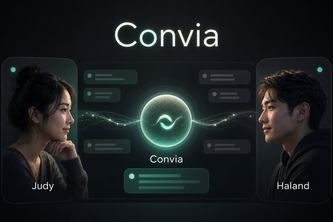
Convia is a messenger product that integrates AI as a distinct participant in human conversations. The author describes it as an experimental project built during the OpenAI 2026 hackathon, evolving from an earlier prototype called Pisces. It allows real people to communicate with each other while also engaging an AI agent (named Convia) within the same conversation thread. The AI replies are visible to both parties and do not impersonate either user.
What changed
The project evolved significantly during the Build Week period, shifting from a phone-shaped mockup into a desktop and mobile product with a redesigned interface. Key technical changes included migrating core text and voice capabilities to OpenAI APIs, implementing idempotency, bounded history, account quotas, and safer third-person forwarding.
Single most important open question
Is there evidence that this concept has traction or commercial viability beyond the experimental phase? The description does not provide any data on user adoption, revenue, or market validation.
What The Product Actually Is
The description states that Convia is a messenger where AI joins real human conversations as itself—helping people coordinate, understand intent, and communicate without impersonating anyone. It combines person-to-person messaging with an AI participant named Convia. In shared conversations, both users see the same AI reply.
It includes features such as:
- Private AI chat
- Streaming responses
- Voice recording and transcription
- Text-to-speech
- Realtime AI call
- Contact groups
- Unread state
- Image generation
- Music generation
The central idea is not to add more AI tools but to make AI a recognizable participant in communication between real people.
Evidence
- The author describes Convia as a messenger where AI participates in conversations.
- Features like shared AI replies, private chat, voice recording, and music generation are listed.
- It supports both desktop and mobile experiences.
Inference The product is described as a hybrid of human communication and AI assistance within the same interface. However, no evidence exists about actual usage or adoption beyond the prototype stage.
Positioning & Claim Evolution
The author positions Convia as an evolution of ChatGPT’s role—moving away from being a general-purpose AI assistant to becoming a messenger where AI becomes part of everyday human relationships and conversations.
Key claims:
- ChatGPT Desktop's attempt to merge coding work and daily communication failed due to mismatched rhythms.
- Codex deserves a focused workspace; ChatGPT should become a messenger.
- AI should be a recognizable participant in communication, not an impersonator.
- The product aims to build the everyday life entry point OpenAI has said it wants to build.
Evidence
- The author explicitly states these positions in the write-up.
- They reference prior prototypes (Pisces) and describe how Convia evolved during Build Week.
Inference The positioning suggests a strategic shift from tool-based AI interaction toward relationship-based communication. However, this is self-described intent rather than proof of traction or market alignment.
Target Customer & ICP
The description does not clearly define target customers or ideal customer profiles (ICP). It implies that the product targets individuals who engage in personal conversations and want AI to assist them without impersonating themselves.
It mentions two demo identities—Judy and Haland—to illustrate how users interact with Convia within a conversation. These are used for judging purposes only, not indicative of real-world users.
Evidence
- The author refers to "real people" and "human conversations."
- Demo identities (Judy and Haland) are used for testing but not described as representative customers.
Inference The ICP likely includes individuals who value authentic communication and wish to integrate AI into their daily interactions. No evidence supports specific demographics or use cases beyond the demo setup.
Business Model & Pricing Evidence
There is no mention of pricing, monetization strategies, or business models in the description. The project appears to be a hackathon submission with no indication of commercial viability or revenue streams.
Evidence
- No pricing information, subscription tiers, or monetization plans are provided.
- The focus remains on product functionality and technical implementation.
Inference While the author hints at future directions involving consent controls and richer group conversations, there is no evidence of a defined business model or pricing structure.
Technical & Delivery Signals
The project was built using:
- Frontend: React 18 + Vite on Vercel
- Backend: Flask on Google Cloud Run
- Data storage: Firestore
- Realtime communication: Ably
- Media storage: Vercel Blob
- AI services: OpenAI Responses, Audio, Realtime APIs; Gemini for image generation and music planning
Key technical improvements during Build Week:
- Interface redesign to resemble ChatGPT
- Migration of text and voice capabilities to OpenAI APIs
- Implementation of idempotency, bounded history, account quotas, friendship validation, and reconciliation tests
- Support for multiple judge accounts via isolated hostnames
Evidence
- The author lists technologies used.
- Technical changes during Build Week are detailed.
Inference The technical stack indicates a modern, scalable architecture. However, the lack of production data or performance metrics limits assessment of maturity or scalability beyond the prototype stage.
Traction & Maturity Signals
There is no evidence of traction, customer adoption, or product maturity beyond the experimental phase. The project was submitted to a hackathon and lacks any indication of real-world usage or user feedback.
Evidence
- The description refers to a demo environment with two judge identities.
- No mention of users, customers, or market validation.
- The project is described as an experiment and prototype.
Inference The product shows early-stage development and conceptual maturity but lacks any indication of real-world traction or commercial success.
Competitive Context
No competitive analysis or references to existing products are included in the description. The author does not name competitors or describe how Convia compares to similar offerings.
Evidence
- No mention of competing platforms or market positioning.
- The focus is on the unique value proposition of AI as a participant rather than comparison with others.
Inference Without explicit references to competitors, it's unclear whether Convia addresses a gap in the market or replicates existing functionality. This leaves open questions about differentiation and competitive advantage.
Open Questions & Risks
Several potential risks and open questions emerge from the description:
- The product is described as experimental and not yet validated in production.
- There is no evidence of revenue, customers, or adoption.
- The author notes that the hardest problem was preserving trustworthy communication semantics around AI responses—suggesting complexity in implementation and trust management.
- The reliance on OpenAI APIs introduces dependency risks.
- The lack of clear monetization or business model raises concerns about long-term viability.
Evidence
- The description emphasizes experimental nature and technical challenges.
- No evidence of commercial traction or financial sustainability.
Inference The project is in early development, with significant unknowns regarding scalability, user trust, and market demand. Risks include over-reliance on external APIs and lack of validated product-market fit.
Questions the description leaves open
- What specific problems are you trying to solve for users? How do you know they exist?
- Have you tested the concept with real users beyond the demo setup?
- Is there a plan for monetization or revenue generation?
- How do you ensure that AI responses maintain trust and clarity in human conversations?
- What are the key assumptions about user behavior and adoption?
- Are there any legal or ethical considerations around AI participation in personal communication?
- What is your roadmap beyond this prototype?
Overall Assessment
Not evidenced
The description provides no data on revenue, customers, traction, or market validation. It describes a conceptually interesting but unproven product in an experimental phase. There is insufficient evidence to assess commercial viability or investment potential.
Confidence Level Low This analysis is based entirely on self-reported information and lacks any independent verification or historical data. Any conclusions drawn are speculative and should not be taken as definitive.
User Stories BotA demo video on every pull request
Get a demo video on every new feature
GitHub App that watches your pull requests and records a narrated, captioned demo.
Save time on demo prep and make informed decisions faster with a video walkthrough of every new feature.
Source
Submitted to the OpenAI 2026 hackathon on Devpost. Project home on Devpost. Back to the full gallery on Devpost.
This competitive analysis was produced by top-founders.com (opens in a new tab)
Generated by a language model from this project's public Devpost page — its tagline, the author's own write-up and any built-with tags listed there — as captured in August 2026. Short quotations are the author's words. It is an opinion on the idea as a business, not on the people behind it, and it reflects the description as published then. If the project has moved on, request a correction below. The analysis is not independent research and contains no verified traction, revenue or customer data.
An independent guide by KFG International LLC — not affiliated with, endorsed by, or connected to Devpost or OpenAI.