

Archive position — measured, not model output
0 likes on Devpost
2,263 of the 7,850 archived projects have more likes, and 5,587 share exactly 0 — so this project's #3,517 place in the like-ranked listing is a tie-break inside that group, not a ranking.
Projects (log scale)
Likes on Devpost. ▲ marks this project's group.
Show the figures
| Likes | Projects | Share of archive |
|---|---|---|
| 0 | 5,587 | 71.2% |
| 1 | 1,758 | 22.4% |
| 2 | 284 | 3.6% |
| 3–4 | 132 | 1.7% |
| 5–9 | 75 | 1.0% |
| 10+ | 14 | 0.2% |
 User Stories BotA demo video on every pull request
Get a demo video on every new feature
GitHub App that watches your pull requests and records a narrated, captioned demo.
Save time on demo prep and make informed decisions faster with a video walkthrough of every new feature.
Executive Summary
Company: ConvoSync
Self-reported basis: The analysis is based entirely on the author's own description of ConvoSync as submitted to the OpenAI 2026 hackathon on Devpost. No external verification or historical data are available.
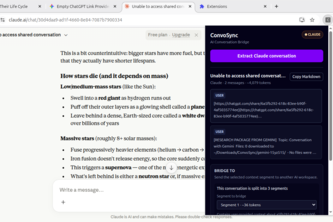
What it appears to be: A Chrome extension that extracts AI conversations from platforms like ChatGPT, Claude, Gemini, and others, then bridges them to other AI platforms or exports them to NotebookLM, preserving context, code blocks, tables, and file references.
What changed: The author states they built this tool in response to the siloed nature of AI conversation tools. They claim to have solved technical challenges around browser extension architecture (MV3), DOM parsing, semantic chunking, and cross-platform bridging using Codex.
Single most important open question: Is there any evidence of user adoption or commercial traction beyond the author's own use case?
What The Product Actually Is
The description states that ConvoSync is a Chrome extension. It is described as:
- A tool to extract full AI conversations from platforms such as ChatGPT, Claude, Gemini, Perplexity, and Copilot.
- Capable of preserving context, including roles, code blocks, tables, file references, and metadata.
- Able to bridge conversations to other AI platforms (e.g., Gemini or Claude) with one click.
- Capable of exporting to NotebookLM as a structured research source.
It is built using:
- Manifest V3 Chrome extension architecture
- React 18 for the popup UI
- TypeScript in strict mode
- Pure client-side processing — no server, no data leaves the browser
The author claims it uses Codex to accelerate development of core technical components like DOM parsers, smart chunking algorithms, and bridge injection logic.
Inference: The product is a browser-based tool designed for individual users who work across multiple AI platforms and want to move conversations between them.
Positioning & Claim Evolution
The author states that ConvoSync was built in response to the siloes between AI tools, where a conversation in one platform cannot be moved to another.
Claim: It bridges these silos by extracting and transferring conversations with full context.
Evolution of claims:
- The initial inspiration is personal: the author uses multiple AI platforms daily.
- The product is positioned as a solution for workflow fragmentation.
- The author emphasizes context preservation, which they claim is critical for meaningful conversation transfer.
Inference: The positioning is centered on user convenience and interoperability, not enterprise or scale. It is framed as a tool for individuals, not organizations.
Target Customer & ICP
The description states that the author uses ChatGPT, Claude, and Gemini daily and builds for users with similar workflows.
Claim: The target customer is someone who works across multiple AI platforms and wants to move conversations between them.
Inference: Based on the self-reported use case, the ICP appears to be individuals or small teams who are active in AI research or development and need to switch between tools.
Not evidenced: No explicit segmentation of customer types, no evidence of personas, or target industries.
Business Model & Pricing Evidence
The description does not state anything about a business model or pricing.
Inference: Since it is a Chrome extension built as a hackathon project, and there is no mention of monetization, the product appears to be non-commercial at this stage.
Not evidenced: No revenue model, pricing structure, or commercial intent.
Technical & Delivery Signals
The author describes:
- A Manifest V3 Chrome extension
- Built with React 18, TypeScript, and Tailwind CSS
- Pure client-side processing — no server
- Uses Codex to accelerate development of parsers, chunking logic, and injection layers
- Overcame technical challenges like:
- MV3 content script limitations (IIFE bundling)
- File attachment detection issues
- Cross-origin injection restrictions
Inference: The tool is technically feasible and addresses browser-level architectural constraints. It shows a strong understanding of browser APIs and AI platform interfaces.
Not evidenced: No evidence of performance benchmarks, scalability, or production deployment beyond the hackathon context.
Traction & Maturity Signals
The description states:
- It was built for the OpenAI 2026 hackathon
- The author is the sole team member
- No mention of users, downloads, or adoption metrics
Inference: This is a proof-of-concept or prototype, not a product with traction.
Not evidenced: No evidence of:
- Users or customer base
- Downloads or usage statistics
- Revenue or monetization
- Product-market fit or user feedback
Competitive Context
The description does not mention any competitors or existing tools in this space.
Inference: The author appears to be unaware of or not referencing existing solutions for bridging AI conversations across platforms. This could indicate either:
- A lack of awareness of the competitive landscape
- A niche or underserved market
Not evidenced: No mention of similar tools, market analysis, or competitive positioning.
Open Questions & Risks
- No commercial traction or user base: The product is described as a hackathon submission with no evidence of adoption.
- Single-person team: Only one developer (the author) is involved, which may limit scalability and long-term development.
- Browser extension limitations: The tool is constrained by browser security and MV3 architecture, which may limit future features or integrations.
- No monetization strategy: No indication of how the product will be monetized or scaled.
- Unverified claims: All technical and functional claims are self-reported and unverified.
Questions the description leaves open
- What is your actual use case for this tool? Is it personal, or do you see a broader market?
- Have you tested the tool with others, or is it purely experimental?
- Are there any plans to monetize or scale this beyond a personal utility?
- How do you plan to address browser security limitations in future versions?
- What are your thoughts on the competitive landscape? Are there existing tools that solve similar problems?
Overall Assessment
Assessment: Not evidenced.
The description does not provide sufficient evidence of commercial viability, traction, or scalability to support an investment or partnership decision.
Inference: This is a personal project or prototype, likely built for the author’s own workflow. It lacks any indication of market demand, monetization, or long-term product strategy.
Confidence level: Low — based on self-reported evidence only, with no external validation or traction data.
User Stories BotA demo video on every pull request
Get a demo video on every new feature
GitHub App that watches your pull requests and records a narrated, captioned demo.
Save time on demo prep and make informed decisions faster with a video walkthrough of every new feature.
Source
Submitted to the OpenAI 2026 hackathon on Devpost. Project home on Devpost. Back to the full gallery on Devpost.
This competitive analysis was produced by top-founders.com (opens in a new tab)
Generated by a language model from this project's public Devpost page — its tagline, the author's own write-up and any built-with tags listed there — as captured in August 2026. Short quotations are the author's words. It is an opinion on the idea as a business, not on the people behind it, and it reflects the description as published then. If the project has moved on, request a correction below. The analysis is not independent research and contains no verified traction, revenue or customer data.
An independent guide by KFG International LLC — not affiliated with, endorsed by, or connected to Devpost or OpenAI.