

Archive position — measured, not model output
0 likes on Devpost
2,263 of the 7,850 archived projects have more likes, and 5,587 share exactly 0 — so this project's #3,515 place in the like-ranked listing is a tie-break inside that group, not a ranking.
Projects (log scale)
Likes on Devpost. ▲ marks this project's group.
Show the figures
| Likes | Projects | Share of archive |
|---|---|---|
| 0 | 5,587 | 71.2% |
| 1 | 1,758 | 22.4% |
| 2 | 284 | 3.6% |
| 3–4 | 132 | 1.7% |
| 5–9 | 75 | 1.0% |
| 10+ | 14 | 0.2% |
 User Stories BotA demo video on every pull request
Get a demo video on every new feature
GitHub App that watches your pull requests and records a narrated, captioned demo.
Save time on demo prep and make informed decisions faster with a video walkthrough of every new feature.
Executive Summary
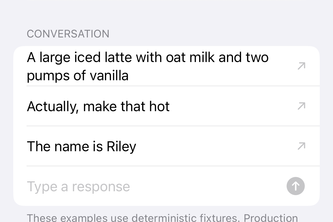
The company appears to be a solo developer project named Conversational Forms, an iOS SwiftUI package aimed at enhancing retail customer experiences by enabling conversational form inputs. The author states this is a hackathon submission built with Swift and LLMs (Codex, GPT), intended as a proof-of-concept for a broader vision of conversational retail interfaces.
What changed: The project was submitted to the OpenAI 2026 hackathon, indicating an initial public release or prototype. It is not evidenced that this has evolved into a product with customers, revenue, or distribution beyond its author's own development and documentation efforts.
The single most important open question: Is there any evidence of real-world adoption, customer feedback, or traction beyond the author’s self-reported development process?
What The Product Actually Is
The description states:
- Conversational Forms is a SwiftUI package that wraps forms to make them "ambiently intelligent."
- It uses on-device transcription and inference to convert spoken words into form inputs.
- It is built using Swift, and the author used Codex and GPT for development assistance.
Inference: The product is a developer-facing tool, not an end-user application. It is designed to be integrated into other iOS apps or systems (e.g., POS plugins), not used standalone.
Positioning & Claim Evolution
The description states:
- The author's inspiration was based on personal experience in retail and customer service.
- The goal is to make the retail experience more human and connected, by reducing reliance on data entry screens.
- The package aims to "make every retail experience conversant and more connected."
Inference: The positioning is aspirational, framed around improving human connection in retail. It does not yet claim to be a commercial product or service but rather a prototype or developer tool with potential for broader application.
Target Customer & ICP
The description states:
- The author’s target is retail workers and systems that manage customer orders.
- The end-user experience is described as one where “the barista is heads down in a screen converting your words into a data structure.”
- The package is intended to be used by developers building iOS apps or POS plugins, not directly by customers.
Inference: The ICP is likely iOS developers working on retail or service-oriented apps, or retail tech teams looking for conversational UI tools. No evidence of actual customer segments or personas is provided.
Business Model & Pricing Evidence
The description states:
- The project is a SwiftUI package, not a commercial product.
- It was built as a hackathon submission and is described as a proof-of-concept.
- No pricing, monetization strategy or business model is mentioned.
Inference: There is no evidence of a business model or pricing structure. The project appears to be an open-source or developer tool, not a commercial offering.
Technical & Delivery Signals
The description states:
- Built with Swift, using on-device transcription and inference.
- Development was aided by Codex and GPT 5.6.
- The author used iterative development and testing with LLMs.
- Documentation was refined using Codex.
Inference: The technical approach is feasible, leveraging modern iOS and AI capabilities. However, no evidence of production use, scalability or performance data is provided.
Traction & Maturity Signals
The description states:
- This is a hackathon submission, not a product with customers or revenue.
- The author says they are proud of how quickly it was built and intend to work on it for years.
- No evidence of user feedback, adoption, or usage metrics is provided.
Inference: There is no traction or maturity evidence beyond the author’s own development process. It is not evidenced that the package has been used in production or by others.
Competitive Context
The description states:
- The author researched existing packages using Codex to inform their approach.
- No mention of competitors, similar tools, or market positioning is provided.
Inference: There is no evidence of competitive analysis or awareness of existing solutions in the space. The project appears to be a novel idea from the author’s perspective, but not validated against a competitive landscape.
Open Questions & Risks
- No commercial traction or revenue: The project is described as a hackathon submission with no evidence of adoption or monetization.
- Unproven market demand: No customer feedback or use cases are provided to validate the need for this tool.
- Solo developer effort: With only one member, there is no team structure or scalability in place.
- No production data or performance metrics: The package’s real-world utility is untested.
Questions the description leaves open
- What specific retail use cases have you tested this with?
- Have any developers or retailers expressed interest in adopting or integrating this package?
- How do you plan to monetize or distribute this tool beyond the current prototype?
- What are the technical limitations of on-device transcription and inference in real-world retail environments?
- Are there any partnerships or integrations planned with POS vendors or retail platforms?
Overall Assessment
Not evidenced: There is no evidence of commercial traction, revenue, customers, or a clear path to monetization. The project is described as a hackathon prototype and developer tool with no indication of market validation or scalability.
Confidence level: Low. This is a self-reported, unverified idea with no external corroboration. It may be an early-stage concept or proof-of-concept that has not yet demonstrated real-world utility or commercial viability.
User Stories BotA demo video on every pull request
Get a demo video on every new feature
GitHub App that watches your pull requests and records a narrated, captioned demo.
Save time on demo prep and make informed decisions faster with a video walkthrough of every new feature.
Source
Submitted to the OpenAI 2026 hackathon on Devpost. Project home on Devpost. Back to the full gallery on Devpost.
This competitive analysis was produced by top-founders.com (opens in a new tab)
Generated by a language model from this project's public Devpost page — its tagline, the author's own write-up and any built-with tags listed there — as captured in August 2026. Short quotations are the author's words. It is an opinion on the idea as a business, not on the people behind it, and it reflects the description as published then. If the project has moved on, request a correction below. The analysis is not independent research and contains no verified traction, revenue or customer data.
An independent guide by KFG International LLC — not affiliated with, endorsed by, or connected to Devpost or OpenAI.