

Archive position — measured, not model output
0 likes on Devpost
2,263 of the 7,850 archived projects have more likes, and 5,587 share exactly 0 — so this project's #3,492 place in the like-ranked listing is a tie-break inside that group, not a ranking.
Projects (log scale)
Likes on Devpost. ▲ marks this project's group.
Show the figures
| Likes | Projects | Share of archive |
|---|---|---|
| 0 | 5,587 | 71.2% |
| 1 | 1,758 | 22.4% |
| 2 | 284 | 3.6% |
| 3–4 | 132 | 1.7% |
| 5–9 | 75 | 1.0% |
| 10+ | 14 | 0.2% |
 User Stories BotA demo video on every pull request
Get a demo video on every new feature
GitHub App that watches your pull requests and records a narrated, captioned demo.
Save time on demo prep and make informed decisions faster with a video walkthrough of every new feature.
Executive Summary
What the company appears to be
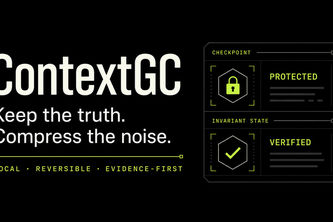
ContextGC is a self-reported tool designed as a "continuity and audit tool" for AI-assisted development environments, specifically targeting Codex users who work on long-running tasks across multiple threads. It claims to manage task state by keeping critical goals and constraints recoverable during compaction or thread transitions.
What changed
The author reports building a narrow plugin that operates around the compaction process in Codex, using lifecycle hooks and local storage to preserve information. It was tested through simulated scenarios and real plugin use within Codex.
Single most important open question
Is there any evidence of actual usage, adoption or revenue generation beyond the author's own testing?
Note: This analysis is based entirely on the self-reported project description provided by the caller. No external verification or historical data is available. All claims are treated as unverified statements made by the author.
What The Product Actually Is
The description states that ContextGC:
- Packages a Codex skill, six lifecycle hooks, and six local MCP tools.
- Turns current tasks into a "bounded Task Frame".
- Separates information into three actions:
- KEEP exact goals and constraints active;
- SUMMARIZE eligible explanation;
- EXTERNALIZE sanitized source to a local hash-addressed archive.
- Deliberately has no DROP action.
- Verifies checkpoint, snapshot, and hook state before compaction.
- Can load verified Task Frames after compaction or in fresh threads.
- Keeps data local by default; model-visible results contain an opaque store ID rather than absolute paths.
- Minimizes common credential patterns (email, phone, home path) before persistence.
Inference: The tool appears to be a lightweight control plane around Codex task management, focused on preserving context and enabling recovery across thread boundaries. It is not described as replacing native compaction or offering full memory management.
Positioning & Claim Evolution
The author states:
- Initially considered creating a tool that could replace the native compactor.
- Realized this was not possible due to token limitations and constraint fidelity issues.
- Shifted focus to building a "reversible control plane around compaction".
- Describes itself as a "continuity and audit tool", not a credit-saving product.
- Reports that its 15%-versus-both savings gate failed, indicating it did not achieve cost reduction goals.
Inference: The positioning evolved from a broad solution to a narrow one focused on safety and recovery rather than efficiency. The author acknowledges the failure of an economic optimization goal, which may reflect early-stage product thinking or misalignment with user needs.
Target Customer & ICP
The description states:
- The author works on several AI-assisted projects at once.
- The tool is intended for users who handle long sessions and must maintain context across threads.
- It targets developers using Codex in software engineering workflows.
- No explicit mention of enterprise customers or broader market segments.
Inference: The primary target appears to be individual developers working with AI-assisted coding tools like Codex, particularly those managing complex, multi-threaded tasks. There is no evidence of a defined ICP beyond the author’s personal use case.
Business Model & Pricing Evidence
The description states:
- Normal installed use keeps data local.
- Model-visible results contain an opaque store ID rather than absolute paths.
- No mention of pricing tiers, subscriptions, or monetization strategy.
- The tool is described as a plugin for Codex and not as a standalone service.
Inference: There is no evidence of a business model or pricing structure. The tool seems to be built for personal use or internal development environments, with no indication of commercial offering or revenue generation.
Technical & Delivery Signals
The description states:
- Built with TypeScript, React, Node.js, OpenAI, MCP, and Vinext.
- Implements SHA-256 content-addressed evidence archive.
- Uses atomic checkpoint, mirror, and latest-pointer publication.
- Includes lifecycle hooks, CLI, and MCP server components.
- Tested using frozen fixtures, hidden deterministic oracles, and negative controls.
- Hardening work includes stale plugin caches, corrupt checkpoint lineage, transactional publication, bounded state reads, unknown compaction triggers, and normalized local file URI redaction.
Inference: The technical stack suggests a developer-focused tool with strong emphasis on integrity, control, and local persistence. It shows some sophistication in handling edge cases but lacks evidence of production deployment or scalability beyond testing.
Traction & Maturity Signals
The description states:
- Tested in two different ways: simulated traces and real plugin use.
- Demonstrated 100% critical retention across tasks.
- Used a fixed 75% threshold, adaptive policy, and manual schedule for comparison.
- Found that ContextGC used 3.20% less UPVS than the fixed policy but 9.36% more than the frozen manual schedule.
- The project's "15%-versus-both savings gate failed".
- No mention of user feedback, adoption metrics, or real-world deployment.
Inference: There is no evidence of traction beyond internal testing. The author reports performance comparisons but does not provide data on actual usage, customer feedback, or market validation.
Competitive Context
The description states:
- No direct competitors are named.
- Focuses on Codex-specific workflows and task continuity.
- Not described as competing with other memory management tools or AI assistants.
- The tool is presented as a niche solution for developers working in AI-assisted environments.
Inference: There is no evidence of competitive analysis or market positioning against existing tools. The project appears to be addressing an unmet need within a specific subset of Codex users, without clear visibility into broader market dynamics.
Open Questions & Risks
The description states:
- No automatic deletion feature.
- No supported token-to-credit estimate.
- Tool does not claim complete PII detection or encryption.
- The author explicitly says the tool is not a proven credit-saving product.
- Failed economics gate suggests potential misalignment with user expectations.
Inference: Key risks include lack of commercial traction, unclear monetization strategy, and failure to meet performance goals. The absence of any revenue, customer data, or market validation raises concerns about viability as a product or business.
Questions the description leaves open
- What specific problems are you solving for users beyond the author’s own use case?
- How do you plan to scale this tool beyond personal development environments?
- Are there any plans for monetization or commercial partnerships?
- Has the tool been tested with actual users outside of the author's testing framework?
- What is your roadmap for addressing the failed economics gate?
- Do you have any data on how often users encounter issues during compaction or recovery?
Overall Assessment
The description states:
- The project was submitted to the OpenAI 2026 hackathon.
- No evidence of funding, revenue, or customer traction.
- The author describes it as a "first version" and acknowledges that a failed promotion gate is useful product information.
- There is no indication of commercial interest or strategic alignment with investors or partners.
Inference: Based on the self-reported description alone, there is insufficient evidence to support an investment or partnership decision. The project lacks demonstrated traction, revenue, or clear market demand. It appears to be a proof-of-concept or early-stage prototype with no verified business model or user base.
User Stories BotA demo video on every pull request
Get a demo video on every new feature
GitHub App that watches your pull requests and records a narrated, captioned demo.
Save time on demo prep and make informed decisions faster with a video walkthrough of every new feature.
Source
Submitted to the OpenAI 2026 hackathon on Devpost. Project home on Devpost. Back to the full gallery on Devpost.
This competitive analysis was produced by top-founders.com (opens in a new tab)
Generated by a language model from this project's public Devpost page — its tagline, the author's own write-up and any built-with tags listed there — as captured in August 2026. Short quotations are the author's words. It is an opinion on the idea as a business, not on the people behind it, and it reflects the description as published then. If the project has moved on, request a correction below. The analysis is not independent research and contains no verified traction, revenue or customer data.
An independent guide by KFG International LLC — not affiliated with, endorsed by, or connected to Devpost or OpenAI.