

Archive position — measured, not model output
0 likes on Devpost
2,263 of the 7,850 archived projects have more likes, and 5,587 share exactly 0 — so this project's #3,473 place in the like-ranked listing is a tie-break inside that group, not a ranking.
Projects (log scale)
Likes on Devpost. ▲ marks this project's group.
Show the figures
| Likes | Projects | Share of archive |
|---|---|---|
| 0 | 5,587 | 71.2% |
| 1 | 1,758 | 22.4% |
| 2 | 284 | 3.6% |
| 3–4 | 132 | 1.7% |
| 5–9 | 75 | 1.0% |
| 10+ | 14 | 0.2% |
 User Stories BotA demo video on every pull request
Get a demo video on every new feature
GitHub App that watches your pull requests and records a narrated, captioned demo.
Save time on demo prep and make informed decisions faster with a video walkthrough of every new feature.
Executive Summary
What the company appears to be
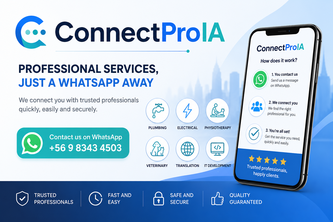
ConnectProIA is an AI-powered platform designed to connect users with local service professionals via WhatsApp and Instagram. The author states that it uses AI to interpret user requests, classify services, qualify leads, and route opportunities automatically. It is described as a marketplace for local services, built around AI-driven lead flow and matching logic.
What changed
The project was submitted to the OpenAI 2026 hackathon, indicating an early-stage development effort. The author describes it as a prototype or MVP that addresses a real-world problem in local service discovery. It is not evidenced to have launched or scaled beyond this submission.
Single most important open question
Is there evidence of traction, revenue, or customer adoption beyond the self-reported project description?
What The Product Actually Is
The description states that ConnectProIA is an AI-powered platform that turns WhatsApp and Instagram conversations into booked customers for local businesses. It uses AI to reply to users, qualify leads, and route opportunities automatically.
It also claims to help users describe their problems in natural language, which the system then analyzes to identify the type of service needed and match them with a professional.
The author describes it as more than a chatbot — it is built to support workflows where AI structures conversations, reduces friction, and supports connection between users and professionals.
Evidence
- The platform uses AI to understand user needs and route requests.
- It integrates with WhatsApp and Instagram.
- It includes backend services, lead flow logic, professional catalogs, service classification, automation checks, and admin tools.
- It is built using technologies like FastAPI, Docker, PostgreSQL, OpenAI, GPT, and webhooks.
Inference It appears to be a marketplace or lead-generation platform for local service providers. The AI layer is central to its functionality, but the exact nature of its automation or routing logic is not detailed.
Positioning & Claim Evolution
The author positions ConnectProIA as a solution to the fragmented and slow process of finding local professionals. It is described as addressing a gap in platforms like Facebook Marketplace that are built for products, not services.
It claims to be an AI-powered marketplace for local services, where users can describe their needs in natural language and get matched with professionals who can help.
The author also states that the platform helps professionals grow their businesses by offering qualified leads and a structured way to connect with customers.
Evidence
- The product is positioned as solving a real-world problem: “people do not know where to look” for local services.
- It is described as a marketplace for service discovery, not product sales.
- It uses AI to understand user needs and match them with professionals.
Inference The positioning has evolved from a simple idea (finding local help) to a more structured platform that leverages AI to automate lead flow and matching. The author emphasizes the importance of workflow and context in making AI useful, not just for generating text but for enabling action.
Target Customer & ICP
The description states that ConnectProIA targets two main groups:
- Users looking for local services (e.g., plumbing, electrical work, locksmiths, physical therapy).
- Professionals who want to grow their businesses, earn extra income, or become independent entrepreneurs.
It also mentions that the platform is designed for people who do not have access to advanced digital tools and are often reliant on informal recommendations or Facebook groups.
Evidence
- Users describe problems in natural language.
- Professionals want to showcase services and receive qualified leads.
- The platform is built for local service discovery, not product sales.
Inference The ICP appears to be local tradespeople or service providers who are under-served by existing platforms. The user base likely includes individuals seeking help with everyday problems, such as home repairs or health-related services.
Business Model & Pricing Evidence
There is no evidence in the description of a business model or pricing structure. The author does not state how the platform monetizes its service, whether through commissions, subscriptions, lead fees, or other mechanisms.
Evidence
- No mention of revenue streams.
- No mention of pricing tiers or models.
- No indication of how professionals are compensated or how users pay for services.
Inference The business model is not described. It could be a freemium model, a commission-based system, or a marketplace where professionals pay to list their services. However, no evidence supports any of these assumptions.
Technical & Delivery Signals
The author states that ConnectProIA was built using technologies such as:
- AI/ML: GPT, OpenAI
- Backend: FastAPI, Docker, PostgreSQL
- Frontend: HTML, CSS, JavaScript
- Integration: WhatsApp, Instagram, webhooks
- Tools: GitHub, REST APIs
It also mentions that the system includes backend services, lead flow logic, professional catalogs, service classification, automation checks, and admin tools.
Evidence
- The platform uses AI for intent recognition and service categorization.
- It has a documented customer journey and workflow.
- It is built with modern development practices (Docker, FastAPI, REST APIs).
Inference The technical stack suggests a scalable, API-driven architecture. However, there is no evidence of production deployment or performance data.
Traction & Maturity Signals
There is no evidence of traction, revenue, or customer adoption beyond the project description.
Evidence
- The project was submitted to a hackathon.
- No mention of users, customers, or revenue.
- No mention of product usage metrics or growth.
Inference The platform appears to be in an early-stage prototype or MVP phase. It is not evidenced to have launched or scaled beyond the development stage.
Competitive Context
The author states that Facebook Marketplace works well for products but not for service discovery, and that there is a gap in platforms designed specifically for local professionals.
Evidence
- The platform addresses a gap in existing tools.
- It is positioned as an AI-powered alternative to informal search methods (e.g., Facebook groups).
Inference It competes with informal networks, social media groups, and general marketplaces like Facebook Marketplace. However, no specific competitors are named or described.
Open Questions & Risks
- No traction or revenue evidence: The platform is not evidenced to have launched or generated any revenue.
- Unproven AI capabilities: While the platform claims to use AI for intent recognition and routing, there is no demonstration of performance or accuracy.
- Unclear monetization model: No business model or pricing structure is described.
- Single-founder team: The team size is listed as one person, which may limit execution capacity.
- No customer feedback or validation: There is no evidence of user testing or feedback loops.
Evidence
- No revenue, customers, or usage data.
- No mention of a monetization strategy.
- No evidence of product-market fit or user validation.
Questions the description leaves open
- What specific AI models are used for intent recognition and service classification?
- How does the platform validate that users' needs are accurately interpreted?
- What is the current stage of development, and how close is it to a production-ready version?
- Have you conducted any user testing or feedback sessions with real users or professionals?
- What is your plan for monetization, and how do you intend to scale the platform?
- How do you plan to verify or authenticate professionals on the platform?
- Are there any partnerships or integrations in place with WhatsApp or Instagram?
Overall Assessment
Not evidenced.
The project is described as a hackathon submission and not evidenced to have any traction, revenue, or customer adoption. The business model, monetization strategy, and scalability are not detailed.
Given the lack of evidence for product-market fit, revenue, or user engagement, it is not possible to assess whether this represents a viable investment or partnership opportunity at this stage.
Confidence level Low. The description provides no data on performance, adoption, or commercial viability.
User Stories BotA demo video on every pull request
Get a demo video on every new feature
GitHub App that watches your pull requests and records a narrated, captioned demo.
Save time on demo prep and make informed decisions faster with a video walkthrough of every new feature.
Source
Submitted to the OpenAI 2026 hackathon on Devpost. Project home on Devpost. Back to the full gallery on Devpost.
This competitive analysis was produced by top-founders.com (opens in a new tab)
Generated by a language model from this project's public Devpost page — its tagline, the author's own write-up and any built-with tags listed there — as captured in August 2026. Short quotations are the author's words. It is an opinion on the idea as a business, not on the people behind it, and it reflects the description as published then. If the project has moved on, request a correction below. The analysis is not independent research and contains no verified traction, revenue or customer data.
An independent guide by KFG International LLC — not affiliated with, endorsed by, or connected to Devpost or OpenAI.