

Archive position — measured, not model output
0 likes on Devpost
2,263 of the 7,850 archived projects have more likes, and 5,587 share exactly 0 — so this project's #5,436 place in the like-ranked listing is a tie-break inside that group, not a ranking.
Projects (log scale)
Likes on Devpost. ▲ marks this project's group.
Show the figures
| Likes | Projects | Share of archive |
|---|---|---|
| 0 | 5,587 | 71.2% |
| 1 | 1,758 | 22.4% |
| 2 | 284 | 3.6% |
| 3–4 | 132 | 1.7% |
| 5–9 | 75 | 1.0% |
| 10+ | 14 | 0.2% |
 User Stories BotA demo video on every pull request
Get a demo video on every new feature
GitHub App that watches your pull requests and records a narrated, captioned demo.
Save time on demo prep and make informed decisions faster with a video walkthrough of every new feature.
Executive Summary
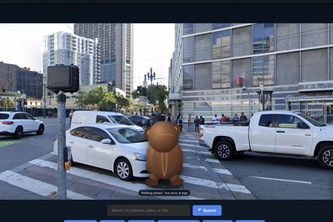
What the company appears to be: A self-reported project named My Magic Map AGI describes an interactive, body-controlled digital map experience that uses webcam gestures to navigate Street View, with an AI voice companion (pet) that identifies objects and provides discovery resources. The product is built using a mix of web technologies including React, TensorFlow.js, MediaPipe, OpenAI GPT-5.6, and Google Maps APIs.
What changed: This is a hackathon submission — not a commercial product or company in operation. It was built as part of the OpenAI 2026 hackathon and has no evidence of revenue, customers, or market traction.
Single most important open question: Is this project intended to evolve into a commercial product or service? The description does not indicate any transition from prototype to business model, nor does it suggest any funding, team, or go-to-market strategy beyond the hackathon submission.
Analysis basis: Self-reported only. No evidence of revenue, customers, funding, or operational history. All claims are from the author’s own description and are unverified.
What The Product Actually Is
The description states that My Magic Map AGI is a digital map experience where users interact with Street View using body gestures (walking in place, shoulder steering, flying pose) via webcam tracking. It includes an AI voice companion (a pet) that responds to user queries about objects seen in the environment.
Key features include:
- Body-controlled navigation through Street View
- Object identification and discovery via pointing or gaze
- Integration with Google Maps and 3D views
- AI-powered visual reasoning using GPT-5.6 and OpenAI Realtime
- Collection, journaling, and postcard generation capabilities
Inference: The product is described as a prototype built for a hackathon, not a commercial offering.
Positioning & Claim Evolution
The author positions the product as an attempt to make digital exploration feel more like real-life curiosity. It is not simply a map with AI added — rather, it reimagines how people interact with maps through physical movement and AI companionship.
Claims:
- “Maps were designed for taps, clicks, and pins. But real exploration is physical.”
- “It is not simply a map with AI added to it. It is an attempt to make digital exploration feel more like curiosity in real life.”
Claim vs Fact: These are positioning statements, not evidence of adoption or traction.
Target Customer & ICP
The description does not define a specific customer segment or ideal customer profile (ICP). The author describes the experience as playful and exploratory, aimed at users who enjoy curiosity-driven discovery in physical space. However, no explicit user persona or target market is stated.
Not evidenced: No indication of who uses this product, what their needs are, or how they would be reached.
Business Model & Pricing Evidence
There is no evidence of a business model or pricing strategy. The project is described as a hackathon submission with no mention of monetization, subscriptions, or paid features.
Not evidenced: No commercial structure, pricing, or revenue streams are described.
Technical & Delivery Signals
The product is built using:
- Frontend: React, TypeScript, TensorFlow.js, MediaPipe
- Backend: Node/Express server
- AI tools: OpenAI GPT-5.6, Codex, WebRTC, Databricks
- APIs: Google Maps JavaScript API, Google Places, Geocoding
Key technical elements:
- Local webcam gesture tracking (no image sent to cloud)
- Use of pose and hand detection for interaction
- Server-side processing only triggered on explicit discovery request
- Voice companion powered by OpenAI Realtime over WebRTC
Inference: The product is technically complex but remains a prototype, not a scalable or production-ready system.
Traction & Maturity Signals
The project was submitted to the OpenAI 2026 hackathon. There is no evidence of:
- Revenue
- Customers
- Product usage metrics
- Market traction
- Team size or structure
- Deployment or launch status
Not evidenced: No signs of product maturity or commercial viability.
Competitive Context
The description does not mention any competitors or existing products in the same space. It is unclear whether similar experiences already exist, nor how this project differentiates from them.
Not evidenced: No competitive landscape or differentiation analysis provided.
Open Questions & Risks
- Prototype only: The product is a hackathon submission with no commercialization plan.
- No team or funding: Team size is listed as 0; no funding rounds or investors are mentioned.
- Unproven AI integration: While GPT-5.6 and Codex are used, there’s no evidence of real-world performance or reliability.
- Privacy concerns: Though privacy protections are described, the use of webcam input raises potential issues.
- No monetization strategy: No indication of how this would be turned into a business.
Inference: The project lacks commercial viability and is not yet a product in any meaningful sense.
Questions the description leaves open
- What is the intended path from this hackathon prototype to a commercial product?
- Are there plans for user testing, feedback loops, or product iteration beyond the hackathon?
- Has the team considered scalability of the webcam-based gesture tracking and AI inference?
- How would you monetize this experience if it were to become a product?
- What are the legal and privacy implications of collecting webcam data in a browser-based app?
Overall Assessment
This is not a company or product ready for investment or partnership. It is a hackathon submission with no evidence of commercial traction, team, funding, or business model.
Assessment: Not ready for due diligence or investment consideration. The project is a creative prototype, not a viable business opportunity.
User Stories BotA demo video on every pull request
Get a demo video on every new feature
GitHub App that watches your pull requests and records a narrated, captioned demo.
Save time on demo prep and make informed decisions faster with a video walkthrough of every new feature.
Source
Submitted to the OpenAI 2026 hackathon on Devpost. Project home on Devpost. Back to the full gallery on Devpost.
This competitive analysis was produced by top-founders.com (opens in a new tab)
Generated by a language model from this project's public Devpost page — its tagline, the author's own write-up and any built-with tags listed there — as captured in August 2026. Short quotations are the author's words. It is an opinion on the idea as a business, not on the people behind it, and it reflects the description as published then. If the project has moved on, request a correction below. The analysis is not independent research and contains no verified traction, revenue or customer data.
An independent guide by KFG International LLC — not affiliated with, endorsed by, or connected to Devpost or OpenAI.