

Archive position — measured, not model output
0 likes on Devpost
2,263 of the 7,850 archived projects have more likes, and 5,587 share exactly 0 — so this project's #5,437 place in the like-ranked listing is a tie-break inside that group, not a ranking.
Projects (log scale)
Likes on Devpost. ▲ marks this project's group.
Show the figures
| Likes | Projects | Share of archive |
|---|---|---|
| 0 | 5,587 | 71.2% |
| 1 | 1,758 | 22.4% |
| 2 | 284 | 3.6% |
| 3–4 | 132 | 1.7% |
| 5–9 | 75 | 1.0% |
| 10+ | 14 | 0.2% |
 User Stories BotA demo video on every pull request
Get a demo video on every new feature
GitHub App that watches your pull requests and records a narrated, captioned demo.
Save time on demo prep and make informed decisions faster with a video walkthrough of every new feature.
Executive Summary
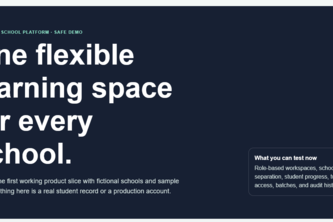
The description states that "My Multi Language School Platform" is a configurable, multi-school platform for self-paced language learning with features including tuition-based access, assessments, progress tracking, and verifiable certificates. The author, Mark Jay Vinluan, built this as a submission to the OpenAI 2026 hackathon using technologies such as Next.js, React, Node.js, PostgreSQL, and TypeScript.
The platform appears to be in early development or conceptual stage, with no evidence of revenue, customers, or traction. The author’s own write-up is minimal — limited to a tagline and technology stack — offering no insight into product-market fit, user adoption, or business model validation.
The single most important open question
What is the actual value proposition to schools or learners, and how does this platform differ from existing language learning tools?
What The Product Actually Is
The description states that the platform is a "configurable, multi-school platform for self-paced language learning." It includes features such as tuition-based access, assessments, progress tracking, and verifiable certificates.
Inference Based on the technology stack (Next.js, React, Node.js, PostgreSQL), it appears to be a web-based SaaS product with a frontend and backend architecture. However, no evidence is provided about how these components interact or whether they are integrated into a working system.
Not evidenced: The actual functionality of the platform beyond its intended features; whether it's a prototype, MVP, or full product.
Positioning & Claim Evolution
The author describes the platform as a "configurable, multi-school platform for self-paced language learning." It is positioned to support tuition-based access and includes assessment and certificate functionalities.
Claim
The platform aims to serve multiple schools with customizable features and self-paced learning environments.
Not evidenced: No evidence of how this product differentiates from existing platforms or what specific value it adds. The description does not indicate any positioning strategy, brand messaging, or prior market validation.
Target Customer & ICP
The description states that the platform is for "self-paced language learning" and supports "tuition-based access," suggesting a focus on educational institutions or learners who want to learn languages independently.
Inference The target customer likely includes schools, language academies, or individual learners seeking structured but flexible language education.
Not evidenced: No evidence of specific buyer personas, customer segments, or use cases. No indication of whether the platform targets K-12, higher education, corporate training, or general learners.
Business Model & Pricing Evidence
The description mentions "tuition-based access," which implies a model where users pay for access to content or services.
Inference The business model may involve subscription or per-use fees, but the exact pricing structure is not described.
Not evidenced: No evidence of pricing tiers, monetization strategy, revenue streams, or customer acquisition costs. The description does not indicate whether this is a B2B or B2C model.
Technical & Delivery Signals
The author states that the platform was built using technologies including codex, eslint, GPT-5.6, Next.js, Node.js, PHP, PostgreSQL, React, TSX, and TypeScript.
Inference The platform is likely a full-stack web application with modern frontend and backend tools, possibly leveraging AI for development (e.g., GPT-5.6).
Not evidenced: No evidence of deployment status, scalability, performance metrics, or technical architecture details. There is no indication of whether the product is live, tested, or production-ready.
Traction & Maturity Signals
The platform was submitted to the OpenAI 2026 hackathon and has a single team member (Mark Jay Vinluan) listed as the creator.
Inference The project appears to be in early development or prototype stage. No evidence of user feedback, customer trials, or product-market fit.
Not evidenced: No evidence of users, revenue, growth metrics, or adoption data. No indication of whether it has been tested with real users or schools.
Competitive Context
The description does not provide any information about competitors or the broader market landscape for language learning platforms.
Inference The platform likely competes in the self-paced language learning space, which includes tools like Duolingo, Babbel, and institutional LMS platforms. However, no evidence of competitive positioning or differentiation is provided.
Not evidenced: No mention of existing solutions, competitive advantages, or market gaps addressed by this product.
Open Questions & Risks
- Lack of traction: The platform has no evidence of users, revenue, or adoption.
- Minimal description: The author provides only a tagline and technology stack — no product details or business model clarity.
- Single founder: A single-person team may limit execution capacity.
- Unverified claims: No validation of the platform’s functionality or market demand.
Not evidenced: No evidence of risks such as regulatory issues, scalability concerns, or technical limitations beyond what is described.
Questions the description leaves open
- What specific problem does this platform solve for schools or learners?
- How does it differ from existing language learning tools in the market?
- Have you tested the platform with real users or institutions?
- What is your monetization strategy and how do you plan to acquire customers?
- What are the key assumptions underlying your product design and business model?
Overall Assessment
The description states that this project was submitted to a hackathon, indicating it is likely in an early stage of development or conceptualization.
Inference At this point, there is no evidence of commercial viability, traction, or a validated business model. The platform appears to be a prototype or proof-of-concept rather than a product ready for investment or partnership.
Not evidenced: No evidence of financials, customer feedback, or commercial readiness. The project lacks the signals typically required for due diligence in M&A or growth equity contexts.
User Stories BotA demo video on every pull request
Get a demo video on every new feature
GitHub App that watches your pull requests and records a narrated, captioned demo.
Save time on demo prep and make informed decisions faster with a video walkthrough of every new feature.
Source
Submitted to the OpenAI 2026 hackathon on Devpost. Project home on Devpost. Back to the full gallery on Devpost.
This competitive analysis was produced by top-founders.com (opens in a new tab)
Generated by a language model from this project's public Devpost page — its tagline and any built-with tags listed there, since the author published no write-up — as captured in August 2026. Short quotations are the author's words. It is an opinion on the idea as a business, not on the people behind it, and it reflects the description as published then. If the project has moved on, request a correction below. The analysis is not independent research and contains no verified traction, revenue or customer data.
An independent guide by KFG International LLC — not affiliated with, endorsed by, or connected to Devpost or OpenAI.