

Archive position — measured, not model output
0 likes on Devpost
2,263 of the 7,850 archived projects have more likes, and 5,587 share exactly 0 — so this project's #3,399 place in the like-ranked listing is a tie-break inside that group, not a ranking.
Projects (log scale)
Likes on Devpost. ▲ marks this project's group.
Show the figures
| Likes | Projects | Share of archive |
|---|---|---|
| 0 | 5,587 | 71.2% |
| 1 | 1,758 | 22.4% |
| 2 | 284 | 3.6% |
| 3–4 | 132 | 1.7% |
| 5–9 | 75 | 1.0% |
| 10+ | 14 | 0.2% |
 User Stories BotA demo video on every pull request
Get a demo video on every new feature
GitHub App that watches your pull requests and records a narrated, captioned demo.
Save time on demo prep and make informed decisions faster with a video walkthrough of every new feature.
Executive Summary
What the company appears to be
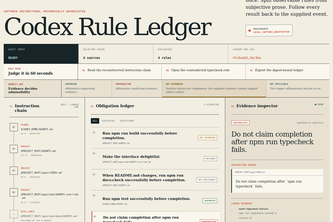
Codex Rule Ledger is a self-reported tool that reconstructs instruction chains from normalized launch-and-session bundles, separates mechanical obligations from subjective prose, and returns four result states: SUPPORTED, CONTRADICTED, NOT_EVIDENCED, or NOT_APPLICABLE. It is designed for staff engineers, platform teams, and security reviewers to decide whether to accept, investigate, or block changes based on evidence.
What changed
The project evolved from a v0.1 browser-based demo to a v0.2 CLI that reuses the same audit contract in a repo-local environment. The author states that both versions are built using Codex and GPT-5.6 for semantic analysis, with deterministic TypeScript handling validation and ledger generation.
Single most important open question
Is there any evidence of real-world usage or integration into existing workflows beyond the synthetic fixtures and public demo?
What The Product Actually Is
The description states that Codex Rule Ledger:
- Reconstructs instruction chains from normalized launch-and-session bundles.
- Separates mechanically observable obligations from subjective prose.
- Returns four result states: SUPPORTED, CONTRADICTED, NOT_EVIDENCED, or NOT_APPLICABLE.
- Links each row to its instruction source and the supplied evidence or search record behind its disposition.
- Exports deterministic SHA-256-bound JSON labeled LOCAL_CAPTURE_UNATTESTED.
It is described as a tool for staff engineers, platform teams, and security reviewers deciding whether to accept, investigate, or block changes based on evidence. The product does not make final assessments; GPT-5.6 proposes typed semantics while deterministic code adjudicates the complete evidence catalog.
Inference: The system appears to be an audit tool that evaluates compliance with rules by analyzing captured events and linking them back to source instructions. It distinguishes between evidence that supports, contradicts, or fails to decide a rule's application.
Positioning & Claim Evolution
The author states:
- The product addresses the problem of agent-produced diffs that look ready but whose session evidence says otherwise.
- It turns an already-normalized launch-and-session bundle into a source-linked evidence ledger for review by engineers and security teams.
- Rule Ledger first asks whether the supplied evidence makes any assessment admissible, distinguishing between missing evidence (which is not failure nor compliance) and actual non-compliance.
The positioning appears to be:
- A tool that improves audit transparency by linking rule outcomes back to their source events.
- Designed for environments where compliance claims are made but lack sufficient supporting evidence.
- Not a general-purpose AI assistant or code generation tool, but rather an evaluation framework for already-generated code changes.
Inference: The evolution from v0.1 (browser demo) to v0.2 (CLI) suggests a shift toward more practical deployment and integration capabilities, though no real-world adoption is evidenced.
Target Customer & ICP
The description states:
- The tool is intended for staff engineers, platform teams, and security reviewers.
- It helps these users decide whether to accept, investigate, or block changes based on evidence.
No specific customer segments or personas are named. The target audience seems to be internal developers or platform teams who need to validate code changes before they are accepted into production.
Inference: The ICP likely includes engineering and security teams within software development organizations that rely on automated tooling but require audit trails and transparency in decision-making processes.
Business Model & Pricing Evidence
Not evidenced.
The description does not contain any information about pricing, monetization strategy, or business model. There is no mention of subscriptions, usage fees, or enterprise licensing.
Technical & Delivery Signals
The description states:
- Built with Codex, GPT-5.6, OpenAI Responses API, structured outputs, Next.js, React, TypeScript, Zod, Vitest, Playwright, GitHub Actions, and Vercel.
- v0.2 CLI reuses the same audit contract in a repo-local environment.
- The public demo exposes synthetic fixtures through a story-labeled, keyless selector.
- Neither the demo nor the CLI accepts visitor-supplied audit material, credentials, or model requests.
- The system supports Ubuntu Linux with Node.js 24 and npm; also supports Node.js ^22.13.0 || >=24.0.0.
- Git clone, npm ci, npm run audit --bundle fixtures/synthetic-retry-recovery-v1 command is provided for local testing.
Inference: The tool uses a combination of AI (GPT-5.6) and deterministic validation logic to process normalized bundles. It supports both browser-based exploration and CLI-based auditing, with no external inputs accepted in public mode.
Traction & Maturity Signals
Not evidenced.
There is no mention of revenue, customers, user base, or adoption beyond the synthetic fixtures and public demo. The author notes that the project was submitted to a hackathon and remains under their sole control.
Competitive Context
Not evidenced.
The description does not reference competitors or similar tools in the market. No comparison with existing audit systems or compliance frameworks is made.
Open Questions & Risks
- No real-world usage: The product has only been demonstrated via synthetic fixtures and a public demo, with no evidence of integration into actual workflows.
- Single-person development: The team consists of one individual (Dan Mercede), which raises questions about scalability and long-term maintenance.
- Limited scope: The tool is described as working on normalized bundles and does not appear to handle full end-to-end change management or CI/CD pipelines.
- Dependency on GPT-5.6: While the system uses GPT-5.6 for semantic analysis, it does not make final decisions — this may limit its utility if the model's accuracy is low or inconsistent.
Questions the description leaves open
- What specific use cases have you identified where this tool would be applied in practice?
- How do you plan to scale beyond a single developer’s workflow?
- Are there any plans for integrating with CI/CD systems or existing audit tools?
- How does the system handle edge cases or ambiguous instructions that are not covered by the current four states?
- What is your roadmap for moving from synthetic fixtures to real-world data and integration?
Overall Assessment
Not evidenced.
There is no indication of funding rounds, valuation, or investment interest. The project appears to be a personal or hackathon effort with no commercial traction or external validation. The author remains the sole contributor and retains all release authorization and decisions.
The tool shows potential for addressing audit transparency in software development but lacks evidence of real-world application or market demand. It is currently in early-stage prototype form, with limited maturity and no demonstrated business model or customer base.
User Stories BotA demo video on every pull request
Get a demo video on every new feature
GitHub App that watches your pull requests and records a narrated, captioned demo.
Save time on demo prep and make informed decisions faster with a video walkthrough of every new feature.
Source
Submitted to the OpenAI 2026 hackathon on Devpost. Project home on Devpost. Back to the full gallery on Devpost.
This competitive analysis was produced by top-founders.com (opens in a new tab)
Generated by a language model from this project's public Devpost page — its tagline, the author's own write-up and any built-with tags listed there — as captured in August 2026. Short quotations are the author's words. It is an opinion on the idea as a business, not on the people behind it, and it reflects the description as published then. If the project has moved on, request a correction below. The analysis is not independent research and contains no verified traction, revenue or customer data.
An independent guide by KFG International LLC — not affiliated with, endorsed by, or connected to Devpost or OpenAI.