

Archive position — measured, not model output
0 likes on Devpost
2,263 of the 7,850 archived projects have more likes, and 5,587 share exactly 0 — so this project's #3,400 place in the like-ranked listing is a tie-break inside that group, not a ranking.
Projects (log scale)
Likes on Devpost. ▲ marks this project's group.
Show the figures
| Likes | Projects | Share of archive |
|---|---|---|
| 0 | 5,587 | 71.2% |
| 1 | 1,758 | 22.4% |
| 2 | 284 | 3.6% |
| 3–4 | 132 | 1.7% |
| 5–9 | 75 | 1.0% |
| 10+ | 14 | 0.2% |
 User Stories BotA demo video on every pull request
Get a demo video on every new feature
GitHub App that watches your pull requests and records a narrated, captioned demo.
Save time on demo prep and make informed decisions faster with a video walkthrough of every new feature.
Executive Summary
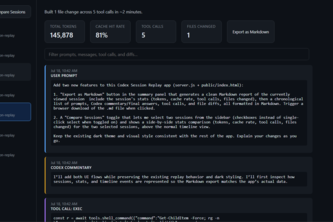
What the company appears to be: Codex Session Replay is a self-reported local tool that visualizes session logs from the Codex CLI — a developer tool for interacting with AI agents like GPT — into timelines and dashboards showing prompts, diffs, and efficiency metrics.
What changed: The author reports building this as a hackathon project, using Codex itself to build parts of the application. It is described as a local-only solution that parses JSONL logs from Codex CLI sessions and renders them visually with features like search, comparison, and Markdown export.
Single most important open question: Is there any evidence of adoption or usage beyond the author's own development environment?
What The Product Actually Is
The description states that Codex Session Replay:
- Scans local session logs from Codex CLI (stored in
~/.codex/sessions) - Renders them as a visual timeline including prompts, tool calls, diffs, and syntax-highlighted code
- Provides an efficiency dashboard showing token usage, cache hit rate, tool call count, and files changed
- Offers search, side-by-side session comparison, and Markdown export functionality
- Operates entirely locally with no external services or API keys required
The author also notes that it was built using Codex CLI itself, which generated both backend (Express.js) and frontend components.
Confidence: Low — this is a self-reported description of a tool built in a single-person hackathon project. No evidence of product-market fit, user feedback, or real-world usage.
Positioning & Claim Evolution
The author claims:
- Codex CLI already logs session data in structured JSONL format
- Nobody was looking at these logs directly
- The tool makes this data visible and actionable for developers
- It is a local-only solution that doesn’t require external services or API keys
There is no indication of broader positioning beyond the hackathon submission. No claims are made about scalability, enterprise use cases, or integration with other tools.
Confidence: Low — the description lacks any evidence of market positioning or strategic evolution beyond a single developer’s personal tool.
Target Customer & ICP
The description states:
- The tool is intended for developers using Codex CLI
- It helps answer "where exactly did Codex accelerate your workflow?"
- It provides insights into token usage, efficiency, and decision points in AI-assisted coding sessions
No explicit customer segments or personas are defined. There is no mention of team-level dashboards, enterprise adoption, or non-developer users.
Confidence: Low — the target audience appears to be limited to individual developers using Codex CLI, with no evidence of broader ICP or segmentation.
Business Model & Pricing Evidence
The description states:
- The tool is entirely local and requires no API keys or external services
- No pricing model is mentioned
- There are no claims about monetization, subscriptions, or paid features
Confidence: Very low — there is no evidence of any business model or pricing strategy.
Technical & Delivery Signals
The author reports:
- Built with Node.js, Express.js, HTML, CSS, JavaScript
- Uses Codex CLI to generate backend and frontend components
- Includes features like syntax highlighting, diff rendering, search, session comparison, and Markdown export
- The tool was built iteratively using multiple Codex sessions
- A bug involving state management was resolved by Codex debugging its own prior output
Confidence: Low — while the technical stack is described, there is no evidence of product maturity, scalability, or production deployment.
Traction & Maturity Signals
The description states:
- This is a hackathon project submitted to the OpenAI 2026 hackathon
- It was built by one person (Al-Ameen Mikail)
- No mention of users, customers, or adoption beyond the author’s own use case
There is no evidence of revenue, customer engagement, or product traction.
Confidence: Very low — no signs of traction or maturity beyond a single developer's prototype.
Competitive Context
The description does not reference any competitors. It focuses solely on Codex CLI and its own session logs.
Confidence: Low — no competitive analysis or market positioning is provided.
Open Questions & Risks
- Single-person project: The tool was built by one person, with no evidence of team or external support.
- No traction or adoption: No users, customers, or real-world usage are reported.
- Local-only solution: The tool does not appear to integrate with any broader platform or ecosystem.
- Unverified claims: All descriptions are self-reported and unverified; no third-party validation exists.
- Limited scope: The tool is narrowly focused on Codex CLI logs, with no indication of expansion plans.
Confidence: Medium — the lack of evidence for traction or scalability raises concerns about viability as a commercial product.
Questions the description leaves open
- What is your definition of success for this tool? Is it meant to be used by others beyond yourself?
- Are there any users or early adopters outside of your own development environment?
- How do you plan to scale beyond a single developer’s use case?
- Have you considered integrating with other AI coding agents, as mentioned in the "What's next" section?
- What are the technical challenges in moving from a local-only tool to something more scalable or shared?
Overall Assessment
Assessment: Not evidenced.
The description is entirely self-reported and lacks any evidence of revenue, customers, traction, or product-market fit. It is a single-person hackathon project with no indication of commercial viability or scalability.
Confidence: Very low — this is not a product that can be evaluated for investment or partnership without further evidence of adoption, usage, or market validation.
User Stories BotA demo video on every pull request
Get a demo video on every new feature
GitHub App that watches your pull requests and records a narrated, captioned demo.
Save time on demo prep and make informed decisions faster with a video walkthrough of every new feature.
Source
Submitted to the OpenAI 2026 hackathon on Devpost. Project home on Devpost. Back to the full gallery on Devpost.
This competitive analysis was produced by top-founders.com (opens in a new tab)
Generated by a language model from this project's public Devpost page — its tagline, the author's own write-up and any built-with tags listed there — as captured in August 2026. Short quotations are the author's words. It is an opinion on the idea as a business, not on the people behind it, and it reflects the description as published then. If the project has moved on, request a correction below. The analysis is not independent research and contains no verified traction, revenue or customer data.
An independent guide by KFG International LLC — not affiliated with, endorsed by, or connected to Devpost or OpenAI.