

Archive position — measured, not model output
0 likes on Devpost
2,263 of the 7,850 archived projects have more likes, and 5,587 share exactly 0 — so this project's #3,401 place in the like-ranked listing is a tie-break inside that group, not a ranking.
Projects (log scale)
Likes on Devpost. ▲ marks this project's group.
Show the figures
| Likes | Projects | Share of archive |
|---|---|---|
| 0 | 5,587 | 71.2% |
| 1 | 1,758 | 22.4% |
| 2 | 284 | 3.6% |
| 3–4 | 132 | 1.7% |
| 5–9 | 75 | 1.0% |
| 10+ | 14 | 0.2% |
 User Stories BotA demo video on every pull request
Get a demo video on every new feature
GitHub App that watches your pull requests and records a narrated, captioned demo.
Save time on demo prep and make informed decisions faster with a video walkthrough of every new feature.
Executive Summary
What the company appears to be
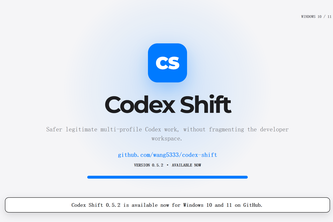
Codex Shift is a self-reported open-source Windows desktop application designed to help developers manage multiple authorized Codex profiles locally, without fragmenting their workspace. It supports switching between profiles securely, displaying usage information, and maintaining encrypted local storage of authentication data.
What changed
The project was submitted as part of the OpenAI 2026 hackathon. The description indicates it is a functional tool built using .NET 8 and C#, with GPT-5.6 Sol used for development assistance. It includes features like profile encryption, temporary home isolation, bilingual UI support, and automated testing.
Single most important open question
Is there any evidence of real-world usage or adoption beyond the hackathon submission? The description does not mention any customers, revenue, or traction beyond its own self-reported functionality.
Note: This analysis is based entirely on the author-supplied project description. All claims are self-reported and unverified. No external data, funding history, headcount, or customer information is available.
What The Product Actually Is
The description states that Codex Shift is:
- A Windows 10/11 control center for managing authorized Codex profiles.
- An open-source desktop utility built with .NET 8 and C#.
- A self-contained Windows Forms application with a UI and core library.
- Capable of creating, encrypting, switching, and displaying profile information.
- Designed to avoid fragmenting the developer workspace or bypassing quotas.
It is described as not merging entitlements, not bypassing quotas, and not operating multiple accounts concurrently.
Inference: The product appears to be a local utility for managing Codex authentication tokens on Windows machines. It does not appear to be a SaaS offering or cloud-based service.
Positioning & Claim Evolution
The description states that Codex Shift:
- Addresses the pain point of switching between multiple Codex profiles in a disruptive way.
- Turns this workflow into a "deliberate, visible, and reversible" desktop operation.
- Keeps the developer's local Codex workspace intact.
- Is built using GPT-5.6 Sol as a development agent.
It positions itself as a tool that improves developer experience by reducing friction in profile switching while maintaining security and compliance with official Codex app-server protocols.
Claim vs Fact: The description claims it solves a real problem for developers, but does not provide evidence of actual user feedback or adoption.
Target Customer & ICP
The description states:
- The tool is aimed at developers who use multiple Codex profiles (e.g., personal, client, educational).
- It targets users working on Windows 10/11.
- It supports both English and Chinese languages.
It does not specify whether the target includes enterprise users or individuals, nor does it describe segmentation beyond developer type or language preference.
Inference: The ICP likely includes individual developers using Codex for work, education, or personal projects who need to manage multiple accounts securely.
Business Model & Pricing Evidence
The description states:
- Codex Shift is open-source.
- It uses the locally installed official Codex app-server without redistributing OpenAI binaries.
- No pricing model or monetization strategy is described.
- There are no mentions of subscriptions, fees, or paid features.
Inference: The business model appears to be non-commercial. It is a developer tool released under an open-source license.
Technical & Delivery Signals
The description states:
- Built with .NET 8 and C#.
- Uses Windows Forms UI and a testable core library.
- Implements atomic file replacement, DPAPI encryption, profile storage, quota models, temporary-home isolation, cleanup, and protocol mapping.
- Supports background refresh, tray icons, notifications, DPI-aware layouts, and bilingual localization.
- Has 343 passing automated tests.
- Uses GPT-5.6 Sol for development assistance.
Inference: The technical stack is solid for a Windows desktop utility. The use of automated testing and security boundaries suggests attention to quality and safety.
Traction & Maturity Signals
The description states:
- It was submitted as part of the OpenAI 2026 hackathon.
- It includes a self-contained installer and portable release.
- It has documentation for security, privacy, installation, and testing.
- It reached 343 passing automated tests.
There is no mention of:
- Real-world usage or adoption.
- Customer feedback.
- Revenue or monetization.
- Product roadmap beyond the hackathon submission.
Absence of evidence: No traction data, user metrics, or commercial activity are reported.
Competitive Context
The description does not reference any competitors. It focuses on solving a specific workflow issue for developers using Codex profiles.
Inference: The tool likely addresses a niche within the developer tools space—specifically, local profile management for Codex users. No direct competitive analysis is provided.
Open Questions & Risks
- No commercial traction or adoption beyond a hackathon submission.
- No evidence of monetization, customers, or revenue.
- Open-source nature may limit scalability or commercial viability.
- Limited team size (1 member) raises questions about long-term maintenance and growth.
- Self-reported tooling and development process—no independent verification of claims.
Inference: The project is in early-stage development with no clear path to market traction or commercialization.
Questions the description leaves open
- What is the actual usage or feedback from developers who have tried this tool?
- Are there any plans for monetization or commercialization beyond the hackathon?
- How does the tool handle edge cases in Codex app-server behavior?
- Is there a plan to support other operating systems beyond Windows 10/11?
- What are the long-term maintenance and scalability plans for this open-source project?
Overall Assessment
The description states that Codex Shift is an open-source tool built during a hackathon, with no evidence of commercial traction or adoption.
Assessment: Not evidenced as a viable investment or partnership opportunity. The tool appears to be a proof-of-concept or early-stage developer utility with no demonstrated market demand or business model. It lacks any indication of revenue, customers, or scalability beyond its own development team.
User Stories BotA demo video on every pull request
Get a demo video on every new feature
GitHub App that watches your pull requests and records a narrated, captioned demo.
Save time on demo prep and make informed decisions faster with a video walkthrough of every new feature.
Source
Submitted to the OpenAI 2026 hackathon on Devpost. Project home on Devpost. Back to the full gallery on Devpost.
This competitive analysis was produced by top-founders.com (opens in a new tab)
Generated by a language model from this project's public Devpost page — its tagline, the author's own write-up and any built-with tags listed there — as captured in August 2026. Short quotations are the author's words. It is an opinion on the idea as a business, not on the people behind it, and it reflects the description as published then. If the project has moved on, request a correction below. The analysis is not independent research and contains no verified traction, revenue or customer data.
An independent guide by KFG International LLC — not affiliated with, endorsed by, or connected to Devpost or OpenAI.