

Archive position — measured, not model output
0 likes on Devpost
2,263 of the 7,850 archived projects have more likes, and 5,587 share exactly 0 — so this project's #5,364 place in the like-ranked listing is a tie-break inside that group, not a ranking.
Projects (log scale)
Likes on Devpost. ▲ marks this project's group.
Show the figures
| Likes | Projects | Share of archive |
|---|---|---|
| 0 | 5,587 | 71.2% |
| 1 | 1,758 | 22.4% |
| 2 | 284 | 3.6% |
| 3–4 | 132 | 1.7% |
| 5–9 | 75 | 1.0% |
| 10+ | 14 | 0.2% |
 User Stories BotA demo video on every pull request
Get a demo video on every new feature
GitHub App that watches your pull requests and records a narrated, captioned demo.
Save time on demo prep and make informed decisions faster with a video walkthrough of every new feature.
Executive Summary
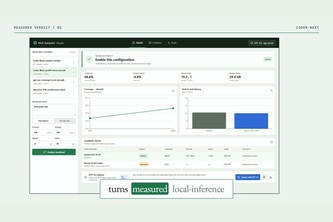
What the company appears to be: MoE Autopilot Studio is a self-reported Windows-based tool designed to make deterministic decisions about enabling, disabling, or measuring mixture-of-experts (MoE) inference workloads. It claims to process measured performance data and produce reproducible operational assessments without requiring network access, Python, models, GPUs, or accounts.
What changed: The project was built during a hackathon as an offline tool for routing MoE workloads, with a focus on safety, determinism, and reproducibility. It includes a Windows interface, a safe runner for known tools, and GPT-5.6 integration for explanations constrained to engine-emitted facts.
Single most important open question: Is there evidence of real-world usage or adoption beyond the hackathon submission? The description does not indicate any commercial traction, revenue, or customer base.
What The Product Actually Is
The description states that MoE Autopilot Studio:
- Loads sanitized measurements and computes canonical expert coverage.
- Checks immutable protocol fingerprints and hardware budgets.
- Produces a deterministic ENABLE, DISABLE, or MEASURE assessment.
- Exposes performance metrics like coverage, decode, prefill, total latency, break-even, RAM, and VRAM in a Windows interface.
- Uses a safe local runner that launches only known llama.cpp tools as argv arrays.
- Persists results locally.
- Works offline in under two minutes without Python, a model, GPU, account, or network access.
- Includes a Windows release with custom imports and measured A/B runs.
Inference: The tool appears to be a research or prototyping utility for managing MoE inference decisions, not a production-grade commercial product. It is described as a "Windows lab" that turns measured evidence into operational decisions.
Positioning & Claim Evolution
The description states:
- The project addresses the “workload-dependent placement problem” in local MoE inference.
- It aims to answer the operational question: “should this workload enable the split, with which measured configuration, and what experiment should run next?”
- It is positioned as a tool that avoids arbitrary tool execution or truth rewriting by the model.
Inference: The positioning is focused on reproducibility, safety, and deterministic decision-making in MoE inference. It does not claim to be a general-purpose platform or commercial product but rather a specialized lab tool for local inference optimization.
Target Customer & ICP
The description does not identify specific customer segments or personas. It implies use by developers or researchers working on local MoE inference, particularly those using llama.cpp tools and concerned with reproducibility and performance.
Inference: The target is likely technical users in AI research or development environments who need to make informed decisions about MoE routing without relying on external systems or models.
Business Model & Pricing Evidence
The description does not provide any information about pricing, monetization, or business model. It is a self-reported hackathon project with no indication of commercialization.
Not evidenced: No evidence of revenue, pricing tiers, or customer acquisition strategy.
Technical & Delivery Signals
The description states:
- Built during Build Week using typed engine, protocol guard, evidence model, Windows Studio, safe runner, imports, exports, tests, CI, packaging, and hosted fixture report.
- Uses Codex App Server over stdio and ChatGPT OAuth.
- Each analysis starts an ephemeral GPT-5.6 Sol thread in a read-only directory with approvals disabled.
- The model receives only user intent and a bounded deterministic report.
- It may select only an experiment ID emitted by the engine, cannot change the assessment, and is rejected if it introduces an unsupported number.
- A safe local runner launches only known llama.cpp tools as argv arrays.
Inference: The tool is built with a strong emphasis on safety, determinism, and reproducibility. It uses a constrained model interface to avoid arbitrary execution or truth rewriting.
Traction & Maturity Signals
The description does not provide any evidence of traction, adoption, or maturity beyond the hackathon submission:
- No revenue, customers, or usage data.
- No mention of product iteration, user feedback, or market validation.
- The project is described as a “Windows lab” and “offline fixture path.”
Not evidenced: No signs of commercial traction or product-market fit.
Competitive Context
The description does not provide any information about competitors or the competitive landscape. It does not reference existing tools or platforms for MoE inference, workload management, or decision-making systems.
Not evidenced: No evidence of competitive positioning or market context.
Open Questions & Risks
- No commercial traction: The project is described as a hackathon submission with no indication of real-world usage.
- Limited scope: It is a specialized tool for local MoE inference, not a general-purpose platform.
- Unverified model behavior: While the GPT integration is constrained, it is not independently verified.
- No evidence of scalability or production readiness: The tool is described as working offline and in under two minutes, but no details on performance or scalability are given.
Questions the description leaves open
- What is the intended use case beyond the hackathon?
- Are there any plans to commercialize this tool or integrate it into existing workflows?
- How does the tool handle edge cases in real-world MoE workloads?
- Is there a plan to expand beyond local inference or Windows environments?
- What are the limitations of the current GPT integration, and how is it constrained?
Overall Assessment
The project is described as a hackathon submission with no evidence of commercial traction, revenue, or customer base. It is a specialized tool for local MoE inference, built with safety and determinism in mind.
Assessment: Not ready for investment or partnership at this stage. The project lacks evidence of product-market fit, scalability, or commercial viability beyond its initial prototype phase.
User Stories BotA demo video on every pull request
Get a demo video on every new feature
GitHub App that watches your pull requests and records a narrated, captioned demo.
Save time on demo prep and make informed decisions faster with a video walkthrough of every new feature.
Source
Submitted to the OpenAI 2026 hackathon on Devpost. Project home on Devpost. Back to the full gallery on Devpost.
This competitive analysis was produced by top-founders.com (opens in a new tab)
Generated by a language model from this project's public Devpost page — its tagline, the author's own write-up and any built-with tags listed there — as captured in August 2026. Short quotations are the author's words. It is an opinion on the idea as a business, not on the people behind it, and it reflects the description as published then. If the project has moved on, request a correction below. The analysis is not independent research and contains no verified traction, revenue or customer data.
An independent guide by KFG International LLC — not affiliated with, endorsed by, or connected to Devpost or OpenAI.