

Archive position — measured, not model output
0 likes on Devpost
2,263 of the 7,850 archived projects have more likes, and 5,587 share exactly 0 — so this project's #3,376 place in the like-ranked listing is a tie-break inside that group, not a ranking.
Projects (log scale)
Likes on Devpost. ▲ marks this project's group.
Show the figures
| Likes | Projects | Share of archive |
|---|---|---|
| 0 | 5,587 | 71.2% |
| 1 | 1,758 | 22.4% |
| 2 | 284 | 3.6% |
| 3–4 | 132 | 1.7% |
| 5–9 | 75 | 1.0% |
| 10+ | 14 | 0.2% |
 User Stories BotA demo video on every pull request
Get a demo video on every new feature
GitHub App that watches your pull requests and records a narrated, captioned demo.
Save time on demo prep and make informed decisions faster with a video walkthrough of every new feature.
Executive Summary
CodexCRM is a self-reported minimal, customizable CRM for SDRs (Sales Development Representatives) built as a hackathon submission. The product is described as a tool that allows small teams (2–20 salespeople) to track leads, manage calls and messages via Twilio, and store data in PostgreSQL on their own AWS account. It was developed using Codex and GPT-5.6 for rapid prototyping, with a public demo hosted on EC2 + Docker Compose.
The author states that the project was submitted to the OpenAI 2026 hackathon. There is no evidence of revenue, customers, or traction beyond the self-reported demo and source code.
Key commercial due-diligence read: The description presents a product concept but lacks any evidence of market validation, customer adoption, or business model execution. It remains unclear whether CodexCRM has moved beyond a prototype or if there is a viable path to monetization or scale.
What The Product Actually Is
The description states that CodexCRM is:
- A minimal CRM for SDRs
- Designed for teams of 2–20 salespeople
- Built with Next.js, Docker, PostgreSQL, Twilio, and AWS
- Hosted in the customer's own cloud (PostgreSQL on AWS)
- Includes lead tracking, notes, statuses, activity timeline
- Supports SMS and call functionality via Twilio (with safety filters)
- Uses Codex and GPT-5.6 for development
- Deployed as a public demo on EC2 + Docker Compose
Inference: The product appears to be a prototype or proof-of-concept built in a short timeframe, likely for a hackathon.
Not evidenced: No actual product features, user interface details, or data structure beyond the description are provided. No evidence of real-world usage or integration with existing workflows.
Positioning & Claim Evolution
The author states that CodexCRM was inspired by a real need at a startup where they work as an SDR. The positioning is:
- A CRM for small teams that avoids the cost and complexity of traditional CRMs
- Built to fit actual workflow, not forced into generic platforms
- Uses AI (Codex, GPT-5.6) to build quickly and efficiently
- Leverages existing cloud infrastructure (AWS) to avoid SaaS licensing costs
Inference: The product is positioned as a lightweight, customizable CRM that avoids vendor lock-in by storing data in the customer’s own cloud.
Not evidenced: No claims about market traction, competitive differentiation, or long-term positioning beyond the hackathon submission. No evidence of prior user feedback or iteration.
Target Customer & ICP
The description states that CodexCRM is designed for:
- Teams of 2–20 salespeople
- SDRs (Sales Development Representatives)
- Startups or small businesses that want a CRM tailored to their workflow
- Companies with existing AWS accounts and cloud infrastructure
Inference: The target customer is a small, early-stage team that values customization and control over data, rather than enterprise-grade features.
Not evidenced: No evidence of actual customers, user personas, or market research. No indication of how the product would scale beyond the demo environment.
Business Model & Pricing Evidence
The description does not state anything about:
- Pricing
- Revenue model
- Monetization strategy
- Subscription plans or usage-based billing
Inference: The project is presented as a prototype, not a commercial offering. It is unclear if there is any intention to monetize the product.
Not evidenced: No business model, pricing structure, or sales process is described. The demo is publicly accessible and uses seed data, suggesting no revenue-generating mechanism exists yet.
Technical & Delivery Signals
The project was built using:
- Technologies: Next.js, Docker, PostgreSQL, Twilio, AWS (EC2), Codex, GPT-5.6, TypeScript
- Deployment: Public demo on EC2 + Docker Compose
- Architecture: Data stored in PostgreSQL on the customer’s own cloud
- Development approach: Use of AI tools (Codex, GPT-5.6) for rapid prototyping
Inference: The product is built with modern, scalable technologies and deployed in a way that allows for easy replication or customization.
Not evidenced: No evidence of production readiness, scalability testing, or long-term infrastructure planning. No mention of security, data backup, or integration capabilities beyond the demo.
Traction & Maturity Signals
The description states:
- The project was submitted to the OpenAI 2026 hackathon
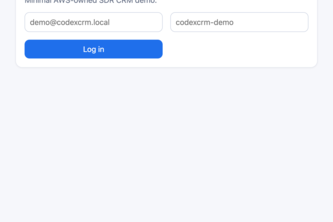
- A live demo is available at http://204.236.254.26:3000/
- Login credentials are provided for the demo
- Source code is on GitHub
Inference: The project exists as a functional prototype, but there is no evidence of adoption or usage beyond the demo.
Not evidenced: No user base, customer feedback, or engagement metrics. No evidence of product iteration or roadmap beyond the initial submission.
Competitive Context
The description states that most CRMs fall into two categories:
- Start affordable, then get expensive through add-ons
- Start expensive and are built for enterprise
CodexCRM is positioned as an alternative that avoids these pitfalls by using existing cloud infrastructure and focusing on customization.
Inference: The product competes with traditional CRMs like Salesforce or HubSpot by offering a cheaper, more flexible, and customizable solution.
Not evidenced: No competitive analysis, pricing comparison, or market positioning data. No mention of competitors or how the product differentiates in the marketplace beyond the author’s personal experience.
Open Questions & Risks
- Prototype only: The product is described as a hackathon submission with no evidence of real-world usage.
- No revenue or monetization: No pricing, subscriptions, or sales process are mentioned.
- Unproven market fit: No evidence of customer demand or feedback beyond the author’s own experience.
- Limited scalability: The demo uses seed data and is hosted on a single EC2 instance; no indication of production readiness.
- AI dependency: Heavy reliance on Codex and GPT-5.6 for development raises questions about long-term maintainability and control.
Not evidenced: No evidence of risk mitigation, product-market fit validation, or long-term strategy.
Questions the description leaves open
- What is the actual workflow you’re trying to solve for SDRs?
- Have you tested this with real users or teams?
- How do you plan to monetize this product?
- What are the technical limitations of running this in a customer’s own cloud?
- Are there any plans to move beyond the demo environment and into production use?
- What is your long-term vision for the product, and how does it scale beyond 20 users?
Overall Assessment
Not evidenced: No evidence of traction, revenue, or customer adoption exists. The project is described as a hackathon submission with no indication of commercial viability or path to market.
Inference: At this stage, CodexCRM appears to be a proof-of-concept or prototype. It may have potential for further development but lacks the commercial signals required for investment or partnership consideration.
Confidence level: Low — based entirely on self-reported project description with no external validation.
User Stories BotA demo video on every pull request
Get a demo video on every new feature
GitHub App that watches your pull requests and records a narrated, captioned demo.
Save time on demo prep and make informed decisions faster with a video walkthrough of every new feature.
Source
Submitted to the OpenAI 2026 hackathon on Devpost. Project home on Devpost. Back to the full gallery on Devpost.
This competitive analysis was produced by top-founders.com (opens in a new tab)
Generated by a language model from this project's public Devpost page — its tagline, the author's own write-up and any built-with tags listed there — as captured in August 2026. Short quotations are the author's words. It is an opinion on the idea as a business, not on the people behind it, and it reflects the description as published then. If the project has moved on, request a correction below. The analysis is not independent research and contains no verified traction, revenue or customer data.
An independent guide by KFG International LLC — not affiliated with, endorsed by, or connected to Devpost or OpenAI.