

Archive position — measured, not model output
0 likes on Devpost
2,263 of the 7,850 archived projects have more likes, and 5,587 share exactly 0 — so this project's #3,353 place in the like-ranked listing is a tie-break inside that group, not a ranking.
Projects (log scale)
Likes on Devpost. ▲ marks this project's group.
Show the figures
| Likes | Projects | Share of archive |
|---|---|---|
| 0 | 5,587 | 71.2% |
| 1 | 1,758 | 22.4% |
| 2 | 284 | 3.6% |
| 3–4 | 132 | 1.7% |
| 5–9 | 75 | 1.0% |
| 10+ | 14 | 0.2% |
 User Stories BotA demo video on every pull request
Get a demo video on every new feature
GitHub App that watches your pull requests and records a narrated, captioned demo.
Save time on demo prep and make informed decisions faster with a video walkthrough of every new feature.
Executive Summary
What the company appears to be:
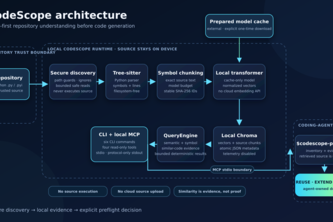
The project described as codescope-mcp-preflight is a local-first, read-only tool for Python repositories that acts as an MCP preflight to help AI coding agents make explicit architectural decisions before editing code. It indexes source files and provides four tools—list_indexed_files, search_code, find_symbol, and find_similar—to support REUSE, EXTEND, or CREATE choices.
What changed:
The author states they built a working MVP for a local MCP server that supports repository-level discovery and decision-making in AI coding workflows. It was developed using Python and integrates with Codex and GPT-5.6 during development.
Single most important open question:
Is there any evidence of product-market fit or early adoption beyond the hackathon context? The description provides no data on usage, customers, revenue, or traction beyond a controlled demonstration.
What The Product Actually Is
The description states that CodeScope is:
- A local-first, read-only MCP preflight for Python repositories.
- Implemented in Python, running as a standard-input/output MCP server.
- Designed to index source files and expose four tools:
list_indexed_filessearch_codefind_symbolfind_similar
- It does not modify or execute code; it only gathers evidence for decision-making.
- The MVP supports
.pyand.pyifiles, usessentence-transformers/all-MiniLM-L6-v2for embeddings, and stores indexes in.codescope.
Inference:
The tool is positioned as a developer-facing assistant, not an autonomous code generator. It complements AI agents by grounding their decisions in repository context.
Positioning & Claim Evolution
The author claims:
- AI coding agents are strong at generating code but often fail due to poor understanding of repository structure.
- CodeScope introduces a structured repository preflight before code generation.
- It helps agents decide whether to REUSE, EXTEND, or CREATE based on evidence from the repository.
Inference:
The positioning evolved from a general problem (lack of repository understanding) to a specific solution (MCP preflight with structured decision framework). The tool is framed as complementary, not replacement, for AI agents like Codex.
Target Customer & ICP
The description states:
- CodeScope targets AI coding agents such as Codex and GPT-5.6.
- It supports Python repositories.
- It is designed to be used in developer workflows, particularly those involving AI-assisted code editing.
Inference:
The primary customer appears to be AI agent developers or integrators who want to improve the reliability of their agents’ repository-level decisions. The ICP is likely early-stage AI coding tooling teams or internal developer tooling teams within tech companies.
Business Model & Pricing Evidence
Not evidenced.
The description does not mention:
- Any pricing model
- Revenue streams
- Monetization strategy
- Customer acquisition plans
Inference:
Given the hackathon context and lack of commercial claims, there is no evidence of a business model or pricing structure. The tool appears to be an open-source or internal prototype.
Technical & Delivery Signals
The description states:
- Built in Python, using tools like
sentence-transformers,typer,pydantic,pytest,mypy,ruff,rich. - Runs as a local MCP server.
- Uses vector embeddings (all-MiniLM-L6-v2) for semantic search.
- Indexes source code and stores index in
.codescope. - Is read-only, does not execute or modify code.
- Supports Python 3.12, tested on Linux.
Inference:
The technical stack suggests a lightweight, developer-focused tool with emphasis on local execution and minimal dependencies. The architecture is consistent with a local-first, offline-ready product.
Traction & Maturity Signals
Not evidenced.
The description does not provide:
- Customer data
- Usage metrics
- Revenue
- Product adoption
- Market traction beyond the hackathon
Inference:
This is an MVP developed for a hackathon. There is no evidence of real-world usage or product maturity beyond a controlled demonstration.
Competitive Context
Not evidenced.
The description does not mention:
- Competitors
- Prior art in repository-level AI tooling
- Market positioning relative to other tools
Inference:
No competitive landscape is described, though the tool appears to address a gap in AI agent decision-making around code reuse and architecture. It may compete with or complement tools like semantic search engines, code analysis platforms, or LLM agents that lack repository-level grounding.
Open Questions & Risks
- No commercial traction: The tool is presented as an MVP for a hackathon with no evidence of adoption or revenue.
- Limited scope: Currently supports only Python repositories and requires Python 3.12.
- Read-only constraint: While a design choice, it may limit utility in more complex workflows where modification or execution is needed.
- No validation beyond demo: The demonstration was controlled; there is no evidence of real-world testing or feedback loops.
Questions the description leaves open
- What is the intended use case for CodeScope beyond the hackathon?
- Are there any plans to expand support beyond Python?
- How does CodeScope integrate with existing CI/CD or editor workflows?
- Has the tool been tested in real-world development environments?
- What are the long-term goals for product evolution and monetization?
Overall Assessment
Not evidenced.
There is no evidence of:
- Funding rounds
- Valuation
- Strategic partnerships
- Commercial interest or investment intent
Inference:
This appears to be a proof-of-concept built during a hackathon. It lacks commercial due-diligence signals such as traction, revenue, or market validation. The tool may have potential for future development but is not currently positioned for investment or partnership.
User Stories BotA demo video on every pull request
Get a demo video on every new feature
GitHub App that watches your pull requests and records a narrated, captioned demo.
Save time on demo prep and make informed decisions faster with a video walkthrough of every new feature.
Source
Submitted to the OpenAI 2026 hackathon on Devpost. Project home on Devpost. Back to the full gallery on Devpost.
This competitive analysis was produced by top-founders.com (opens in a new tab)
Generated by a language model from this project's public Devpost page — its tagline, the author's own write-up and any built-with tags listed there — as captured in August 2026. Short quotations are the author's words. It is an opinion on the idea as a business, not on the people behind it, and it reflects the description as published then. If the project has moved on, request a correction below. The analysis is not independent research and contains no verified traction, revenue or customer data.
An independent guide by KFG International LLC — not affiliated with, endorsed by, or connected to Devpost or OpenAI.