

Archive position — measured, not model output
0 likes on Devpost
2,263 of the 7,850 archived projects have more likes, and 5,587 share exactly 0 — so this project's #5,316 place in the like-ranked listing is a tie-break inside that group, not a ranking.
Projects (log scale)
Likes on Devpost. ▲ marks this project's group.
Show the figures
| Likes | Projects | Share of archive |
|---|---|---|
| 0 | 5,587 | 71.2% |
| 1 | 1,758 | 22.4% |
| 2 | 284 | 3.6% |
| 3–4 | 132 | 1.7% |
| 5–9 | 75 | 1.0% |
| 10+ | 14 | 0.2% |
 User Stories BotA demo video on every pull request
Get a demo video on every new feature
GitHub App that watches your pull requests and records a narrated, captioned demo.
Save time on demo prep and make informed decisions faster with a video walkthrough of every new feature.
Executive Summary
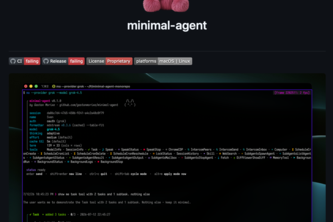
The company appears to be a developer tooling project named "minimal-agent", self-described as a composable, zero-dependency terminal agent harness for running multi-agent workflows in the terminal. The author states it supports multiple LLM providers and plugin architectures but provides no evidence of revenue, customers, or adoption. The product is described as a local CLI tool built with Bun and TypeScript, with no runtime npm dependencies.
The single most important open question is: What is the actual commercial traction or use case that would justify building this tool beyond personal experimentation?
This analysis is based entirely on the self-reported project description provided by the caller. It contains no verified financials, customer data, or market evidence — only the author's own claims and descriptions.
What The Product Actually Is
The description states:
- A local terminal agent that runs an "agent loop" with interactive REPL, one-shot prompts, stdin, tool calls, streamed output, and session resume
- Talks to any model through a provider-agnostic architecture
- Keeps the terminal sharp with live input, status rows, diffs, spinners, Markdown, and quit UX
- Makes internals inspectable: network captures, session JSONL, plugin manifests, config parsing, tool definitions
- Built for people who care about "the wire shape"
- Uses Bun only, zero runtime npm dependencies by policy
- Supports multiple LLM providers (OpenAI, Anthropic, OpenRouter, Ollama, etc.)
- Has a plugin system for tools, TUIs, modes, live-area slots, slash commands, schedule/cron
- Enables sub-agents, intercom, computer use, Chrome CDP, memory, skills through first-class ports
Inference: The product is a developer-focused CLI tool that allows users to orchestrate and inspect LLM-based agents in a terminal environment. It emphasizes composability, inspectability, and minimal dependencies.
Positioning & Claim Evolution
The author states:
- Most agent CLIs feel like black boxes
- They wanted the opposite: a tiny, beautiful, composable agent harness
- Every moving part is a file you can read, test, and debug
- Built for people who care about "the wire shape"
- The project was built with Codex using GPT-5.6
Inference: The positioning is that of a developer tool for inspectable, composable agent workflows, aimed at developers who want transparency and control over their LLM integrations.
The claim evolution shows:
- A critique of existing black-box agent tools
- A move toward transparency and composability
- Emphasis on developer experience and debuggability
Target Customer & ICP
The description states:
- Built for people who care about "the wire shape"
- The host never imports a concrete plugin, plugins never reach into host internals
- Architecture fitness tests enforce boundaries in CI
Inference: The target customer is likely developer tooling users or advanced developers who want to build, inspect, and debug agent workflows in a terminal environment.
However, there is no evidence of:
- Specific customer personas
- Use cases beyond personal experimentation
- Market segmentation or targeting strategy
Business Model & Pricing Evidence
The description states:
- No pricing information provided
- No revenue model described
- No mention of monetization or commercial use cases
Inference: There is no evidence of a business model or pricing structure.
Technical & Delivery Signals
The description states:
- Runtime: Bun only, zero runtime npm dependencies by policy
- TypeScript source runs directly, no build step
- LLM layer: canonical request/events + capability schema + model registry
- Plugin system: tools, TUIs, modes, live-area slots, slash commands, schedule/cron
- Sub-agents, intercom, computer use, Chrome CDP, memory, skills: first-class ports for multi-agent work and real machine control
Inference: The technical stack is developer-centric, with a focus on:
- Zero-dependency runtime
- Plugin architecture
- Terminal UX
- Multi-agent orchestration
Traction & Maturity Signals
The description states:
- Submitted to the OpenAI 2026 hackathon
- Mono Repository (private now)
- GitHub repo exists: https://github.com/gastonmorixe/minimal-agent-core.git
- git clone and login commands provided
Inference: The project is in an early-stage prototype or proof-of-concept phase, with no evidence of:
- Revenue
- Customers
- Adoption
- Product-market fit
- Market traction
Competitive Context
The description states:
- Most agent CLIs feel like black boxes
- The goal was to build the opposite: a tiny, beautiful, composable agent harness
Inference: The competitive context is developer tooling for LLM agents, with a focus on transparency and composability. However, no specific competitors are named or described.
Open Questions & Risks
- No evidence of commercial traction or use case
- No pricing model or monetization strategy
- No customer data or feedback
- Project is in a hackathon submission phase
- No public product, no revenue, no adoption
- Self-reported only — no independent verification
Questions the description leaves open
- What is the actual use case that drives demand for this tool?
- Are there any customers or users beyond personal experimentation?
- How does this differ from existing open-source agent frameworks?
- Is there a plan to monetize or scale this beyond a developer tool?
- What are the key technical challenges in scaling this to real-world usage?
- What is the long-term vision for this project?
Overall Assessment
Not evidenced
There is no evidence of:
- Revenue
- Customers
- Traction
- Market demand
- Commercial viability
This appears to be a developer tool in early-stage prototype form, submitted as a hackathon project. No commercial due-diligence signals are present.
The author states this is a personal project built with Codex using GPT-5.6, and no evidence of product-market fit or business model exists beyond the self-description.
User Stories BotA demo video on every pull request
Get a demo video on every new feature
GitHub App that watches your pull requests and records a narrated, captioned demo.
Save time on demo prep and make informed decisions faster with a video walkthrough of every new feature.
Source
Submitted to the OpenAI 2026 hackathon on Devpost. Project home on Devpost. Back to the full gallery on Devpost.
This competitive analysis was produced by top-founders.com (opens in a new tab)
Generated by a language model from this project's public Devpost page — its tagline, the author's own write-up and any built-with tags listed there — as captured in August 2026. Short quotations are the author's words. It is an opinion on the idea as a business, not on the people behind it, and it reflects the description as published then. If the project has moved on, request a correction below. The analysis is not independent research and contains no verified traction, revenue or customer data.
An independent guide by KFG International LLC — not affiliated with, endorsed by, or connected to Devpost or OpenAI.