

Archive position — measured, not model output
0 likes on Devpost
2,263 of the 7,850 archived projects have more likes, and 5,587 share exactly 0 — so this project's #3,354 place in the like-ranked listing is a tie-break inside that group, not a ranking.
Projects (log scale)
Likes on Devpost. ▲ marks this project's group.
Show the figures
| Likes | Projects | Share of archive |
|---|---|---|
| 0 | 5,587 | 71.2% |
| 1 | 1,758 | 22.4% |
| 2 | 284 | 3.6% |
| 3–4 | 132 | 1.7% |
| 5–9 | 75 | 1.0% |
| 10+ | 14 | 0.2% |
 User Stories BotA demo video on every pull request
Get a demo video on every new feature
GitHub App that watches your pull requests and records a narrated, captioned demo.
Save time on demo prep and make informed decisions faster with a video walkthrough of every new feature.
Executive Summary
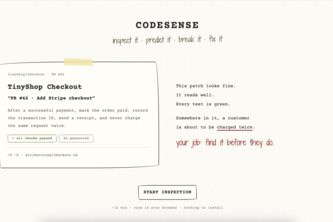
What the company appears to be: CodeSense is an educational tool built as a hackathon project that uses AI to guide learners through interactive lessons on engineering judgment, particularly around system reliability and risk in code. It presents AI-generated pull requests with hidden flaws, allowing users to inspect, predict, break, and fix them in a structured learning environment.
What changed: The author describes building a structured, deterministic framework for AI-assisted education that avoids arbitrary model outputs by using explicit state machines and authored content. The project evolved from an initial version where the AI controlled coaching to one where the learner's actions determine the path through a fixed curriculum.
The single most important open question: Is there evidence of traction or commercial viability beyond this hackathon prototype? The description states no revenue, customers, or adoption data exist — only self-reported claims about educational value and future roadmap.
What The Product Actually Is
- The description states that CodeSense is an interactive lesson platform for engineering judgment.
- It presents AI-generated code (e.g., a checkout implementation) with hidden risks.
- Users engage in a structured learning flow: Review → Coach → Predict → Break → Fix → Verify → Replay → Reflect → Summary.
- Learning content is authored in scenario files, not generated freely.
- The model interprets user language and extracts quotes; deterministic code handles consequential decisions like coaching routes, question selection, test execution, and conclusions.
- Real code runs in browser Web Workers during the "Verify" stage.
- It uses GPT-5.6 as an architecture collaborator and Codex as an implementation partner, with a smaller model (5.4 nano) for narrow classification tasks.
Inference: The product is not a commercial SaaS offering but rather an experimental educational prototype.
Positioning & Claim Evolution
- The description states that CodeSense was built to help junior engineers evaluate AI-generated code by practicing judgment skills.
- It positions itself as a way to teach "when code is unsafe, what it assumes, and how it might break in production."
- The author claims the tool helps bridge a gap between traditional CS education (which covers transactions and idempotency) and real-world application.
- There's no evidence of prior positioning or evolution beyond this single project submission.
Inference: This is a self-contained educational experiment, not a product with a defined market or brand positioning.
Target Customer & ICP
- The description states that CodeSense targets engineers who are learning to evaluate AI-generated code.
- It aims at junior engineers or those in training, helping them develop judgment skills around system reliability.
- No specific customer segments or personas are named; the target is inferred from the educational context.
Inference: The ICP appears to be early-career developers or students, though no explicit segmentation or targeting data is provided.
Business Model & Pricing Evidence
- Not evidenced. The description does not mention any pricing structure, monetization strategy, or business model.
- No indication of whether the tool will be offered for free, sold as a SaaS product, or used internally by companies.
Inference: There is no evidence of a business model beyond its role as an educational prototype.
Technical & Delivery Signals
- Built with Next.js, TypeScript, Vercel.
- Uses explicit state machine architecture.
- Model outputs are constrained via verbatim-quote guards and deterministic logic.
- Learning content is authored in scenario files rather than generated dynamically.
- Real code execution occurs in browser Web Workers during verification.
- The system includes hidden test cases designed to catch incomplete fixes.
Inference: The technical approach shows a deliberate attempt at reproducibility and control over AI behavior, but no evidence of scalability or production deployment.
Traction & Maturity Signals
- Not evidenced. No data on users, adoption, retention, or usage metrics.
- The project was submitted to the OpenAI 2026 hackathon.
- No mention of any product launch, beta program, or customer feedback loops.
- No evidence of revenue, headcount, funding rounds, or market traction.
Inference: This is an unproven prototype with no demonstrated traction or maturity.
Competitive Context
- Not evidenced. The description does not reference competitors, similar tools, or market analysis.
- No indication of how CodeSense compares to existing educational platforms or AI-assisted learning systems.
Inference: There is no evidence of competitive positioning or awareness of the broader marketplace.
Open Questions & Risks
- Unproven commercial viability: The tool exists only as a hackathon submission with no evidence of traction, revenue, or user base.
- Limited scope: The project is described as a single prototype, not a scalable product.
- High dependency on author’s expertise: With only one team member (Anna Zou Zou), the risk of knowledge silos and lack of scalability is high.
- No clear path to monetization: No business model or pricing strategy is evident.
- Self-reported nature: All claims are unverified, and there is no independent validation.
Inference: The project lacks commercial viability, traction, and a clear path forward beyond its initial form.
Questions the description leaves open
- What specific educational outcomes or skills does CodeSense aim to improve?
- How do you plan to scale the curriculum beyond this single prototype?
- Are there any plans for monetization or commercial use of the tool?
- What are your long-term goals for the platform — is it intended as a standalone tool or part of a larger ecosystem?
- Have you tested the effectiveness of the learning experience with real users?
- How do you intend to handle content creation and updates over time?
Overall Assessment
- Not evidenced. No financial data, valuation, funding history, or partnership opportunities are mentioned.
- The project is described as a hackathon submission with no indication of investment interest or strategic value beyond its experimental nature.
Inference: There is insufficient evidence to support an investment or partnership decision at this time. The tool remains unproven and lacks any commercial or traction signals.
User Stories BotA demo video on every pull request
Get a demo video on every new feature
GitHub App that watches your pull requests and records a narrated, captioned demo.
Save time on demo prep and make informed decisions faster with a video walkthrough of every new feature.
Source
Submitted to the OpenAI 2026 hackathon on Devpost. Project home on Devpost. Back to the full gallery on Devpost.
This competitive analysis was produced by top-founders.com (opens in a new tab)
Generated by a language model from this project's public Devpost page — its tagline, the author's own write-up and any built-with tags listed there — as captured in August 2026. Short quotations are the author's words. It is an opinion on the idea as a business, not on the people behind it, and it reflects the description as published then. If the project has moved on, request a correction below. The analysis is not independent research and contains no verified traction, revenue or customer data.
An independent guide by KFG International LLC — not affiliated with, endorsed by, or connected to Devpost or OpenAI.