

Archive position — measured, not model output
0 likes on Devpost
2,263 of the 7,850 archived projects have more likes, and 5,587 share exactly 0 — so this project's #3,355 place in the like-ranked listing is a tie-break inside that group, not a ranking.
Projects (log scale)
Likes on Devpost. ▲ marks this project's group.
Show the figures
| Likes | Projects | Share of archive |
|---|---|---|
| 0 | 5,587 | 71.2% |
| 1 | 1,758 | 22.4% |
| 2 | 284 | 3.6% |
| 3–4 | 132 | 1.7% |
| 5–9 | 75 | 1.0% |
| 10+ | 14 | 0.2% |
 User Stories BotA demo video on every pull request
Get a demo video on every new feature
GitHub App that watches your pull requests and records a narrated, captioned demo.
Save time on demo prep and make informed decisions faster with a video walkthrough of every new feature.
Executive Summary
What the company appears to be
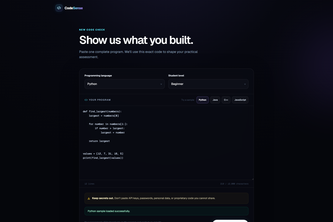
CodeSense is an educational platform that presents students with interactive assessments based on their own code submissions. The tool analyzes code without execution, generates questions about it, evaluates answers using a scoring system, and provides personalized feedback and improvement plans.
What changed
The project was submitted as part of the OpenAI 2026 hackathon. It is described as an MVP built with Next.js, React, TypeScript, Tailwind CSS, and OpenAI Codex (GPT-5.6), deployed via Vercel. The platform currently uses a deterministic local engine for assessment and stores progress in browser sessionStorage.
The single most important open question
Is there any evidence of user adoption or traction beyond the hackathon submission? The description does not indicate whether CodeSense has been used by students, educators, or institutions beyond its development phase.
What The Product Actually Is
The description states that CodeSense allows students to select a programming language and difficulty level, then paste or load a program. It analyzes the code for concepts such as functions, variables, loops, conditionals, return values, input/output, code flow, and edge cases. Based on this analysis, it generates five questions related to the actual identifiers and behavior in the submitted code.
It evaluates answers using an explainable scoring system that considers relevance, expected programming concepts, references to identifiers, clarity, and examples. Weak answers trigger follow-up questions, and all scores are preserved in a final report.
After assessment, students complete a debugging challenge and receive a personalized improvement report including:
- Overall CodeSense score
- Code-understanding score
- Logic and tracing score
- Debugging score
- Explanation-quality score
- Strengths and weak concepts
- Question-by-question review
- Personalized seven-day improvement plan
- Short concept lesson
- Recommended practice challenge
The platform is built with Next.js, React, TypeScript, Tailwind CSS, and uses OpenAI Codex (GPT-5.6) for development support but does not execute or upload user code to external APIs.
Positioning & Claim Evolution
The author claims that CodeSense addresses a gap in traditional programming education where students can memorize code but fail to understand how it works. The platform aims to shift focus from rote learning to real understanding through interactive practical assessments.
It positions itself as an adaptive AI examiner that challenges users with bugs and creates personalized improvement reports. It also describes itself as a tool for checking actual comprehension rather than just output recall.
The claim evolution appears to be:
- Initial idea: Help students understand code better.
- Development focus: Build an assessment engine that works without executing user code.
- Future vision: Expand into learning mode, voice exams, classroom dashboards, and progress tracking.
This is a self-reported progression; no evidence of prior versions or product iterations exists beyond the MVP described.
Target Customer & ICP
The description states that CodeSense targets students who struggle to explain how their code works despite being able to write or copy it. It implies a focus on learners in programming education contexts, particularly those preparing for lab exams or practical assessments.
There is no explicit mention of teachers, institutions, or other stakeholders beyond the student user. The platform seems designed primarily for individual self-assessment rather than institutional deployment at this stage.
No evidence of specific ICP segments (e.g., K-12, college-level, bootcamp students) is provided.
Business Model & Pricing Evidence
Not evidenced.
The description does not contain any information about pricing models, monetization strategies, or business plans beyond the MVP being free and self-hosted. There is no indication of paid features, subscriptions, or revenue streams.
Technical & Delivery Signals
The platform was built with:
- Frameworks: Next.js, React
- Languages: TypeScript, JavaScript
- UI Library: Tailwind CSS
- AI Tools: OpenAI Codex (GPT-5.6)
- Deployment: Vercel
- Storage: Browser-based sessionStorage
It uses a deterministic local engine for assessments to avoid API key exposure and ensure reliability. Submitted code is not executed or uploaded externally.
The system includes:
- Code analysis logic
- Question generation rules
- Adaptive scoring
- Follow-up evaluation
- Persistent state management
Challenges mentioned include generating questions from diverse code styles, avoiding false detections, designing fair scoring, and ensuring follow-ups are not skipped.
Traction & Maturity Signals
Not evidenced.
There is no evidence of users, customers, or adoption beyond the hackathon submission. No data on usage frequency, retention, or engagement is provided. The platform is described as an MVP deployed via Vercel, with no indication of scaling or growth metrics.
Competitive Context
Not evidenced.
The description does not mention competitors, market positioning relative to existing tools, or how CodeSense compares technically or functionally to other educational platforms or code assessment tools.
Open Questions & Risks
- No traction or user data: The platform is described only as an MVP from a hackathon; no evidence of real-world usage.
- Limited scope: The current version does not support external AI APIs, which may limit future capabilities.
- Self-reported maturity: All claims about functionality and performance are based on the author's account, with no independent verification.
- Browser-based storage: Reliance on sessionStorage means progress is lost if users close the browser or refresh the page — a limitation for long-term use.
- No business model: No indication of monetization strategy or path to revenue.
Questions the description leaves open
- Has CodeSense been tested with real students or educators? If so, what were the results?
- What is the plan for scaling beyond the MVP and browser-based storage?
- Are there any plans to integrate external AI APIs for enhanced functionality?
- How does the scoring system handle ambiguous or edge-case answers?
- Is there a roadmap for teacher dashboards or classroom integration?
- What are the long-term goals for monetization or product expansion?
Overall Assessment
Not evidenced.
There is insufficient evidence to assess whether CodeSense has investment potential, strategic value, or readiness for partnership. The project is described as an MVP from a hackathon with no indication of traction, revenue, or scalability beyond its initial implementation. Any commercial viability remains unproven.
User Stories BotA demo video on every pull request
Get a demo video on every new feature
GitHub App that watches your pull requests and records a narrated, captioned demo.
Save time on demo prep and make informed decisions faster with a video walkthrough of every new feature.
Source
Submitted to the OpenAI 2026 hackathon on Devpost. Project home on Devpost. Back to the full gallery on Devpost.
This competitive analysis was produced by top-founders.com (opens in a new tab)
Generated by a language model from this project's public Devpost page — its tagline, the author's own write-up and any built-with tags listed there — as captured in August 2026. Short quotations are the author's words. It is an opinion on the idea as a business, not on the people behind it, and it reflects the description as published then. If the project has moved on, request a correction below. The analysis is not independent research and contains no verified traction, revenue or customer data.
An independent guide by KFG International LLC — not affiliated with, endorsed by, or connected to Devpost or OpenAI.