

Archive position — measured, not model output
0 likes on Devpost
2,263 of the 7,850 archived projects have more likes, and 5,587 share exactly 0 — so this project's #3,351 place in the like-ranked listing is a tie-break inside that group, not a ranking.
Projects (log scale)
Likes on Devpost. ▲ marks this project's group.
Show the figures
| Likes | Projects | Share of archive |
|---|---|---|
| 0 | 5,587 | 71.2% |
| 1 | 1,758 | 22.4% |
| 2 | 284 | 3.6% |
| 3–4 | 132 | 1.7% |
| 5–9 | 75 | 1.0% |
| 10+ | 14 | 0.2% |
 User Stories BotA demo video on every pull request
Get a demo video on every new feature
GitHub App that watches your pull requests and records a narrated, captioned demo.
Save time on demo prep and make informed decisions faster with a video walkthrough of every new feature.
Executive Summary
What the company appears to be
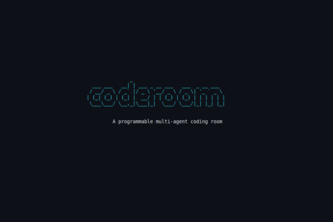
coderoom is a self-reported terminal-based tool built in Go that enables developers to collaborate with named AI agents (e.g., Ada, Tim) in a shared coding environment. It supports both interactive collaboration and automation of workflows using a prompt-based programming language.
What changed
The author describes an evolution from direct agent interaction to structured coordination and then to automation via a custom prompt-based language. The tool was built during the OpenAI 2026 hackathon, with early features focused on CLI commands, shell execution, and bounded loops.
Single most important open question
Is there evidence of real-world usage or adoption beyond the author’s own development workflow? The description does not indicate any customers, revenue, or external validation.
What The Product Actually Is
The description states that coderoom is a Go terminal application. It allows developers to:
- Collaborate with named AI agents (e.g., Ada, Tim) in a shared environment.
- Use conversational CLI commands like
@ada investigate the failing testsand/handoff ada tim. - Automate workflows using a prompt-based language with constructs such as:
/def tests /shell go test ./.../loop @ada make the tests pass without weakening them /until /tests /max 3
Agents operate through Codex app-server and share the same git workspace with the developer.
Inference The tool is designed for developers working in terminal environments, integrating AI agents into their development process. It supports both real-time collaboration and automation of repetitive tasks.
Positioning & Claim Evolution
The author claims that coderoom was built to support a collaborative workflow, where developers interact with agents step-by-step rather than delegating tasks and waiting for results.
It evolved from:
- Direct agent interaction
- Coordination between agents (e.g.,
/handoff) - Automation using a prompt-based language
The author states that the tool does not prescribe fixed workflows but instead provides building blocks for developers to define automation patterns themselves.
Inference The positioning is centered on empowering developers to gradually adopt agentic workflows, starting with collaboration and moving toward automation.
Target Customer & ICP
The description implies that coderoom targets:
- Developers who work in terminal environments
- Teams or individuals exploring agentic workflows
- Users looking for a way to collaborate with AI agents step-by-step before automating
No explicit customer segments, personas, or use cases beyond the author’s own workflow are mentioned.
Not evidenced No stated target customer profile, industry verticals, or specific buyer types.
Business Model & Pricing Evidence
There is no mention of pricing, monetization strategy, or business model in the description.
Not evidenced No indication of how coderoom would generate revenue or whether it is intended as a commercial product.
Technical & Delivery Signals
The author states:
- Built with Go, Codex, and GPT-5.6
- Runs as a terminal application
- Supports:
- Cancellable shell execution
- User-defined commands backed by shell
- Command invocation and resolution
- Bounded do...until loops
- Deterministic feedback passed back to agents
The system uses a prompt-based programming layer that turns CLI commands into composable primitives.
Inference The tool is technically grounded in terminal interaction, shell integration, and AI agent orchestration. It reflects a developer-focused approach with strong emphasis on control and traceability.
Traction & Maturity Signals
The description indicates:
- Development occurred during the OpenAI 2026 hackathon
- The author built it alone (team size: 1)
- It is currently being used by the author in their own workflow
- The author is sharing it within their network and seeking pilot customers
Not evidenced No external users, customer feedback, or adoption metrics. No evidence of product-market fit or traction beyond personal use.
Competitive Context
The description does not reference competitors or similar tools.
Not evidenced No mention of existing solutions in the agentic coding or developer tooling space.
Open Questions & Risks
- No external validation: The tool is described only by its author and has no evidence of real-world usage.
- Single-person development: With only one team member, there may be limited scalability or long-term maintenance concerns.
- Unproven market demand: No indication that developers are actively seeking this type of tool or workflow.
- Unclear commercial viability: No pricing, monetization, or go-to-market strategy is described.
Questions the description leaves open
- What specific workflows do you see as most valuable for automation in your own development process?
- Have you identified any early adopters or users outside of your personal network?
- How do you plan to scale beyond a single developer’s workflow?
- Are there any technical limitations or edge cases that have emerged during prototyping?
- What is the intended path from current prototype to commercial product?
Overall Assessment
Not evidenced No financials, funding history, or strategic fit for investment or partnership are provided.
The description presents coderoom as a personal project built during a hackathon, with no evidence of traction, revenue, or customer adoption. While the idea shows potential in aligning collaboration and automation in developer workflows, there is insufficient data to assess commercial viability or market readiness.
Confidence Level Low — based entirely on self-reported information without external corroboration.
User Stories BotA demo video on every pull request
Get a demo video on every new feature
GitHub App that watches your pull requests and records a narrated, captioned demo.
Save time on demo prep and make informed decisions faster with a video walkthrough of every new feature.
Source
Submitted to the OpenAI 2026 hackathon on Devpost. Project home on Devpost. Back to the full gallery on Devpost.
This competitive analysis was produced by top-founders.com (opens in a new tab)
Generated by a language model from this project's public Devpost page — its tagline, the author's own write-up and any built-with tags listed there — as captured in August 2026. Short quotations are the author's words. It is an opinion on the idea as a business, not on the people behind it, and it reflects the description as published then. If the project has moved on, request a correction below. The analysis is not independent research and contains no verified traction, revenue or customer data.
An independent guide by KFG International LLC — not affiliated with, endorsed by, or connected to Devpost or OpenAI.