

Archive position — measured, not model output
0 likes on Devpost
2,263 of the 7,850 archived projects have more likes, and 5,587 share exactly 0 — so this project's #3,352 place in the like-ranked listing is a tie-break inside that group, not a ranking.
Projects (log scale)
Likes on Devpost. ▲ marks this project's group.
Show the figures
| Likes | Projects | Share of archive |
|---|---|---|
| 0 | 5,587 | 71.2% |
| 1 | 1,758 | 22.4% |
| 2 | 284 | 3.6% |
| 3–4 | 132 | 1.7% |
| 5–9 | 75 | 1.0% |
| 10+ | 14 | 0.2% |
 User Stories BotA demo video on every pull request
Get a demo video on every new feature
GitHub App that watches your pull requests and records a narrated, captioned demo.
Save time on demo prep and make informed decisions faster with a video walkthrough of every new feature.
Executive Summary
What the company appears to be
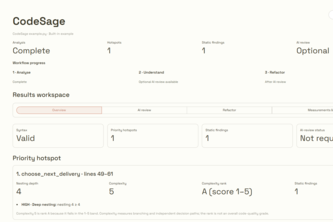
CodeSage is a solo-developed Python code analysis and refactoring tool that performs static maintainability checks on Python scripts using deterministic methods, then uses GPT-5.6-sol to explain findings and suggest focused refactorings.
What changed
The project evolved from an idea about software sustainability into a working prototype that combines static analysis with AI explanation and controlled refactoring. It was built in under four days as a hackathon submission.
Single most important open question
Is there a viable market for this type of tool, or is it a one-off research experiment?
What The Product Actually Is
The description states that CodeSage is a maintainability coach for complete Python scripts. It allows users to paste code, upload .py files, load public GitHub files, or use an example. It performs static analysis without executing code and measures complexity, nesting, size, parameters, and maintainability smells.
It then uses GPT-5.6-sol to explain the findings with references to measurements and code locations. When a refactor is justified, it returns only selected functions or methods, which CodeSage reconstructs locally while preserving unrelated code.
The tool does not claim that static checks prove runtime correctness; instead, it shows improvements, remaining issues, and trade-offs.
Evidence
- The author describes the workflow as three stages: Analyse → Understand → Refactor.
- It uses Python’s
astmodule, Radon, Pydantic, Streamlit, OpenAI API, Codex, and GPT-5.6-sol. - It supports pasted code, file uploads, GitHub files, and built-in examples.
Inference The tool is a developer-facing static analysis and AI-assisted refactoring assistant for Python.
Positioning & Claim Evolution
The author states that CodeSage grew out of an interest in software sustainability, specifically focusing on maintainability, energy use, performance, and longevity. The core idea was to measure first, explain second, and refactor carefully.
It positions itself as a tool for helping Python developers identify and understand difficult-to-maintain code and assess whether AI-generated refactors actually improve the measured issue.
The project evolved from a broad sustainability question into a focused practical problem: identifying maintainability hotspots and guiding targeted refactoring.
Evidence
- The inspiration came from wanting to assess software sustainability.
- The focus shifted to helping developers understand and refactor hard-to-maintain code.
- It avoids aggregate scores and focuses on transparent, evidence-based explanations.
Inference It is positioned as a niche tool for Python developers who care about maintainability and want AI-assisted guidance without blind trust in generated code.
Target Customer & ICP
The description states that CodeSage is aimed at Python developers, particularly those working with complete scripts. It supports pasted code, file uploads, GitHub files, and built-in examples — suggesting a developer audience who may be working on or reviewing Python code.
It does not explicitly name specific roles (e.g., senior engineers, DevOps teams) but implies a user base that values maintainability and wants to understand the implications of refactoring decisions.
Evidence
- It is described as a "maintainability coach for complete Python scripts."
- It supports developers uploading or pasting code.
- The interface is designed around summaries, diffs, collapsible evidence, and print-friendly reports — suggesting a developer user base.
Inference The ICP likely includes mid-to-senior-level Python developers who are concerned with code quality and want to make informed decisions about refactoring.
Business Model & Pricing Evidence
There is no evidence of any pricing model or business model in the description. The project was submitted as a hackathon entry, and no mention is made of monetization, subscriptions, or paid features.
Evidence
- No pricing information.
- No mention of revenue streams.
- No indication of commercial intent beyond the prototype.
Inference It appears to be a prototype with no current business model. If it were to become a product, that would be an open question.
Technical & Delivery Signals
The tool is built using:
- GPT-5.6-sol, Codex, Python, Streamlit
- OpenAI Responses API, Pydantic,
astmodule, Radon - Uses deterministic static analysis (e.g., complexity, nesting) alongside AI explanations
It separates the measurement phase from the explanation and refactoring phases to avoid unsupported AI recommendations.
The author mentions that:
- It supports more than 200 automated tests.
- It was tested on a 50,000-character Python file with 248 analysable units.
- Refactors are reconstructed locally and validated for preservation of unrelated code.
- Trade-offs between refactorings are shown rather than declaring one better.
Evidence
- Built as a solo project in under four days.
- Uses deterministic analysis + AI explanation + local reconstruction.
- Supports multiple input methods (paste, upload, GitHub, example).
- Includes automated tests and handles large files.
Inference The tool is technically sound for its stated use case, with a clear separation of concerns between static analysis and AI guidance.
Traction & Maturity Signals
There is no evidence of traction or adoption. The project was submitted as a hackathon entry, and no data on users, downloads, or usage is provided.
The author states:
- It was built in under four days.
- It includes more than 200 automated tests.
- It supports multiple input methods.
- It was tested on a large file.
Evidence
- No user base or adoption metrics.
- No mention of customers or market feedback.
- No production deployment or usage data.
Inference It is a prototype, not yet a product with traction. The maturity level is low to moderate for a hackathon project but high in terms of technical execution.
Competitive Context
The description does not provide any information about competitors or the competitive landscape. No mention is made of similar tools or platforms in the Python code analysis or AI-assisted refactoring space.
Evidence
- No competitor names, products, or market positioning.
- No discussion of existing tools for static analysis or AI code review.
Inference The competitive context is unknown. It may be a niche tool with no direct competitors, or it could overlap with general-purpose code review or static analysis platforms.
Open Questions & Risks
- No commercial traction or evidence of demand.
- Solo-built prototype — no team, no scaling plan.
- No pricing model or monetization strategy.
- Unproven market fit for a niche developer tool.
- Reliance on GPT-5.6-sol — may not be scalable or sustainable long-term.
- No data on user feedback or adoption beyond the author’s testing.
Evidence
- Submitted as a hackathon project.
- No revenue, customers, or usage metrics.
- No mention of commercialization plans.
Inference The tool is unproven in the market and lacks any evidence of viability as a product or business.
Questions the description leaves open
- What is your plan for monetizing this tool?
- Have you tested it with real users beyond your own testing?
- How do you intend to scale from a solo-built prototype to a product?
- Are there any technical dependencies or limitations that could prevent adoption?
- What are the key trade-offs between maintainability and runtime performance, and how does CodeSage address them?
- Do you have plans to expand beyond Python or support other types of code analysis?
Overall Assessment
Not evidenced.
There is no evidence of revenue, customers, traction, or a clear path to monetization. The project is described as a hackathon prototype with no commercial intent or business model.
Inference At this stage, it is not a viable investment or partnership opportunity. It may be an interesting research experiment or early-stage idea, but lacks the evidence of market demand or product-market fit required for due diligence.
User Stories BotA demo video on every pull request
Get a demo video on every new feature
GitHub App that watches your pull requests and records a narrated, captioned demo.
Save time on demo prep and make informed decisions faster with a video walkthrough of every new feature.
Source
Submitted to the OpenAI 2026 hackathon on Devpost. Project home on Devpost. Back to the full gallery on Devpost.
This competitive analysis was produced by top-founders.com (opens in a new tab)
Generated by a language model from this project's public Devpost page — its tagline, the author's own write-up and any built-with tags listed there — as captured in August 2026. Short quotations are the author's words. It is an opinion on the idea as a business, not on the people behind it, and it reflects the description as published then. If the project has moved on, request a correction below. The analysis is not independent research and contains no verified traction, revenue or customer data.
An independent guide by KFG International LLC — not affiliated with, endorsed by, or connected to Devpost or OpenAI.