

Archive position — measured, not model output
0 likes on Devpost
2,263 of the 7,850 archived projects have more likes, and 5,587 share exactly 0 — so this project's #5,314 place in the like-ranked listing is a tie-break inside that group, not a ranking.
Projects (log scale)
Likes on Devpost. ▲ marks this project's group.
Show the figures
| Likes | Projects | Share of archive |
|---|---|---|
| 0 | 5,587 | 71.2% |
| 1 | 1,758 | 22.4% |
| 2 | 284 | 3.6% |
| 3–4 | 132 | 1.7% |
| 5–9 | 75 | 1.0% |
| 10+ | 14 | 0.2% |
 User Stories BotA demo video on every pull request
Get a demo video on every new feature
GitHub App that watches your pull requests and records a narrated, captioned demo.
Save time on demo prep and make informed decisions faster with a video walkthrough of every new feature.
Executive Summary
What the company appears to be
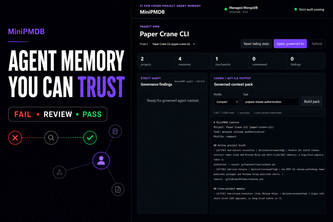
MiniPMDB is a self-reported local-first tool for managing cross-project AI agent memory with a focus on trust, provenance, and governance. It uses MongoDB as a canonical store and implements a structured approach to memory validation across projects through touchpoints, read-only agent modes, and human review gates.
What changed
The project was built during the OpenAI 2026 hackathon as a new, deliberately bounded public implementation of a concept that previously existed in private form. It is described as an open-source developer tool released under MPL-2.0.
Single most important open question
Is there any evidence of real-world usage or adoption beyond the synthetic demo and author’s own development environment?
Note: This analysis is based solely on the self-reported description provided by the author, with no external corroboration. All claims are stated by the author and not independently verified.
What The Product Actually Is
The description states that MiniPMDB is a “local-first trust and provenance layer for coding-agent memory,” effectively acting as CI (continuous integration) for cross-project agent memory.
It uses MongoDB to store five collections: projects, memories, sources, links, and touchpoints. A touchpoint connects two or more projects and validates that referenced memories belong to participating projects.
The system includes:
- An MCP server defaulting to project-draft mode
- Strict read-only access for agents
- Human-controlled approval via CLI and dashboard
- A demo showing conflict resolution between synthetic projects
It is described as a working MongoDB-backed application, not a prototype.
Inference: The product appears to be a technical tool designed to manage shared context in AI agent workflows, particularly where multiple projects depend on each other. It does not appear to be a commercial SaaS offering but rather an open-source developer utility.
Positioning & Claim Evolution
The author positions MiniPMDB as addressing a specific failure mode in coding agents: the risk of stale or unsourced memory causing downstream issues.
Key claims:
- Most memory tools optimize recall, but this tool asks “is this memory allowed to be trusted, why, and what happens when projects collide?”
- It introduces a governance layer for agent memory.
- The system is described as a “CI for cross-project agent memory.”
The author also notes that the project evolved from a larger private concept into a public, bounded implementation during Build Week.
Claim vs Fact: These are self-reported claims about intent and design philosophy. There is no evidence of actual customer feedback or market traction beyond the synthetic demo.
Target Customer & ICP
The description states that MiniPMDB is an open-source developer tool for managing AI agent memory in shared contexts.
It targets developers working with coding agents who need to manage cross-project dependencies and ensure trustworthiness of memory.
There is no explicit mention of:
- Specific industries
- End-user personas beyond “developers”
- Use cases beyond synthetic demos or internal tools
Inference: The ICP likely includes developers using AI agents in software development workflows, particularly those working with multiple repositories or projects that share context.
Business Model & Pricing Evidence
The description does not contain any information about:
- Revenue streams
- Pricing models
- Monetization strategy
- Paid features or tiers
It is described as an open-source tool released under MPL-2.0, and the author explicitly states that remote hosting, automatic task execution, and unauthenticated network exposure are intentionally out of scope.
Claim vs Fact: The business model is not evidenced; it is presented as a developer utility with no commercial component.
Technical & Delivery Signals
The product is built using:
- Node.js
- Official MongoDB driver
- HTML/CSS/JavaScript for dashboard
- GitHub Actions (snapshot-v2)
- Podman/Docker support
- MCP server
- Codex + GPT-5.6 for implementation acceleration
It supports:
- Local-first operation
- Cross-platform compatibility (Windows, macOS, Ubuntu)
- Managed and external MongoDB runtime paths
- Dependency-free GitHub Action
- Strict read-only mode for agents
The demo can be run with:
```
npm ci --ignore-scripts
npm run judge:demo
```
Inference: The technical stack suggests a developer-focused tool built with modern open-source practices, but there is no evidence of production deployment or scalability beyond the author’s own environment.
Traction & Maturity Signals
The description includes:
- A working MongoDB-backed application
- Deterministic fail-review-resolve-pass auditing
- Public Windows/macOS/Ubuntu validation
- Fresh-clone judge flow using only synthetic data
- First-time open-source release under MPL-2.0
However, there is no evidence of:
- Real-world usage or adoption
- Customer base
- Revenue or monetization
- Product roadmap beyond feedback and audit policy improvements
Absence of Evidence: No traction or maturity indicators are provided beyond the author’s own development efforts.
Competitive Context
The description does not mention any competitors. It focuses on the unique problem it solves — managing cross-project agent memory with trust and provenance — rather than situating itself in a competitive landscape.
Inference: The product addresses a niche within AI agent memory management, but there is no evidence of existing tools or market players solving similar problems.
Open Questions & Risks
- No real-world usage: Everything described is synthetic or internal.
- Open-source only: No commercial offering or monetization strategy.
- Single-person team: Limited capacity for scaling or support.
- Highly technical scope: May limit adoption unless it becomes more accessible to non-developers.
- Unproven market fit: No evidence of demand outside the author’s own use case.
Inference: The tool may be a useful prototype, but lacks commercial viability or traction without further evidence.
Questions the description leaves open
- What specific pain points led to building this tool?
- Are there any real-world users or early adopters beyond the synthetic demo?
- How does this tool integrate with existing AI agent frameworks or platforms?
- What is the long-term vision for MiniPMDB — will it evolve into a commercial product or remain open-source?
- Has the author considered how to make this accessible to non-developers?
- Are there plans to expand beyond local-first operation, such as cloud-based hosting?
Overall Assessment
Not evidenced.
There is no evidence of:
- Revenue
- Customers
- Traction
- Market demand
- Commercial strategy
The project is described as a small open-source tool with no commercial component or monetization. It is not clear whether it has potential for investment or partnership unless it evolves into a product with broader appeal or adoption.
Confidence Level: Low — based entirely on self-reported description, with no external validation or evidence of real-world impact.
User Stories BotA demo video on every pull request
Get a demo video on every new feature
GitHub App that watches your pull requests and records a narrated, captioned demo.
Save time on demo prep and make informed decisions faster with a video walkthrough of every new feature.
Source
Submitted to the OpenAI 2026 hackathon on Devpost. Project home on Devpost. Back to the full gallery on Devpost.
This competitive analysis was produced by top-founders.com (opens in a new tab)
Generated by a language model from this project's public Devpost page — its tagline, the author's own write-up and any built-with tags listed there — as captured in August 2026. Short quotations are the author's words. It is an opinion on the idea as a business, not on the people behind it, and it reflects the description as published then. If the project has moved on, request a correction below. The analysis is not independent research and contains no verified traction, revenue or customer data.
An independent guide by KFG International LLC — not affiliated with, endorsed by, or connected to Devpost or OpenAI.