

Archive position — measured, not model output
0 likes on Devpost
2,263 of the 7,850 archived projects have more likes, and 5,587 share exactly 0 — so this project's #3,349 place in the like-ranked listing is a tie-break inside that group, not a ranking.
Projects (log scale)
Likes on Devpost. ▲ marks this project's group.
Show the figures
| Likes | Projects | Share of archive |
|---|---|---|
| 0 | 5,587 | 71.2% |
| 1 | 1,758 | 22.4% |
| 2 | 284 | 3.6% |
| 3–4 | 132 | 1.7% |
| 5–9 | 75 | 1.0% |
| 10+ | 14 | 0.2% |
 User Stories BotA demo video on every pull request
Get a demo video on every new feature
GitHub App that watches your pull requests and records a narrated, captioned demo.
Save time on demo prep and make informed decisions faster with a video walkthrough of every new feature.
Executive Summary
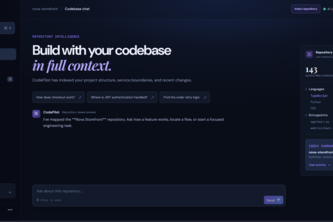
The company appears to be a solo developer project submitted to the OpenAI 2026 hackathon. The author describes it as an AI-powered software engineering assistant that helps developers with code explanation, bug detection, testing, documentation, and code review. It is built using Java, Spring Boot, and OpenAI Codex.
The project has no evidenced traction, revenue, customers or adoption data. The description states the team size is one person (SANJAY V). There is no evidence of funding, partnerships, or commercial deployment.
The single most important open question is: What is the actual commercial viability of this concept?
The author claims to have built a scalable backend architecture and integrated AI into development workflows. However, there is no evidence that this has been validated with real users or that it addresses a market need beyond the developer's own experience.
Confidence level Low — based entirely on self-reported project description with no external verification.
What The Product Actually Is
The description states that CodePilot AI is an AI-powered software engineering assistant. It is described as a tool that helps developers throughout the development lifecycle by:
- Explaining source code in simple language
- Detecting potential bugs and code quality issues
- Generating unit test suggestions
- Creating project documentation and README files
- Reviewing code and providing improvement suggestions
- Answering questions about a project through an AI-powered chat interface
- Providing project insights to help developers maintain better code quality
It is built using:
- Java
- Spring Boot
- Maven
- REST APIs
- OpenAI Codex for AI-assisted development and code generation
- Git & GitHub for version control
The backend architecture is described as modular with controllers, services, DTOs, and repositories.
Inference The product appears to be a developer tool that integrates AI capabilities into common software engineering tasks. It is not a finished commercial product but rather a prototype or proof-of-concept built during a hackathon.
Positioning & Claim Evolution
The author states the inspiration was to simplify repetitive tasks in software development, such as understanding existing code, fixing bugs, writing documentation, and creating tests. The goal was to create "a single AI-powered assistant that could simplify these repetitive tasks and help developers focus on solving real problems."
The positioning is described as:
- A unified AI developer assistant (instead of separate tools)
- An assistant that automates multiple software engineering tasks in one platform
- A tool that can save developers significant time on repetitive tasks
Inference The author positions this as a solution to inefficiencies in current development workflows, aiming to increase developer productivity by reducing time spent on routine tasks.
Target Customer & ICP
The description states the target audience is developers, particularly students who spend more time understanding existing code and fixing bugs than building new features. The author notes that developers often want to focus on solving real problems rather than repetitive tasks.
There is no explicit segmentation beyond "developers" or "students". No specific job function, company size, or technical skill level is mentioned.
Inference The primary customer segment appears to be individual developers or small teams working in software engineering roles. However, the lack of detailed targeting suggests this may be a broad early-stage concept without refined ICP.
Business Model & Pricing Evidence
No evidence of business model or pricing structure is provided in the description.
The author mentions plans to expand the product by:
- Adding support for multiple programming languages
- GitHub repository integration
- Pull request reviews powered by AI
- Security vulnerability detection
- Automatic code refactoring suggestions
- Team collaboration features
- IDE extensions for Visual Studio Code and IntelliJ IDEA
- Deployment as a cloud-based SaaS platform
Inference Based on the expansion plans, it appears the author envisions a SaaS model with potential subscription-based pricing. However, no concrete business model or pricing information is stated.
Technical & Delivery Signals
The project was built using:
- Java
- Spring Boot
- Maven
- REST APIs
- OpenAI Codex for AI-assisted development and code generation
- Git & GitHub for version control
The backend architecture is described as modular with controllers, services, DTOs, and repositories.
Challenges mentioned include:
- Designing a clean and modular backend architecture
- Integrating AI capabilities into multiple development workflows
- Debugging Spring Boot configuration and dependency issues
- Handling API responses consistently across different features
- Ensuring the application remained maintainable as new features were added
Accomplishments noted:
- Built a unified AI developer assistant instead of separate tools
- Automated multiple software engineering tasks in one platform
- Created a scalable backend architecture
- Successfully integrated AI into the development workflow
Inference The technical stack and approach suggest a backend-first system designed for scalability. However, no evidence exists regarding performance, reliability, or production readiness.
Traction & Maturity Signals
The description states that this is a hackathon project submitted to the OpenAI 2026 hackathon, built by one person (SANJAY V). There is no evidence of:
- Revenue
- Customers
- User adoption
- Product-market fit
- Market traction
- Commercial deployment
The author mentions accomplishments such as building a scalable backend architecture and integrating AI into workflows, but these are self-reported achievements without external validation.
Inference The project shows early-stage development maturity. It is not yet proven in the market or validated with real users.
Competitive Context
No evidence of competitive landscape is provided in the description.
The author states that they wanted to build a single AI-powered assistant instead of separate tools, implying there are existing tools in this space but none that fully integrate all desired functions.
Inference The competitive context is not described. It's unclear whether similar products already exist or what the competitive advantage might be.
Open Questions & Risks
- Solo developer project: Only one team member (SANJAY V) is mentioned, which raises concerns about execution capacity and scalability.
- No traction or revenue: No evidence of users, customers, or monetization.
- Unproven commercial viability: The author's claims are self-reported without external validation.
- Limited scope in description: The project is described as a hackathon prototype with no indication of how it will evolve into a viable product.
- No clear differentiation: No evidence of competitive advantages over existing tools or platforms.
Inference The risk of failure is high due to lack of validation, limited team resources, and absence of any commercial proof-of-concept.
Questions the description leaves open
- What specific problem are you solving for developers that current tools don’t address?
- How do you plan to validate your concept with real users before scaling?
- What is the path from this hackathon prototype to a commercial product?
- Are there any existing competitors in this space, and how do you differentiate?
- What is your go-to-market strategy for reaching developers?
- Have you considered the technical challenges of supporting multiple programming languages?
- How will you ensure data privacy and security for code repositories?
- What are the key metrics you would use to measure success once launched?
Overall Assessment
Not evidenced
There is no evidence of:
- Revenue
- Customers
- Traction
- Funding rounds
- Valuation
- Market validation
- Commercial deployment
The project is described as a hackathon submission by one developer with no external verification. The author makes claims about functionality and scalability, but these are unproven.
Inference At this stage, the project does not meet criteria for investment or partnership consideration. It lacks commercial viability indicators and market validation. Any potential value lies in its conceptual framework, which has not been demonstrated in practice.
User Stories BotA demo video on every pull request
Get a demo video on every new feature
GitHub App that watches your pull requests and records a narrated, captioned demo.
Save time on demo prep and make informed decisions faster with a video walkthrough of every new feature.
Source
Submitted to the OpenAI 2026 hackathon on Devpost. Project home on Devpost. Back to the full gallery on Devpost.
This competitive analysis was produced by top-founders.com (opens in a new tab)
Generated by a language model from this project's public Devpost page — its tagline, the author's own write-up and any built-with tags listed there — as captured in August 2026. Short quotations are the author's words. It is an opinion on the idea as a business, not on the people behind it, and it reflects the description as published then. If the project has moved on, request a correction below. The analysis is not independent research and contains no verified traction, revenue or customer data.
An independent guide by KFG International LLC — not affiliated with, endorsed by, or connected to Devpost or OpenAI.