

Archive position — measured, not model output
0 likes on Devpost
2,263 of the 7,850 archived projects have more likes, and 5,587 share exactly 0 — so this project's #5,312 place in the like-ranked listing is a tie-break inside that group, not a ranking.
Projects (log scale)
Likes on Devpost. ▲ marks this project's group.
Show the figures
| Likes | Projects | Share of archive |
|---|---|---|
| 0 | 5,587 | 71.2% |
| 1 | 1,758 | 22.4% |
| 2 | 284 | 3.6% |
| 3–4 | 132 | 1.7% |
| 5–9 | 75 | 1.0% |
| 10+ | 14 | 0.2% |
 User Stories BotA demo video on every pull request
Get a demo video on every new feature
GitHub App that watches your pull requests and records a narrated, captioned demo.
Save time on demo prep and make informed decisions faster with a video walkthrough of every new feature.
Executive Summary
What the company appears to be
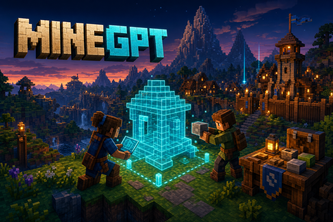
MineGPT is a browser-native multiplayer voxel world designed for small groups of friends. It allows users to collaborate on building structures using AI-assisted planning tools, with a core feature called "Worldsmith" that uses GPT-5.6 to propose bounded blueprints. The system is built around deterministic validation and human approval before any construction begins.
What changed
The project was developed as part of the OpenAI 2026 Hackathon. It represents an experimental approach to integrating generative AI into collaborative creative environments, emphasizing user agency over automated execution.
Single most important open question
Is there evidence that this concept has traction or demand from users beyond the hackathon context?
What The Product Actually Is
The description states that MineGPT is a browser-native multiplayer voxel world for small groups of friends. It includes features such as:
- Real-time collaborative building
- A core feature called "Worldsmith"
- Uses GPT-5.6 to propose bounded blueprints based on user input
- Proposals are validated by a deterministic compiler before being accepted
- Users must manually place blocks and approve designs
- Deterministic terrain generation, chunking, lighting, weather, creatures, inventory systems, and signal circuits
- Multiplayer infrastructure hosted on Cloudflare using Workers and Durable Objects
Inference The product is described as a sandbox-style game with AI-assisted design tools, but it does not appear to be a commercial product or service yet.
Positioning & Claim Evolution
The description states that MineGPT was created for the OpenAI Hackathon and is an independent project without endorsement from OpenAI. It positions itself as:
- A tool for creative collaboration where AI helps interpret ideas into actionable plans
- Not a one-click generator or fully automated world creator
- An architecture sketchbook approach: AI proposes, humans build
Inference The positioning reflects a focus on preserving human creativity and control while leveraging AI for idea generation. It emphasizes the distinction between AI assistance and autonomous execution.
Target Customer & ICP
The description states that MineGPT is designed for "small groups of friends" who want to collaborate in a shared voxel world. The primary use case involves:
- Collaborative building
- Shared planning through Worldsmith
- Multiplayer experience within a browser
Inference There is no explicit mention of specific demographics, industries, or verticals beyond general gamers or creative users. The ICP appears to be casual or hobbyist players interested in collaborative sandbox experiences.
Business Model & Pricing Evidence
The description does not provide any information about pricing, monetization strategies, or business models. It only describes the technical and gameplay aspects of the product.
Not evidenced
Technical & Delivery Signals
The project is built with:
- Frontend: React, TypeScript, Vinext, Three.js, WebGL
- Backend: Cloudflare Workers, Durable Objects, SQLite
- AI Integration: OpenAI Responses API with GPT-5.6
- Other Tools: Codex, WebSockets, and custom voxel runtime
Key technical elements include:
- Deterministic validation of AI proposals
- Bounded repair paths for failed model outputs
- Single-use play tickets and session management
- Persistent state across reconnects
- Explicit separation between client-side and authoritative room state
Inference The architecture shows a strong emphasis on safety, determinism, and secure multiplayer behavior. The use of Cloudflare Workers suggests a serverless approach to hosting.
Traction & Maturity Signals
The description indicates that this is an experimental project submitted for the OpenAI 2026 Hackathon. It includes:
- A recorded production evaluation showing 12 out of 12 mechanical validation passes
- A two-client smoke test demonstrating protocol functionality
- Plans for usability testing with first-time participants
- Future steps including bundle optimization, touch-device support, and multiplayer capacity testing
Not evidenced
Competitive Context
The description does not mention any competitors or direct market comparisons. It focuses on the unique aspects of integrating AI into voxel-based collaborative environments.
Not evidenced
Open Questions & Risks
- Unproven Market Demand: The project is described as a hackathon submission with no evidence of user traction or commercial viability.
- AI Dependency Risk: Heavy reliance on GPT-5.6 and OpenAI APIs introduces potential dependency risks if those services change or become unavailable.
- Scalability Concerns: While the system includes mechanisms for handling multiplayer, there is no indication of how it scales beyond small groups or under load.
- Limited Traction Data: No data on user engagement, retention, or monetization exists.
Inference The lack of real-world usage or revenue data raises questions about whether this concept has broader appeal or commercial potential.
Questions the description leaves open
- What is the expected timeline for transitioning from a hackathon prototype to a scalable product?
- Are there any plans for monetization or business model development beyond initial testing?
- How do you plan to handle scalability and performance issues in larger multiplayer environments?
- What are your thoughts on integrating other AI models or APIs beyond GPT-5.6?
- Have you considered how user feedback will be collected and incorporated into future versions?
- Is there a roadmap for expanding beyond the current scope of features?
Overall Assessment
Not evidenced
The project is described as an experimental hackathon submission with no evidence of traction, revenue, or customer adoption. While it demonstrates technical sophistication and a clear design philosophy, there is insufficient data to assess its commercial viability or investment potential at this stage.
User Stories BotA demo video on every pull request
Get a demo video on every new feature
GitHub App that watches your pull requests and records a narrated, captioned demo.
Save time on demo prep and make informed decisions faster with a video walkthrough of every new feature.
Source
Submitted to the OpenAI 2026 hackathon on Devpost. Project home on Devpost. Back to the full gallery on Devpost.
This competitive analysis was produced by top-founders.com (opens in a new tab)
Generated by a language model from this project's public Devpost page — its tagline, the author's own write-up and any built-with tags listed there — as captured in August 2026. Short quotations are the author's words. It is an opinion on the idea as a business, not on the people behind it, and it reflects the description as published then. If the project has moved on, request a correction below. The analysis is not independent research and contains no verified traction, revenue or customer data.
An independent guide by KFG International LLC — not affiliated with, endorsed by, or connected to Devpost or OpenAI.