

Archive position — measured, not model output
0 likes on Devpost
2,263 of the 7,850 archived projects have more likes, and 5,587 share exactly 0 — so this project's #7,275 place in the like-ranked listing is a tie-break inside that group, not a ranking.
Projects (log scale)
Likes on Devpost. ▲ marks this project's group.
Show the figures
| Likes | Projects | Share of archive |
|---|---|---|
| 0 | 5,587 | 71.2% |
| 1 | 1,758 | 22.4% |
| 2 | 284 | 3.6% |
| 3–4 | 132 | 1.7% |
| 5–9 | 75 | 1.0% |
| 10+ | 14 | 0.2% |
 User Stories BotA demo video on every pull request
Get a demo video on every new feature
GitHub App that watches your pull requests and records a narrated, captioned demo.
Save time on demo prep and make informed decisions faster with a video walkthrough of every new feature.
Executive Summary
What the company appears to be
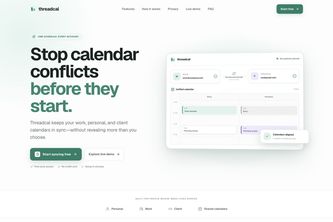
Threadcal is a self-reported calendar synchronization tool that connects multiple Google Calendar accounts and applies directional privacy rules to control how much information is shared across them. It allows users to define what details are visible in mirrored events, supports automated sync with conflict detection, and provides booking pages that expose open times without revealing underlying event data.
What changed
The project was submitted as part of the OpenAI 2026 hackathon, indicating it is a prototype or early-stage product. It includes features like GPT-5.6-powered rule creation, encrypted credential handling, and a simulated sync policy engine. The author states that the tool was built using Next.js, Vercel, Clerk, and GPT-5.6.
Single most important open question
Is there any evidence of user adoption, revenue, or traction beyond the self-reported project description?
What The Product Actually Is
The description states that Threadcal is a calendar synchronization tool that connects multiple Google Calendar accounts and applies directional privacy rules to control event visibility. It includes:
- A consolidated calendar view (day/week/month) with search, filters, and source indicators.
- Sync policies that can show full details, just the title, or a generic "Blocked" label.
- GPT-5.6 integration for natural-language rule drafting.
- Read-only simulation of sync rules before applying them.
- Shareable booking pages that expose open times without revealing calendar events.
- Clerk-based authentication and Google OAuth for access control.
The product is built using Next.js, Vercel, Clerk, Google Calendar API, GPT-5.6, Neon Postgres, and React.
Note
The author describes the tool as a prototype or hackathon submission, not a production-ready SaaS offering.
Positioning & Claim Evolution
The description states that Threadcal was built to solve the problem of people living across multiple calendars (e.g., work, personal, family) and experiencing double bookings due to limited visibility. It positions itself as a way to weave all calendars together while letting users decide how much information they share.
It claims to offer:
- Directional privacy rules.
- Consolidated calendar views with conflict detection.
- GPT-powered rule creation.
- Encrypted credentials and OAuth-based access control.
- Booking pages that protect underlying calendar details.
There is no evidence of prior positioning or evolution beyond this single self-reported submission. The author does not describe any prior versions, product iterations, or market feedback.
Inference This appears to be a new product idea, possibly in early development or prototype stage, with no known prior commercial existence.
Target Customer & ICP
The description states that Threadcal is intended for users who manage multiple calendars (e.g., company Google Workspace, personal Gmail, client environments, shared family calendars). It targets individuals who want to avoid double bookings and control what information they expose.
It does not specify:
- Whether the tool is aimed at individuals or teams.
- If it supports enterprise use cases.
- Any segmentation beyond “users with multiple calendars.”
Not evidenced No explicit ICP (Ideal Customer Profile) or customer persona details are provided.
Business Model & Pricing Evidence
The description does not state anything about:
- Revenue model.
- Pricing structure.
- Monetization strategy.
- Subscription tiers or freemium offerings.
It mentions that the tool includes shareable booking pages, but no information is given on whether these are monetized or part of a paid feature set.
Not evidenced No evidence of pricing or business model.
Technical & Delivery Signals
The description provides several technical details:
- Built with Next.js App Router, deployed on Vercel.
- Uses Neon Postgres for data storage.
- Integrates with Google Calendar API and OAuth.
- Implements AES-GCM encryption for Google refresh tokens.
- Employs GPT-5.6 for rule drafting and simulation.
- Includes idempotent synchronization, cancellation cleanup, loop prevention, and account recovery states.
- Uses Clerk for authentication and workspace-scoped data isolation.
It also mentions:
- A read-only simulator to preview sync rules.
- A public demo that requires no credentials.
- Use of Codex during development, including UI design, copywriting, testing, and deployment.
Inference The tool appears to be a technical prototype with strong engineering foundations, but it is not confirmed to be in production or scalable beyond the hackathon context.
Traction & Maturity Signals
The description states that this was submitted as part of a hackathon (OpenAI 2026). It does not mention:
- Any users, customers, or adoption.
- Revenue or monetization.
- Product usage metrics.
- Any prior versions or iterations.
Not evidenced No traction or maturity signals beyond the project submission.
Competitive Context
The description does not provide any information about:
- Competitors in the calendar synchronization space.
- Market positioning relative to existing tools.
- Differentiation from other solutions like Calendly, Doodle, or Google Calendar’s own sharing features.
Not evidenced No competitive analysis or market context provided.
Open Questions & Risks
- No verified traction or revenue: The product is described only as a hackathon submission with no evidence of adoption.
- Unproven scalability: While technical architecture is detailed, there is no indication that it has been tested at scale.
- GPT dependency: Heavy reliance on GPT-5.6 for rule creation may not be sustainable or scalable without further validation.
- Limited scope: The tool only supports Google Calendar and lacks support for Microsoft 365 or other platforms (though this is noted as a future goal).
- Unverified claims: All features are self-reported, with no independent verification.
Inference The product may be technically sound but lacks commercial viability or market validation.
Questions the description leaves open
- What is the current status of Threadcal? Is it a prototype, MVP, or in production?
- Has there been any user feedback or testing beyond the hackathon?
- Are there plans to support Microsoft 365 or other calendar platforms?
- How does the tool handle edge cases like recurring events or large-scale calendar syncs?
- What is the long-term monetization strategy?
- Is there a plan for data privacy compliance (e.g., GDPR, CCPA)?
- How do you intend to scale beyond a single developer?
Overall Assessment
The description states that Threadcal was built as part of a hackathon and is currently a self-reported prototype. There is no evidence of:
- Revenue.
- Customers.
- Traction.
- Product-market fit.
- Commercial viability.
Assessment Not evidenced as a viable investment or partnership opportunity at this stage. The product shows technical sophistication but lacks commercial signals. A follow-up investigation would require evidence of traction, user feedback, and a clear path to monetization.
User Stories BotA demo video on every pull request
Get a demo video on every new feature
GitHub App that watches your pull requests and records a narrated, captioned demo.
Save time on demo prep and make informed decisions faster with a video walkthrough of every new feature.
Source
Submitted to the OpenAI 2026 hackathon on Devpost. Project home on Devpost. Back to the full gallery on Devpost.
This competitive analysis was produced by top-founders.com (opens in a new tab)
Generated by a language model from this project's public Devpost page — its tagline, the author's own write-up and any built-with tags listed there — as captured in August 2026. Short quotations are the author's words. It is an opinion on the idea as a business, not on the people behind it, and it reflects the description as published then. If the project has moved on, request a correction below. The analysis is not independent research and contains no verified traction, revenue or customer data.
An independent guide by KFG International LLC — not affiliated with, endorsed by, or connected to Devpost or OpenAI.