

Archive position — measured, not model output
2 likes on Devpost
221 of the 7,850 archived projects have more likes, and 284 share exactly 2 — so this project's #280 place in the like-ranked listing is a tie-break inside that group, not a ranking.
Projects (log scale)
Likes on Devpost. ▲ marks this project's group.
Show the figures
| Likes | Projects | Share of archive |
|---|---|---|
| 0 | 5,587 | 71.2% |
| 1 | 1,758 | 22.4% |
| 2 | 284 | 3.6% |
| 3–4 | 132 | 1.7% |
| 5–9 | 75 | 1.0% |
| 10+ | 14 | 0.2% |
 User Stories BotA demo video on every pull request
Get a demo video on every new feature
GitHub App that watches your pull requests and records a narrated, captioned demo.
Save time on demo prep and make informed decisions faster with a video walkthrough of every new feature.
Executive Summary
What the company appears to be
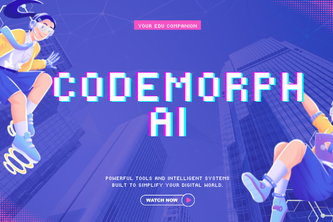
CodeMorph AI is a self-reported VS Code extension designed to help computer science students debug code by transforming runtime errors into interactive learning experiences. It combines deterministic source-code and runtime analysis with AI-generated explanations, visualizations, and guided puzzles.
What changed
The project was submitted as part of the OpenAI 2026 hackathon. The description indicates it is a proof-of-concept or early-stage prototype built by a team of four developers over a short time frame.
Single most important open question
Is there evidence that CodeMorph AI has been adopted, tested, or used beyond the hackathon context? If not, what are the implications for its commercial viability and product-market fit?
What The Product Actually Is
The description states that CodeMorph AI is a VS Code extension. It runs code, captures runtime errors, highlights failing lines, and opens an AI Tutor view in a webview.
It includes:
- A TypeScript monorepo with two main parts:
- A VS Code extension that handles execution, diagnostics, and rendering.
- A TypeScript backend for analyzing source code and runtime traces.
- Uses Tree-sitter AST parsing to inspect C, Java, and Python code.
- Renders visualizations such as:
- Memory layouts
- Execution timelines
- Interactive debugging puzzles
- Integrates with OpenAI’s API to generate explanations, analogies, quizzes, and visualization plans.
Inference The product is a learning tool for students, not a general-purpose debugging assistant for developers. It is built as an extension for a specific IDE (VS Code) and targets a niche educational use case.
Positioning & Claim Evolution
The description states that CodeMorph AI was inspired by the idea that debugging should feel like learning, not copying. The goal is to turn runtime errors into interactive experiences where students can understand why programs failed, rather than just providing corrected code.
It positions itself as:
- A learning companion for students.
- An alternative to traditional debugging tools or coding assistants.
- A tool that emphasizes guided discovery over immediate fixes.
Inference The positioning is educational and pedagogical. It does not claim to be a general-purpose developer tool, but rather a specialized learning aid.
Target Customer & ICP
The description states that CodeMorph AI is intended for computer science students who are learning difficult programming concepts such as pointers, null references, memory allocation, and runtime failures.
It also mentions:
- The extension works with C, Java, and Python.
- It aims to teach through hints, puzzles, and visualizations.
Inference The primary customer is likely a student or educational institution, not an enterprise developer. The ICP appears to be students in introductory or intermediate programming courses.
Business Model & Pricing Evidence
The description does not state anything about:
- Revenue streams
- Pricing models
- Monetization strategy
- Customer acquisition plans
Not evidenced.
Technical & Delivery Signals
The project is built using:
- esbuild
- extension
- gpt-5
- langgraph
- node.js
- openai
- typescript
- webviews
It uses:
- Tree-sitter AST parsing
- React webview
- OpenAI’s Responses API
- Structured JSON outputs
The team built a TypeScript monorepo, with:
- VS Code extension
- Backend analysis engine
- Frontend React-based UI
Inference The technical stack is consistent with a developer-focused educational tool. It shows early-stage development and integration of AI with code analysis.
Traction & Maturity Signals
The description states that this was built for the OpenAI 2026 hackathon, indicating it is likely an early prototype or proof-of-concept.
It includes:
- A working VS Code extension
- AST-based analysis for C, Java, and Python
- Interactive UI elements like puzzles and timelines
- Integration with AI APIs
However, there is no evidence of:
- Customer adoption
- Revenue
- Usage metrics
- Product-market fit
- Real-world testing beyond the hackathon
Not evidenced.
Competitive Context
The description does not mention any competitors or existing tools in this space.
It does not state whether similar educational debugging tools exist, nor how CodeMorph AI differentiates from them.
Not evidenced.
Open Questions & Risks
- No evidence of traction or adoption beyond the hackathon.
- No revenue model or monetization strategy described.
- Product is self-reported as a hackathon project, suggesting it may be early-stage.
- Limited technical scope: currently supports only C, Java, and Python.
- Highly niche use case: focused on student learning, not enterprise developers.
- Dependence on AI APIs (e.g., OpenAI) for explanations and visualizations — raises concerns about scalability or cost.
Questions the description leaves open
- What is the current stage of development beyond the hackathon?
- Has the product been tested with students or educators in a real-world setting?
- Are there any plans to expand beyond C, Java, and Python?
- How does CodeMorph AI plan to monetize its educational tool?
- What are the technical challenges in scaling this for broader use?
- Is there any interest from educational institutions or platforms (e.g., Coursera, edX)?
- How do you intend to differentiate from existing educational tools or IDEs with debugging features?
Overall Assessment
The description indicates that CodeMorph AI is a self-reported hackathon project with no evidence of traction, revenue, or customer adoption.
It is positioned as an educational tool for students and does not appear to have a clear commercial model or path to monetization.
Confidence: Low.
This is a pre-product-stage idea, likely in early prototype form. It has potential but lacks the evidence to support a commercial due-diligence read beyond its initial concept.
User Stories BotA demo video on every pull request
Get a demo video on every new feature
GitHub App that watches your pull requests and records a narrated, captioned demo.
Save time on demo prep and make informed decisions faster with a video walkthrough of every new feature.
Source
Submitted to the OpenAI 2026 hackathon on Devpost. Project home on Devpost. Back to the full gallery on Devpost.
This competitive analysis was produced by top-founders.com (opens in a new tab)
Generated by a language model from this project's public Devpost page — its tagline, the author's own write-up and any built-with tags listed there — as captured in August 2026. Short quotations are the author's words. It is an opinion on the idea as a business, not on the people behind it, and it reflects the description as published then. If the project has moved on, request a correction below. The analysis is not independent research and contains no verified traction, revenue or customer data.
An independent guide by KFG International LLC — not affiliated with, endorsed by, or connected to Devpost or OpenAI.