

Archive position — measured, not model output
1 like on Devpost
505 of the 7,850 archived projects have more likes, and 1,758 share exactly 1 — so this project's #2,243 place in the like-ranked listing is a tie-break inside that group, not a ranking.
Projects (log scale)
Likes on Devpost. ▲ marks this project's group.
Show the figures
| Likes | Projects | Share of archive |
|---|---|---|
| 0 | 5,587 | 71.2% |
| 1 | 1,758 | 22.4% |
| 2 | 284 | 3.6% |
| 3–4 | 132 | 1.7% |
| 5–9 | 75 | 1.0% |
| 10+ | 14 | 0.2% |
 User Stories BotA demo video on every pull request
Get a demo video on every new feature
GitHub App that watches your pull requests and records a narrated, captioned demo.
Save time on demo prep and make informed decisions faster with a video walkthrough of every new feature.
Executive Summary
What the company appears to be
WriteAIBook is a self-reported tool that uses GPT-5.6 Terra to generate connected, editable manuscripts from a single premise. It claims to support continuity-aware generation, persistent book states, and delta-only billing for additional chapters.
What changed
The project description indicates an extension built after July 13, focusing on integrating GPT-5.6 Terra, improving durability of generation, and enhancing recovery mechanisms. The author notes changes in authentication handling, billing logic, and artifact-level feedback.
Single most important open question
Is there evidence of actual usage or monetization beyond the developer's own account?
What The Product Actually Is
The description states that WriteAIBook is a Python-based application built with Quart, SQLAlchemy, SQLite, JavaScript, and server-side generation jobs. It uses GPT-5.6 Terra through OpenAI API or OpenRouter as a fallback.
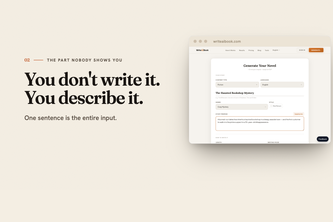
It generates stories from a premise, genre, language, and desired length, producing a story bible and chapter plan before generating prose against that shared state.
The output is delivered as an editable Word document, with the goal being “one premise in, one connected and editable manuscript out.”
Evidence
- Built with: Python 3.12, Quart, SQLAlchemy, SQLite, JavaScript, server-side jobs, Stripe billing, S3-compatible storage.
- Uses GPT-5.6 Terra via OpenAI API or OpenRouter fallback.
- Generates story bibles and chapter plans.
- Delivers output as editable Word documents.
Inference The product appears to be a single-user creative writing tool that leverages AI for narrative generation while maintaining continuity across chapters.
Positioning & Claim Evolution
The author states that WriteAIBook started addressing a problem in raw AI chats: inconsistency between early and later chapters due to forgotten names, contradictions, or drift into unrelated plots.
It evolved from an idea existing before Build Week to a production-ready extension focused on:
- Continuity-aware expansion
- Durable generation
- Safer recovery
- Artifact-level feedback
The positioning is that it turns one premise into a connected manuscript, powered by GPT-5.6 Terra.
Evidence
- Started with the problem of AI-generated stories losing coherence.
- Built post-July 13 focused on continuity and durability.
- Claims to support “durable generation,” “continuity-aware expansion,” and “safer recovery.”
Inference The product evolved from a conceptual idea into a more robust system designed for long-form creative writing with AI.
Target Customer & ICP
The description does not explicitly name target customers or personas. However, it implies the tool is aimed at authors who want to write books using AI but struggle with maintaining continuity and structure.
It supports:
- Authors entering a premise, genre, language, and desired length.
- Producing full-length manuscripts in editable formats.
- Managing multiple chapters without losing context.
Evidence
- Designed for users who enter a premise, genre, language, and desired length.
- Supports generation of full-length stories with continuity.
- Delivers output as editable Word documents.
Inference The likely ICP includes amateur or professional writers using AI to draft books, particularly those seeking structured, connected narratives.
Business Model & Pricing Evidence
There is no explicit mention of pricing tiers, subscriptions, or monetization in the description. However, it states:
- Authors receive a free Pro chapter after signing in.
- Only newly requested chapters are billed.
- Uses Stripe for billing.
- Delta-only billing for additional chapters.
Evidence
- Free Pro chapter upon sign-in.
- Billing only for new chapters.
- Uses Stripe for payments.
- Delta-only billing model.
Inference The business model appears to be a usage-based or per-chapter pricing model, likely with a freemium tier and paid upgrades for extended content generation.
Technical & Delivery Signals
The system is built using:
- Python 3.12
- Quart (web framework)
- SQLAlchemy (ORM)
- SQLite (database)
- JavaScript (frontend)
- Server-side generation jobs
- Stripe billing
- S3-compatible artifact storage
It integrates GPT-5.6 Terra via OpenAI API or OpenRouter, with failover logic to maintain quality.
Key technical features include:
- Persistence of manuscript, story bible, and chapter plans.
- Generation continues server-side if the page closes.
- Authentication return state preserved.
- Delta-only billing for additional chapters.
- Capability-aware request construction.
- Regression tests for production failures.
Evidence
- Built with Python 3.12, Quart, SQLAlchemy, SQLite, JavaScript.
- Uses GPT-5.6 Terra via OpenAI API or OpenRouter.
- Supports server-side generation and recovery.
- Implements delta-only billing.
- Includes regression testing and capability-aware request handling.
Inference The technical stack suggests a lightweight but functional system built for reliability and continuity in AI-assisted creative workflows.
Traction & Maturity Signals
There is no evidence of revenue, customer base, or adoption metrics. The author describes the product as existing before Build Week and being extended during it, but does not provide any data on usage, retention, or monetization.
Evidence
- No mention of users, customers, or revenue.
- Product was extended post-July 13.
- No traction indicators such as downloads, sign-ups, or usage stats.
Inference No traction or maturity signals are evident from the description. The product appears to be in early development or pre-launch stage.
Competitive Context
The description does not provide information about competitors or market positioning beyond self-reported claims.
Evidence
- No mention of direct or indirect competitors.
- No reference to existing tools for AI-assisted writing or narrative generation.
Inference There is no evidence of competitive landscape analysis or differentiation from other tools in the space.
Open Questions & Risks
Several risks and open questions are present based on the self-reported nature of the description:
- No verified traction or monetization: The product has not demonstrated real-world usage or revenue.
- Single-person team: Limited development capacity for scaling or addressing complex issues.
- Self-reported only: All claims are unverified and lack independent corroboration.
- Unproven market demand: No evidence of user interest or market validation beyond the author’s own experience.
- High technical complexity without external validation: The system handles continuity, recovery, and billing — all high-risk areas in AI applications.
Evidence
- No revenue, customers, or usage data.
- Team size is one person.
- All claims are self-reported.
- No mention of market demand or competitive analysis.
Inference The risk of failure is high due to lack of traction, limited team, and unverified assumptions about product-market fit.
Questions the description leaves open
- What is the actual user base or engagement level?
- How many chapters are typically generated per book?
- Are there any early adopters or beta testers?
- What are the current conversion rates from free to paid usage?
- How does the system handle edge cases like large-scale generation failures?
- What is the long-term vision for monetization beyond chapter-based billing?
- Has the product been tested with real users, and what feedback was received?
Overall Assessment
Not evidenced.
The description provides no information on financials, traction, or market validation that would support an investment or partnership decision.
Evidence
- No revenue, customer data, or traction metrics.
- No indication of product-market fit or scalability.
- No mention of funding rounds or investor interest.
Inference Without verified evidence of commercial viability, no clear assessment can be made regarding potential investment or partnership opportunities.
User Stories BotA demo video on every pull request
Get a demo video on every new feature
GitHub App that watches your pull requests and records a narrated, captioned demo.
Save time on demo prep and make informed decisions faster with a video walkthrough of every new feature.
Source
Submitted to the OpenAI 2026 hackathon on Devpost. Project home on Devpost. Back to the full gallery on Devpost.
This competitive analysis was produced by top-founders.com (opens in a new tab)
Generated by a language model from this project's public Devpost page — its tagline, the author's own write-up and any built-with tags listed there — as captured in August 2026. Short quotations are the author's words. It is an opinion on the idea as a business, not on the people behind it, and it reflects the description as published then. If the project has moved on, request a correction below. The analysis is not independent research and contains no verified traction, revenue or customer data.
An independent guide by KFG International LLC — not affiliated with, endorsed by, or connected to Devpost or OpenAI.