

Archive position — measured, not model output
1 like on Devpost
505 of the 7,850 archived projects have more likes, and 1,758 share exactly 1 — so this project's #787 place in the like-ranked listing is a tie-break inside that group, not a ranking.
Projects (log scale)
Likes on Devpost. ▲ marks this project's group.
Show the figures
| Likes | Projects | Share of archive |
|---|---|---|
| 0 | 5,587 | 71.2% |
| 1 | 1,758 | 22.4% |
| 2 | 284 | 3.6% |
| 3–4 | 132 | 1.7% |
| 5–9 | 75 | 1.0% |
| 10+ | 14 | 0.2% |
 User Stories BotA demo video on every pull request
Get a demo video on every new feature
GitHub App that watches your pull requests and records a narrated, captioned demo.
Save time on demo prep and make informed decisions faster with a video walkthrough of every new feature.
Executive Summary
Project: Chattanooga Animal Radar
Author's self-description: An animal-first Chattanooga routing prototype that turns fictional reports into evidence-aware next steps without overstating provider authority, capacity, or outcomes.
Team size: 1
Technology stack: CSS3, GPT-5.6, HTML5, JavaScript, OpenAI, Python, Responses
Context: Submitted to the OpenAI 2026 hackathon on Devpost
This is a self-reported prototype project built during a hackathon. The description states it is a routing tool for animal welfare reports in Chattanooga, designed to avoid overstating authority or outcomes by using fictional data and structured outputs from GPT-5.6. It does not claim revenue, customers, or traction beyond its own demonstration.
Key Insight: The project appears to be an experimental system that separates language understanding from authority assignment, using a deterministic gate to prevent overstatement in routing decisions. It is built with a focus on evidence transparency and accessibility.
Most Important Open Question: What is the actual scope of the routing logic, and how does it map to real-world animal-control jurisdictions? The project claims to use "reviewed routing research" but provides no details about that research or its applicability beyond fictional examples.
What The Product Actually Is
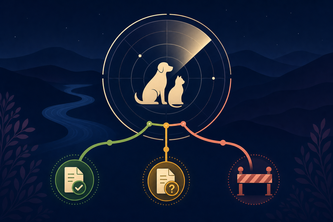
The description states that Chattanooga Animal Radar is a routing prototype for animal welfare reports in Chattanooga, Tennessee. It uses fictional narratives as input and produces one of three outcomes:
- A verified first contact for the City of Chattanooga;
- A withheld route for Ridgeside due to conflicting authoritative sources; or
- A narrow published lead for Signal Mountain that is not broadened into a full animal-control pathway.
It includes:
- An HTML, CSS, and JavaScript interface;
- A pure JavaScript routing core shared by UI and tests;
- A loopback-only Python server with an allowlisted static surface;
- Strict schema-constrained extraction via OpenAI Responses API;
- Deterministic claim-state gates and provenance-preserving evidence receipts.
The system is described as non-operational — it does not collect, store, or transmit real animal reports. It uses fictional data only and is intended to demonstrate how routing decisions can be made without overstating authority or outcomes.
Inference: The product is a proof-of-concept for a routing engine that separates natural language processing from jurisdictional assignment, using structured outputs and deterministic logic to avoid false certainty.
Positioning & Claim Evolution
The description states that the project began as an animal-first, organization-neutral way to make uncertainty visible in Chattanooga’s animal-control pathways. It aims to help residents find the next responsible step without pretending the evidence says more than it does.
It positions itself as a tool that:
- Makes uncertainty visible;
- Avoids overstating provider authority or outcomes;
- Uses fictional narratives to avoid real-world risks;
- Demonstrates how language models can be used responsibly in public services.
Inference: The project is positioned as a responsible AI prototype, emphasizing transparency and evidence-based decision-making over certainty or operational claims.
Target Customer & ICP
The description states that the tool is intended for Chattanooga residents who are uncertain about which animal-control provider to contact, due to:
- Municipal boundaries differing from provider roles;
- Mailing addresses not identifying governing jurisdiction;
- Official sources disagreeing.
It does not state a specific customer segment beyond this general audience. The system is described as organization-neutral, meaning it is not tied to any one agency or service provider.
Inference: The target customer is Chattanooga residents seeking clarity in animal-control pathways, with no explicit commercial or B2B focus.
Business Model & Pricing Evidence
The description does not mention a business model, pricing, or monetization strategy. It is described as a prototype built for a hackathon and is not intended to be operational or scalable beyond its demonstration.
Not evidenced: No information on revenue, pricing, or commercial viability.
Technical & Delivery Signals
The system uses:
- HTML5, CSS3, JavaScript for frontend;
- Python with loopback-only server;
- OpenAI GPT-5.6 via Responses API;
- Strict schema-constrained extraction;
- Deterministic routing gates;
- Evidence-preserving receipts;
- Accessibility features (keyboard, screen readers, dyslexia-friendly fonts, etc.).
It is described as:
- Dependency-free;
- Browser-based with no API key exposure;
- Using store: false for model requests;
- Executable tests included;
- Demonstrated with timed captions and transcripts.
Inference: The technical design emphasizes security, accessibility, and evidence transparency, with a clear separation between language understanding and authority assignment.
Traction & Maturity Signals
The project is described as a hackathon prototype. It does not claim any real-world deployment, user base, or traction beyond its own demonstration.
Not evidenced: No data on adoption, usage, revenue, or customer feedback.
Competitive Context
The description does not mention competitors or similar tools in the animal welfare or public service routing space. It is a self-contained prototype, not positioned as part of an existing ecosystem.
Not evidenced: No competitive landscape or market positioning beyond its own claims.
Open Questions & Risks
- The system is fictional and non-operational, with no real-world data or users.
- It uses GPT-5.6, which may not be available in production environments, and the use of "store: false" suggests a limited or experimental setup.
- The project is described as a hackathon prototype — there is no indication it has evolved into a product or service.
- The system does not collect or store real data, but its design choices may not scale to a production environment without additional validation.
Inference: This is an experimental tool, not a commercial product. It lacks evidence of scalability, production readiness, or real-world impact.
Questions the description leaves open
- What specific “reviewed routing research” underpins the three routing outcomes? Is it based on public records or internal documentation?
- How does the deterministic gate ensure that only reviewed claims are used in routing decisions?
- Has this system been tested with real animal reports, or is it limited to fictional examples?
- What would be required to transition from a prototype to an operational system?
- Are there plans to expand beyond Chattanooga, and if so, how would jurisdictional mapping scale?
Overall Assessment
Not evidenced: No commercial traction, revenue, or customer data is provided.
The project is described as a hackathon prototype, not a product or service. It demonstrates a design philosophy around responsible AI use in public services but does not show evidence of market demand, scalability, or operational readiness.
Confidence Level: Low — the description is self-reported and unverified, with no external validation or data to support commercial viability.
Assessment: Not ready for investment or partnership. It may be a useful concept or prototype to explore further, but it does not meet due-diligence thresholds for commercial evaluation.
User Stories BotA demo video on every pull request
Get a demo video on every new feature
GitHub App that watches your pull requests and records a narrated, captioned demo.
Save time on demo prep and make informed decisions faster with a video walkthrough of every new feature.
Source
Submitted to the OpenAI 2026 hackathon on Devpost. Project home on Devpost. Back to the full gallery on Devpost.
This competitive analysis was produced by top-founders.com (opens in a new tab)
Generated by a language model from this project's public Devpost page — its tagline, the author's own write-up and any built-with tags listed there — as captured in August 2026. Short quotations are the author's words. It is an opinion on the idea as a business, not on the people behind it, and it reflects the description as published then. If the project has moved on, request a correction below. The analysis is not independent research and contains no verified traction, revenue or customer data.
An independent guide by KFG International LLC — not affiliated with, endorsed by, or connected to Devpost or OpenAI.